
Xiaomi's TakeVLA Teaches Self-Driving AI to Avoid Crashes Before They Happen
A new arXiv paper reframes VLA post-training for self-driving by teaching the model what to do before a human takes the wheel.
 Pro
Takeaways
- Researchers from CASIA and Xiaomi EV propose TakeVLA, a post-training recipe for driving Vision-Language-Action models.
- Key idea: supervise the VLA on frames before a human takeover, not just after, to anticipate hazards.
- Adds Scenario Dreaming, a GRPO-style RL fine-tune replayed inside reconstructed near-miss scenarios.
- Built on the SimLingo baseline with a front-camera input and language-conditioned actions.
- On Bench2Drive: +4.93 Driving Score over SimLingo and +11.76% average time-to-collision.
- No code or weights released; method is architectural guidance for VLA driving pipelines.
Researchers from the Chinese Academy of Sciences and Xiaomi EV have released a paper proposing TakeVLA, a post-training recipe for Vision-Language-Action driving policies that focuses on the moments right before a human safety driver has to intervene. Today's driving VLAs learn only from what an expert did after grabbing the wheel, which produces reactive policies with thin safety margins. TakeVLA instead supervises the model on the run-up to the incident and then fine-tunes it with reinforcement learning inside reconstructed near-crash scenarios.
The work targets a well-known weakness of end-to-end driving stacks. Current Vision-Language-Action paradigms rely on offline training from static datasets, leaving them vulnerable to distribution shift. Recent post-training methods that use expert takeover samples still restrict supervision to the period after the takeover moment and depend on passive preference optimization that lacks active exploration. In plain terms, once a policy drifts off the training distribution, imitation-only fine-tuning teaches it how to recover but not how to avoid the mistake in the first place.

What counts as takeover data
In closed-loop driving evaluation, a "takeover" is a moment where a scripted expert or safety driver overrides the learned policy because it is about to cause an infraction. The most useful signals in autonomous driving are often not ordinary logged trajectories, but cases that reveal model weaknesses: takeovers, disengagements, near-misses, rule violations, recovery behaviors, and difficult interactions. Prior work like TakeAD mines these events and applies DAgger-style imitation plus preference optimization on the recovery trajectory, but the pre-failure frames, arguably the most informative ones, are thrown away.
Two ideas, one loop
TakeVLA is built on top of SimLingo, a strong open-source VLA baseline for CARLA. The baseline uses a Chain-of-Thought approach that conditions driving actions on generated language, taking a front-view camera image (448 x 896) and a language instruction, including vehicle speed and task prompts, as inputs. On top of that, the authors add two mechanisms:
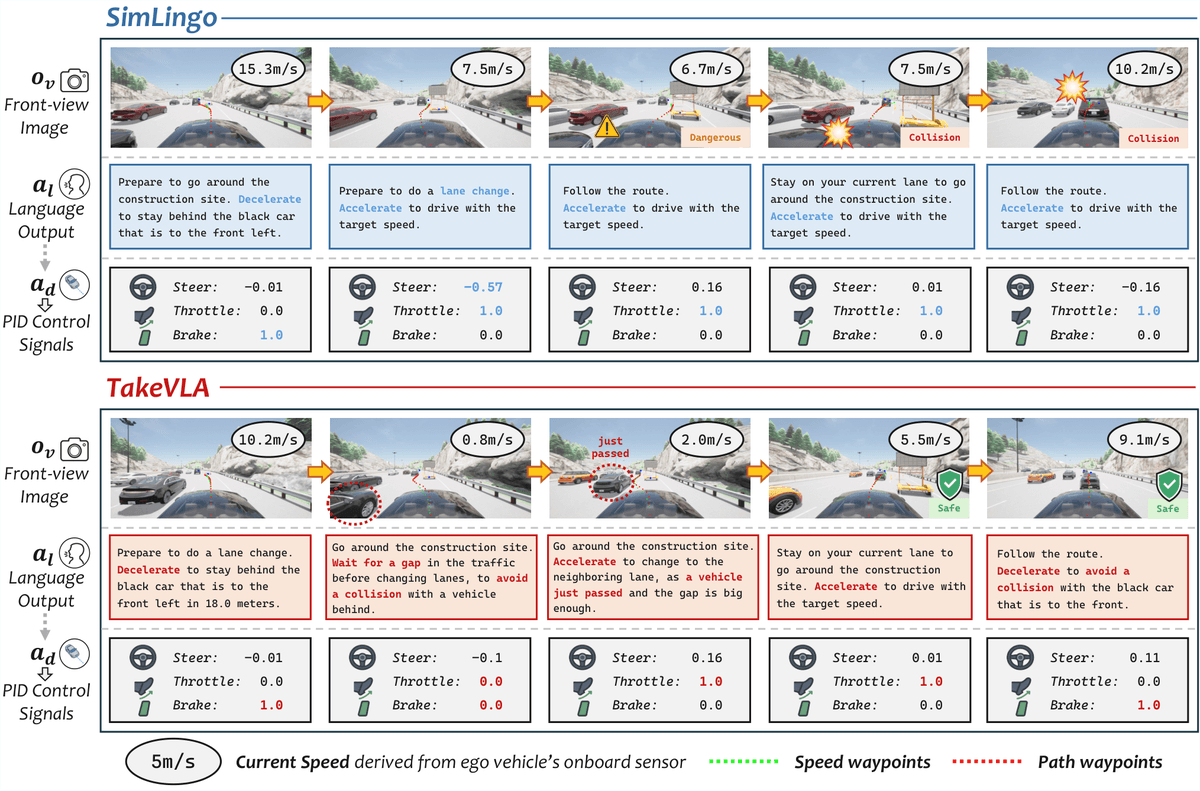
- Pre-takeover language supervision. Supervised fine-tuning on pre-takeover samples enables the model to anticipate hazards earlier through refined language outputs. By leveraging the VLA's inherent ability to align linguistic semantics with low-level actions, the resulting language-conditioned behavior substantially enlarges safety margins in error-prone situations. Concretely, original labels for the frames leading up to a Follow, Collision, or Restart takeover are rewritten to make the cause and urgency explicit, so the language head learns to say things like "slow down, vehicle ahead braking" a few seconds earlier than it would otherwise.
- Scenario Dreaming. To overcome the lack of active exploration in preference-based optimization, the authors introduce a task they call Scenario Dreaming. By reconstructing takeover scenarios in a pseudo-simulation environment, they apply reinforcement fine-tuning to encourage exploration of better language outputs. The RFT stage uses GRPO-style optimization, letting the policy sample multiple candidate behaviors in the same replayed near-miss and get graded on the outcome.

How the training loop runs
The training pipeline is iterative rather than a one-shot fine-tune. TakeVLA starts from a pre-trained VLA and iteratively performs multiple rounds of takeover dataset construction and post-training. Each round comprises online interaction with expert takeovers to construct pre-takeover and takeover datasets, supervised fine-tuning on those datasets, and reinforcement fine-tuning via Scenario Dreaming in reconstructed takeover scenarios. Pre-training itself is unchanged from SimLingo: supervised pre-training on data collected by the privileged PDM-Lite expert, with a pre-training dataset containing approximately 3.1 million driving frames at 4 fps.
The numbers
Evaluation runs on Bench2Drive, the standard CARLA-based closed-loop suite. Bench2Drive is fully closed-loop, built on CARLA with reactive multi-agent traffic, and reports Driving Score and Success Rate, making it well suited for evaluating long-horizon errors and interaction behavior. The official evaluation protocol comprises 44 interactive scenarios with 5 routes each, for a total of 220 official routes across diverse weather conditions.
On this benchmark, TakeVLA achieves state-of-the-art closed-loop performance, surpassing the strong VLA baseline SimLingo by 4.93 in driving score, with an 11.76% increase in average TTC. The TTC (time-to-collision) jump is arguably the more interesting number: the policy is not just completing routes more often, it is leaving more headroom before things go wrong. For reference, SimLingo already sits near the top of published Bench2Drive results, so a ~5-point DS gain is meaningful rather than incremental.
Caveats worth knowing
TakeVLA is best understood as an addition to a growing family of driving VLA post-training methods. Recent works such as TakeAD, TakeVLA, and SpanVLA use field signals or recovery-oriented data to improve post-training, though these signals are still mostly consumed offline as a fixed dataset for a single post-training stage. A few practical caveats:
- All results are reported in CARLA with the PDM-Lite privileged expert. Bench2Drive routes are short and each contains one scripted safety-critical event, and models are exposed to the same towns during training, so the benchmark stresses reactive skill more than open-world generalization.
- The method requires an expert takeover oracle. In simulation this is cheap; in a real fleet it means either human safety drivers or a rule-based supervisor good enough to flag imminent failures.
- Scenario Dreaming replays reconstructed scenes rather than simulating fully novel ones, so it explores variations of known failure modes, not truly unseen ones.
No code or model weights have been released with the preprint yet, and the arXiv listing points only to the PDF and HTML versions. For teams working on VLA-based planners, the useful takeaway is architectural rather than something you can pip install today: keep the frames before a disengagement, rewrite their language labels to describe the hazard explicitly, and pair the resulting SFT with an RL fine-tune that replays the same scene. That combination, more than any single trick, is what appears to buy the extra safety margin.