
Xiamen University Study Proves Bigger Quantized Models Beat Smaller Precise Ones on Laptops
A new benchmark study of 11 LLMs across 7 quantization methods on consumer hardware reveals that a heavily quantized 7B model beats a lightly compressed 1.5B every time — and exactly where the performance cliff is.
 Pro
Takeaways
- Big model, low precision wins: A 14B model at ~3.4 bits-per-weight scores 89% on GSM8K; a 1.5B model at full fp16 scores only 60.8%.
- The 3.5 BPW cliff: Performance holds above ~3.5 effective bits-per-weight, then collapses — 2-bit quantization is nearly unusable for small models.
- 4-bit is the sweet spot: The paper finds q4_k accelerates throughput 30–50% vs. 8-bit with near-zero accuracy loss.
- Bottleneck depends on model size: Large models (>1B) are memory-bandwidth-bound; tiny models (<0.5B) are compute-bound — different optimization strategies apply.
- Hardware matters for quantization format: q4_0 beats q4_k in throughput; but q5_k beats q5_0 on CPUs with VNNI instructions.
- Code is open-source: The evaluation codebase includes a custom llama.cpp harness for reproducing results on your own hardware.
Running a large language model locally on a laptop sounds like a compromise. Less capable, slower, riskier. But a new paper from researchers at Xiamen University, CUHK, and Huawei challenges that intuition with hard numbers: a systematic evaluation of on-device LLMs covering 11 models from 0.5B to 14B parameters, seven quantization methods, and three dimensions of performance. The headline finding is counterintuitive but actionable: when RAM is limited, you are almost always better off running a larger model at lower precision than a smaller model at higher precision.
Why running models locally is harder than it looks
The appeal of on-device LLMs is real. On-device execution eliminates delays from sending data to a cloud server and keeps sensitive information local, reducing the chance of data breaches. Healthcare, finance, and any application where user data cannot leave the device are obvious candidates. The problem is that LLMs are massive and computationally intensive, while edge devices are resource-constrained in terms of power, memory, and processing capabilities , making them inherently unsuitable for full-sized models.
The standard workaround is quantization: compressing a model's weights from 16-bit floating point down to 8, 4, 3, or even 2 bits per weight. The standard recipe has converged , train in 16-bit, quantize to 4-bit for deployment , and GPTQ and AWQ showed that 4-bit post-training quantization preserves most model quality with a 4x memory reduction. But knowing the recipe and knowing which model to pick, at which precision, on which hardware, are very different problems. That gap is what this paper targets.
Most existing benchmarks only measure one thing at a time: accuracy, or speed, or power draw. A common limitation is that most existing works typically concentrate on a subset of metrics, often evaluating accuracy, efficiency, or power consumption in isolation. This paper builds a tripartite framework that measures all three simultaneously, on real consumer hardware.
The setup: real laptops, real constraints
The investigation employs two configurations: a representative consumer-grade laptop with a single CPU and 16GB RAM, mirroring typical user hardware, and a profiled configuration with varied computational resources modeling heterogeneous environments. The primary test machine is a Core i7-1360P laptop with 16GB DDR5 RAM , the kind of machine a developer or researcher might actually have on their desk.
The models tested span three families:
- Qwen 2.5: 0.5B, 1.5B, 3B, 7B, 14B
- Qwen 3: 0.6B, 1.7B, 4B, 8B
- Llama 3: 1.5B, 3B, 8B
The upper limit of 14B parameters was chosen as it represents the largest model size that can be reliably deployed on a laptop with 16GB RAM after quantization. The quantization methods tested were q2_k, q3_k, q4_k, q4_0, q5_k, q5_0, and q8_0 , all implemented via llama.cpp, the open-source inference engine that also powers Ollama.
Capability was measured across five benchmarks: GSM8K (math reasoning), HellaSwag (commonsense), MMLU (general knowledge), HumanEval (code generation), and TruthfulQA (factual reliability). Efficiency was measured as tokens per second (TPS) during both the prefill stage (processing the input prompt) and the decode stage (generating output tokens). Resource utilization tracked CPU power draw, memory footprint, and energy consumption.
The 3.5-bit threshold that changes everything
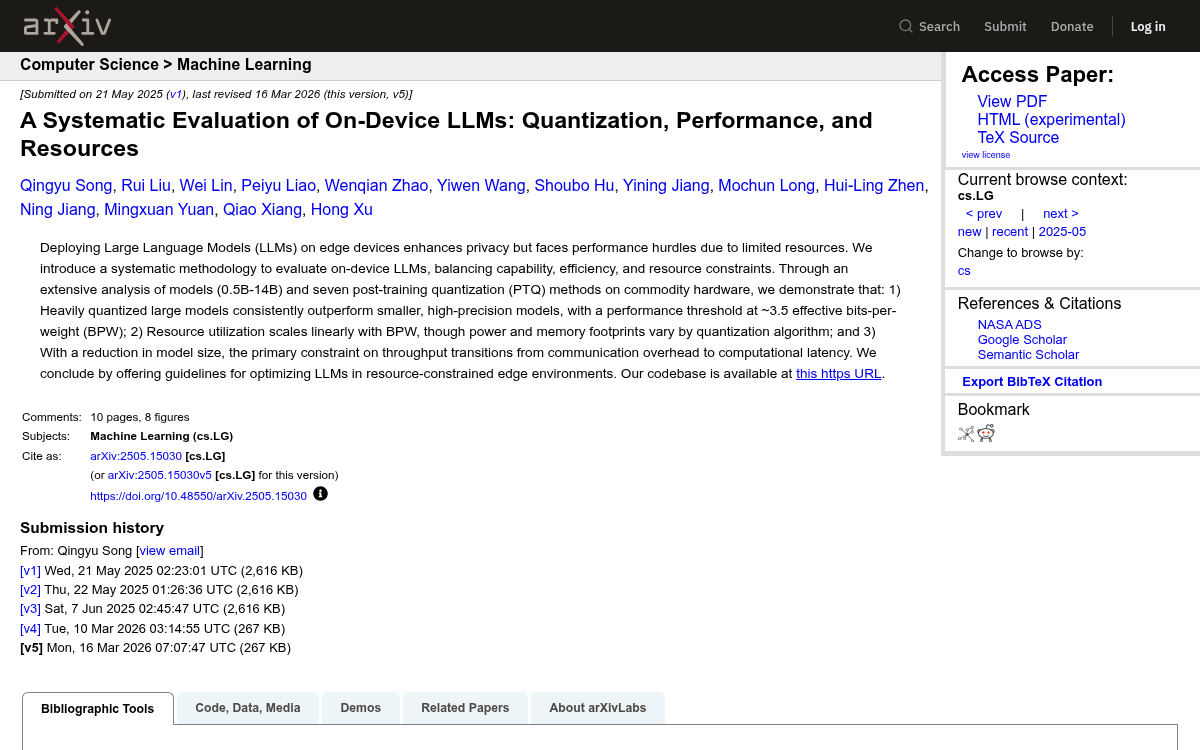
The most important finding is a clear performance cliff. Heavily quantized large models consistently outperform smaller, high-precision models, with a performance threshold at approximately 3.5 effective bits-per-weight (BPW). Above that threshold, you can trade bits for parameters and come out ahead. Below it, accuracy collapses.
The data makes this concrete. On GSM8K (grade-school math), the Qwen 2.5 14B model at q3_k (roughly 3.4 BPW) scores 89.01% , while the 1.5B model at full fp16 precision scores only 60.80%. A 14B model compressed down to ~3.4 bits per weight still beats a 1.5B model running at full precision by nearly 30 percentage points. Large models demonstrate superior resilience to performance degradation induced by aggressive low-precision quantization compared to smaller models.
The 2-bit floor is where things break down for everyone. Extreme compression (e.g., 2-bit quantization) results in critical performance loss across all model sizes. The 1.5B model at q2_k drops to just 21.46% on GSM8K , barely above random. Even the 14B model takes a meaningful hit, falling from 89% to 84% at 2-bit. The practical takeaway: never go below 3 bits if accuracy matters.
Code generation is the most fragile task. Tasks involving code generation, such as HumanEval, prove particularly sensitive to compression. The 1.5B model at q5_0 achieves 39% on HumanEval versus the 14B model's 69.5% , a gap that no amount of precision tuning on the smaller model can close.
The bottleneck shifts as models shrink
One of the more technically interesting findings is that the nature of the performance bottleneck is not fixed , it changes with model size. Resource utilization scales linearly with BPW, though power and memory footprints vary by quantization algorithm. And with a reduction in model size, the primary constraint on throughput transitions from communication overhead to computational latency.
Here is what that means in practice:
- Large models (>1B parameters) are communication-bound during decoding. The bottleneck is moving weights from RAM to the CPU, not doing the math. Adding more CPU cores barely helps; you need faster memory bandwidth.
- Tiny models (<0.5B parameters) are compute-bound. The weights fit easily in cache, so the bottleneck shifts to raw arithmetic throughput. More CPU cores actually help here.
The paper quantifies this with a clean experiment. For models above 0.5B, switching from 2-bit to 16-bit precision (an 8x increase in data transferred from RAM) causes throughput to drop by more than 30% in both prefill and decode phases. Changing the input length from 64 to 512 tokens (an 8x increase in compute) causes less than 7% degradation. The math is clear: for most models you will run on a laptop, memory bandwidth is the binding constraint, not compute.
Not all 4-bit quantization is equal
A subtler finding involves the difference between the _k and _0 quantization families in llama.cpp. Both q4_k and q4_0 store weights at roughly 4 bits, but they use different internal representations that interact differently with CPU instruction sets.
q4_0 consistently outperforms q4_k in throughput across all setups, irrespective of VNNI support, due to its streamlined unpacking process. But for the 5-bit family, the situation reverses: q5_k achieves higher throughput than q5_0 when VNNI (Vector Neural Network Instructions) is enabled, because the complex bit-shifting operations required for q5_0 unpacking offset the parallelization gains. VNNI is available on most modern Intel and AMD CPUs.
The practical implication: if you are running on a modern laptop CPU with VNNI support (check with lscpu | grep vnni on Linux), prefer q4_0 for 4-bit and q5_k for 5-bit. On older hardware without VNNI, q5_0 may actually be faster.
Power and memory: what the numbers say
CPU power consumption stayed in a narrow band of 7.9W to 9.5W regardless of model size or quantization level , which is good news for battery life. But the pattern of power draw is informative. CPU power consumption correlates with the computational intensity of the quantization methods rather than the BPW. Methods like q3_k that require more complex unpacking operations (padding and bit-shift instructions) actually consume less power than simpler methods like q8_0, because they spend more time waiting on memory rather than executing arithmetic.
Memory footprint, on the other hand, scales predictably. Memory consumption exhibits a monotonic increase with BPW. The 7B model ranges from 2.4GB at q2_k to 7.3GB at q8_0. One anomaly: q4_0 uses significantly more memory than its BPW would suggest , the 7B q4_0 model requires 6.9GB, far above the expected ~4.8GB. This is a known artifact of its internal block structure and worth keeping in mind if you are near your RAM ceiling.
The Pareto-optimal choice: 4-bit, large model
Pulling all three dimensions together, the paper's Pareto analysis , which plots accuracy against throughput while encoding memory footprint in marker size , points to a clear winner. 4-bit quantization emerges as the optimal operating point, accelerating inference throughput by 30–50% while maintaining near-lossless accuracy. Pushing compression beyond this threshold results in precipitous degradation of model performance.
The guidelines the authors derive:
- For accuracy-critical applications: use the largest model that fits in RAM at 4-bit (
q4_k). On a 16GB machine, that is a 14B model. - For latency-sensitive applications: use a smaller model at 4-bit. The throughput gains from smaller size outweigh the accuracy loss from lower precision.
- Never use 2-bit unless you have a specific reason and have validated accuracy on your task.
- Qwen 2.5 consistently outperforms Llama 3 at equivalent parameter counts and quantization levels across all five benchmarks.
What this means for your stack
If you are building a local-first application with Ollama or any llama.cpp-based tool, this paper gives you a principled basis for model selection rather than trial and error. The finding that a 7B model at q4_k beats a 3B model at q8_0 on nearly every benchmark , while using similar RAM , is directly actionable. The 3.5 BPW threshold is a useful heuristic: if your quantization scheme pushes effective bits-per-weight below that, expect meaningful accuracy degradation.
The evaluation codebase is publicly available, including the custom lm-evaluation-harness extension for llama.cpp that the authors built to make the benchmarks work. If you want to run the same evaluation on your own hardware configuration, the tooling is there.