
Xi'an Jiaotong's WAT Framework Beats GPT-4o on Real-Time Video Understanding
Researchers propose a hierarchical memory framework that separates passive video watching from query-triggered reasoning, reporting strong streaming benchmark scores.
 Pro
Takeaways
- New two-stage framework WAT decouples query-independent watching from query-triggered thinking for streaming video.
- Hierarchical memory pairs a 16-frame FIFO STM with a 768-slot LTM using redundancy-aware cosine-similarity eviction.
- Context-aware retrieval fuses query with STM before pulling top-K frames from LTM for reasoning.
- Retrieval Alignment Contrastive Learning adds InfoNCE-style objective, lifting OVO-Bench by 4.5 points alone.
- Reports 77.7% on StreamingBench and 55.2% on OVO-Bench at 1 FPS input.
- Companion WAT-85K dataset targets real-time perception, backward tracing, and proactive forecasting.
A team from Xi'an Jiaotong University, China Telecom's TeleAI, and University of Science and Technology Beijing has introduced WAT (Watching Before Thinking), a two-stage framework for online video understanding that tries to fix a persistent weakness in Video LLMs: keeping useful visual history around when frames keep arriving and memory is tight. Alongside the framework, the authors release WAT-85K, a training dataset built specifically for streaming-style tasks like real-time perception, backward tracing, and proactive forecasting.
The paper frames online video reasoning as fundamentally different from the offline case that most Video LLMs are built for. In offline settings, models get the full clip up front and can afford to sample uniformly or crunch everything at once. In a stream, frames arrive one by one, questions can be asked at any timestamp, and the model has to answer using only what it has seen so far, without blowing past its memory budget.
Why streaming breaks vanilla Video LLMs
Existing methods for online video understanding must employ feature compression to handle the continuous influx of video frames under finite computational resources. The authors group prior approaches into two failure modes:
- Sampling-time compression aggressively drops incoming frames. Cheap, but the model degrades into coarse scene summarization and misses transient actions.
- Storage-time compression keeps more frames but merges or evicts adjacent ones based on feature similarity. This risks losing foreground activity buried under dominant background content, and heavy local merging breaks temporal coherence.
A common thread in prior online systems is that memory updates are reactive to the query. Frames the user has not yet asked about tend to get discarded, which cripples any later question that requires long-range temporal reasoning.

Watch first, think later
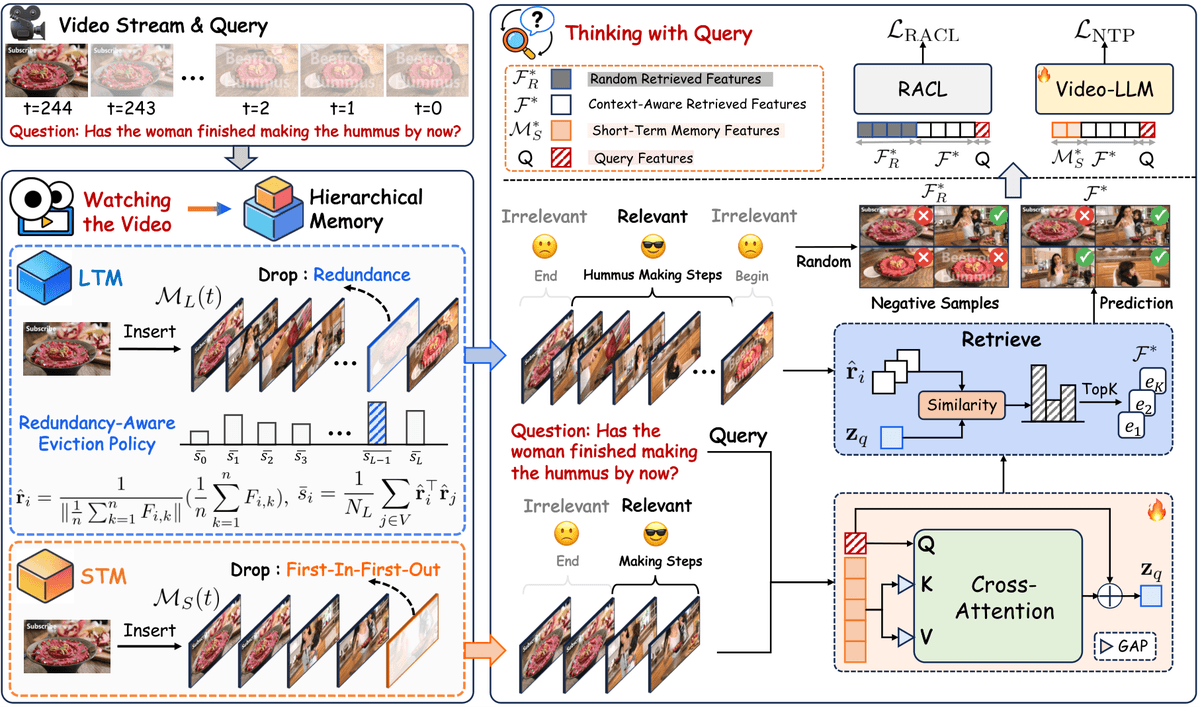
WAT's core idea is to decouple perception from reasoning. Processing splits into a query-independent watching stage and a query-triggered thinking stage. The watching stage builds a hierarchical memory system with a Short-Term Memory (STM) that buffers recent frames and a fixed-capacity Long-Term Memory (LTM) that maintains a diverse summary of historical content using a redundancy-aware eviction policy. In the thinking stage, a context-aware retrieval mechanism combines the query with the current STM context to retrieve relevant historical frames from the LTM for cross-temporal reasoning.
Concretely, the STM is a small FIFO buffer (16 frames in the reference config) holding high-fidelity recent context. The LTM has a fixed capacity of 768 frames. Each LTM entry stores both the full feature map and a normalized descriptor computed by global average pooling plus L2 normalization, so similarity checks stay cheap.
Redundancy-aware eviction
When the LTM fills up, WAT does not evict the oldest frame. Instead, it computes pairwise cosine similarity between every stored descriptor and picks the frame with the highest average similarity to everything else, meaning the most redundant one. A small protected zone (the most recent 10 percent of entries) is exempt, so genuinely new content is not deleted before the model has a chance to use it. In effect, the LTM is nudged toward a diverse, non-redundant summary of the entire video so far.
Here is the eviction logic condensed to pseudocode:
def update_ltm(F_t, LTM, protect_ratio=0.1):
    r_t = normalize(mean(F_t))          # descriptor
    if len(LTM) < N_L:
        LTM.append((F_t, r_t))
    else:
        S = cosine_sim_matrix([e.r for e in LTM])
        avg_sim = S.mean(axis=1)
        protected = recent_indices(LTM, protect_ratio)
        i_star = argmax(avg_sim, exclude=protected)
        LTM[i_star] = (F_t, r_t)
Retrieval that knows the current context
When a question arrives, WAT does not just embed the query and search the LTM. It first fuses the query embedding with the pooled STM content through an attention module, producing a context-aware query vector. That fused vector then retrieves the top-K most relevant LTM frames by cosine similarity. The retrieved frames are concatenated with the full STM and passed to the underlying MLLM (Qwen2.5-VL-7B in the reference implementation) for generation.
During training, an auxiliary objective called Retrieval Alignment Contrastive Learning (RACL) pulls query embeddings toward the aggregated features of the correctly retrieved frames while pushing them away from random LTM samples and in-batch negatives. It is an InfoNCE-style loss added to the standard next-token prediction loss, and the ablation shows it lifts OVO-Bench from 50.1 to 54.6 on its own.
WAT-85K, and what the numbers look like
To train the retriever and MLLM jointly on streaming-flavored data, the authors built WAT-85K. It combines a filtered subset of LLaVA-Video-178K with online samples derived from TimeChat-Online-178K, keeping full long-form videos rather than pre-cut clips, plus hand-authored samples for real-time perception and forecasting scenarios the authors identified as underrepresented.
On StreamingBench, which spans ten real-time visual understanding subtasks, the paper reports WAT reaching 77.7 percent overall at 1 FPS input. On OVO-Bench, which evaluates Real-Time Visual Perception, Backward Tracing, and Forward Active Responding, it reports 55.2 percent. The paper's tables place both numbers ahead of prior open-source online Video LLMs like TimeChat-Online-7B (75.36 / 46.7) and Dispider-7B (67.63) under the same streaming protocol, and the StreamingBench figure also lands above the reported 1-FPS scores for Gemini 1.5 Pro (75.69) and GPT-4o (73.28) on that specific benchmark. On OVO-Bench overall, proprietary systems still lead.

Where it helps, and where it does not
Ablations clarify what each piece contributes:
- Adding only the LTM to the Qwen2.5-VL baseline raises StreamingBench from 73.7 to 75.7. Adding STM on top brings it to 77.7 and OVO-Bench to 55.2.
- Growing LTM capacity from 32 to 768 entries gains 3.2 points on OVO-Bench but only 0.8 on StreamingBench, which the authors attribute to StreamingBench being dominated by recent-context tasks where STM already suffices.
- The framework also generalizes offline: WAT hits 63.9 on MLVU and 62.4 on VideoMME (50.8 on the long-video subset) using just 1 FPS sampling, comparable to offline models that consume far denser frame budgets.
Two caveats worth flagging. First, the LTM is capacity-bound at 768 entries with a fixed protection ratio, so extremely long streams still eventually see semantic dilution as the eviction policy tries to preserve diversity. Second, on tasks like Counting in StreamingBench (45.74) WAT actually trails TimeChat-Online, suggesting redundancy-aware eviction can throw away visually similar frames that are individually meaningful to a counting task. The authors do not currently indicate a public code release in the paper itself; the arXiv page lists only the manuscript.
Why the separation matters
The subtler contribution here is not any single component but the argument that online video reasoning should treat perception as an ongoing background process independent of what the user might ask. Query-driven memory pipelines end up optimizing for whatever question is being asked right now, at the cost of everything that might be asked later. Watching before thinking is a simple reframing that maps well onto realistic applications like continuous driving assistants, live event analysis, or robots that need to answer questions about actions they performed minutes ago.