
Xi'an Jiaotong's IGASA Hits 100% Recall Aligning Noisy LiDAR Point Clouds
A new research paper introduces IGASA, a point cloud registration framework combining hierarchical attention with iterative geometric refinement across four 3D vision benchmarks.
 Pro
Takeaways
- IGASA is a new point cloud registration framework proposed in arXiv 2603.12719, combining hierarchical attention with iterative geometric refinement.
- Built on three modules: Hierarchical Pyramid Architecture (HPA), Hierarchical Cross-Layer Attention (HCLA), and Iterative Geometry-Aware Refinement (IGAR).
- Reports 94.6% Registration Recall on 3DMatch and 76.5% on the harder 3DLoMatch benchmark, beating GeoTransformer and SIRA-PCR.
- Hits 100% Registration Recall on KITTI with 4.6cm translation error, though the 2m/5° threshold is already saturated by peers.
- Uses soft geometric consistency weighting instead of RANSAC hard filtering for outlier rejection over 5 iterations.
- PyTorch code is open-sourced on GitHub, trained on a single RTX 3090.
Aligning two 3D point clouds captured from different viewpoints sounds simple until you try it on real LiDAR scans full of noise, occlusion, and sparse regions. A new preprint from researchers at Xi'an Jiaotong University proposes IGASA, a registration framework that combines a multi-scale attention mechanism with an iterative geometry-aware refinement loop, and reports gains over recent transformer-based baselines on four standard benchmarks.
Point cloud registration (PCR) is the task of estimating the rotation and translation that align a source point cloud with a target one. It underpins autonomous driving, robot navigation, and environmental modeling, but existing pipelines still stumble when overlap between the two scans is low or when data is sparse and non-uniform.
Where current methods break down
Classical approaches like the Iterative Closest Point (ICP) algorithm minimize distances between nearest neighbors, but they are highly sensitive to initialization and can converge to local minima when data is corrupted by noise or occlusion. Learning-based methods, especially transformer variants like GeoTransformer and CoFiNet, capture longer-range context but hit what the authors call a semantic gap: as networks go deeper to capture high-level structure, aggressive downsampling washes out the fine geometric details needed for precise alignment.
The refinement stage is another weak spot. Many pipelines rely on RANSAC or hard thresholds to filter outlier correspondences, which is computationally expensive and can discard valid matches in low-overlap regions.
Three modules stacked together
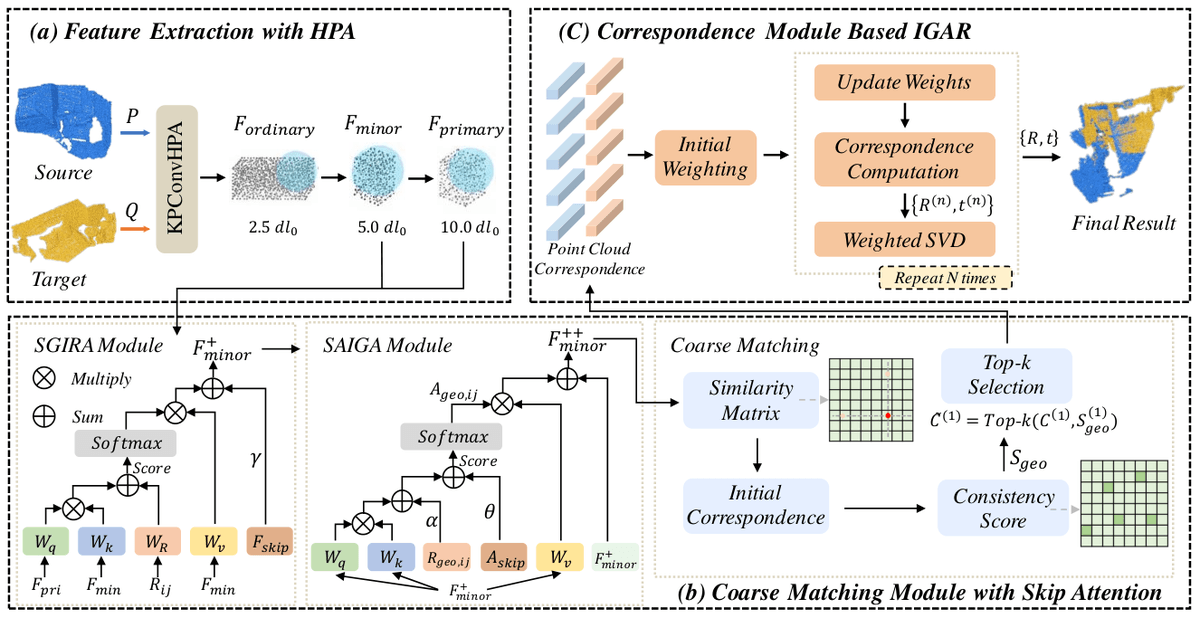
IGASA is organized around a Hierarchical Pyramid Architecture (HPA) built on Kernel Point Convolution (KPConv), which extracts features at three resolutions (ordinary, minor, primary) with progressively larger receptive fields. Two additional modules sit on top:
- Hierarchical Cross-Layer Attention (HCLA): uses skip attention to let deep semantic features guide the refinement of high-resolution ones. It contains two sub-units, SGIRA (which filters ambiguous local features using global context) and SAIGA (which sharpens local geometric distinctiveness through self-attention).
- Iterative Geometry-Aware Refinement (IGAR): replaces hard RANSAC-style filtering with a soft, dynamic weighting scheme. Each correspondence gets a weight based on its spatial fidelity, and the rotation and translation are re-estimated by SVD on a weighted cross-covariance matrix. The paper uses N=5 iterations.

How it scores on the benchmarks
The authors evaluate on 3DMatch (30%+ overlap indoor scans), 3DLoMatch (10-30% overlap), KITTI (outdoor LiDAR), and nuScenes (sparse LiDAR).
| Benchmark | Registration Recall | Notable metric |
|---|---|---|
| 3DMatch | 94.6% | Inlier Ratio 87.9% |
| 3DLoMatch | 76.5% | Inlier Ratio 61.6% |
| KITTI | 100.0% | RTE 4.6 cm, RRE 0.24° |
| nuScenes | 99.9% | RTE 0.12 m, RRE 0.21° |
The 100% Registration Recall figure on KITTI comes with a caveat: a KITTI registration counts as successful when RRE is below 5° and RTE below 2 m, which is a coarse threshold that several recent methods already saturate. Predator, CoFiNet, GeoTransformer, and OIF-Net all sit at 99.8% on the same metric, so IGASA's edge is really in the tighter translation error (4.6 cm versus 6.5-6.8 cm for the closest competitors).
The ablation is more revealing. Stripping HCLA and IGAR from the pipeline drops 3DMatch RR from 94.6% to 91.3%, and the Inlier Ratio jump from 79.2% to 87.9% suggests the iterative refinement is doing most of the work suppressing residual outliers.
Where it falls short
On feature matching recall for 3DLoMatch, IGASA lands at 82.1%, well behind RoITr (89.6%) and SIRA-PCR (88.8%). The authors acknowledge that under sparse sampling, feature robustness is an area for further work. Runtime is also worth noting: total inference is 2.763 seconds per pair on an RTX 3090, competitive with GeoTransformer (2.701s) but not real-time. The iterative refinement adds roughly 0.1s of overhead compared to CoFiNet.
Code and reproducibility
The authors have released their implementation on GitHub, with PyTorch code trained using AdamW at a 1e-4 learning rate over 15 epochs on 3DMatch and 30 epochs on KITTI. If you are already working with KPConv backbones or GeoTransformer-style pipelines, the HCLA and IGAR modules are the most transferable pieces. Anyone building SLAM or LiDAR odometry systems where sub-centimeter alignment matters more than latency will find the trade-offs reasonable; for real-time robotics, the iterative refinement loop is the piece to profile first.