
Xanadu Argues Quantum Computers Beat Classical AI Through Fourier Spectrum Control
A Xanadu team argues that the Quantum Fourier Transform is a natural tool for building the simplicity biases that make modern machine learning work.
Takeaways
- Xanadu researchers argue quantum computers are natural hardware for spectral methods in machine learning
- The Quantum Fourier Transform manipulates model Fourier spectra directly, an operation prohibitive for classical models
- Spectral biases underlie deep learning, kernel methods, SVMs, convolutional networks, and Neural Tangent Kernel theory
- A toy example shows generative empirical smoothing over bitstrings via Walsh-Hadamard transforms and low-pass filters
- Key limits: Born rule distortion, post-selection cost, and dequantizability of some filters via kernel methods
- Promising directions include permutation modeling on the symmetric group and quantum resource theories
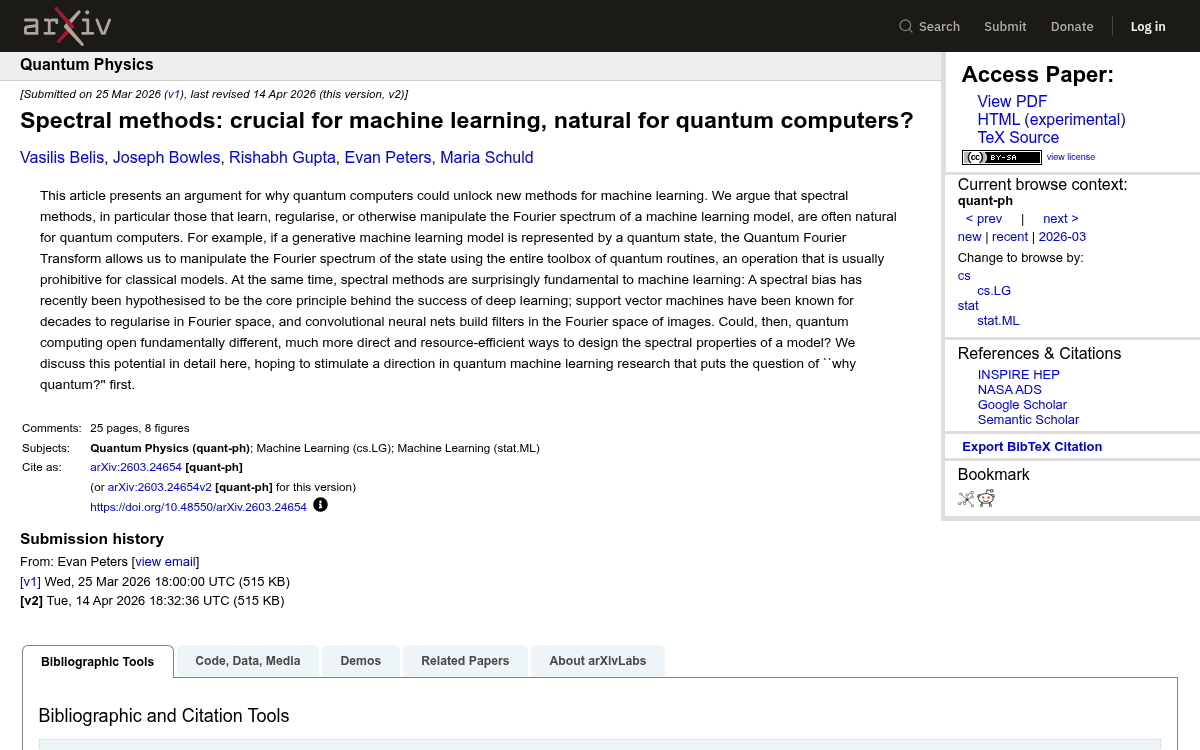
A team of researchers at Xanadu Quantum Technologies has published a perspective paper making a bold claim: the reason quantum computers might one day matter for machine learning has nothing to do with speeding up linear algebra or running fancy neural networks on qubits. The case rests on something more subtle. Spectral methods, they argue, are the hidden engine behind why modern models generalize, and quantum computers happen to be unusually good at manipulating Fourier spectra directly.
The paper, authored by Vasilis Belis, Joseph Bowles, Rishabh Gupta, Evan Peters, and Maria Schuld, blends perspective, tutorial, and review. It does not propose a new model or benchmark. What it does is reframe the question of why quantum?
for machine learning in a way that connects tightly with what deep learning researchers have learned about generalization over the past decade.
The regularization problem hiding in plain sight
A fact has quietly become central to deep learning theory: good models have a soft bias toward simplicity. Spectral bias is now hypothesized as the underlying principle driving the success of deep learning, and simplicity for a function usually translates into a Fourier spectrum that decays at high frequencies. Smooth functions do not have much high-frequency content.
Many familiar techniques exploit this without saying so out loud. Support vector machines have been known for decades to regularise in Fourier space, and convolutional neural nets build filters in the Fourier space of images. Kernel methods, the Maximum Mean Discrepancy used to train GANs, and the Neural Tangent Kernel framework all turn out to be spectral techniques in disguise.