
Wuhan University's DeepSketcher Lets a 7B Model Draw Inside Its Own Mind
A new vision language model skips external tools and manipulates images directly in embedding space, learning from 31k code-rendered reasoning traces.
 Pro
Takeaways
- DeepSketcher pairs a 31k code-rendered reasoning dataset with a self-contained 7B multimodal model.
- The model edits images inside its embedding space, avoiding external tools and coordinate prediction entirely.
- Beats Qwen2.5-VL-7B base by 3.9 points on average, with 8.3 points on LogicVista.
- A Q-Former variant uses visual tokens as queries and edit instructions as keys and values.
- Three-phase decoupled training beats single-stage end-to-end by 2.9 points on average.
- Code and Hugging Face demo available at MiliLab/DeepSketcher.
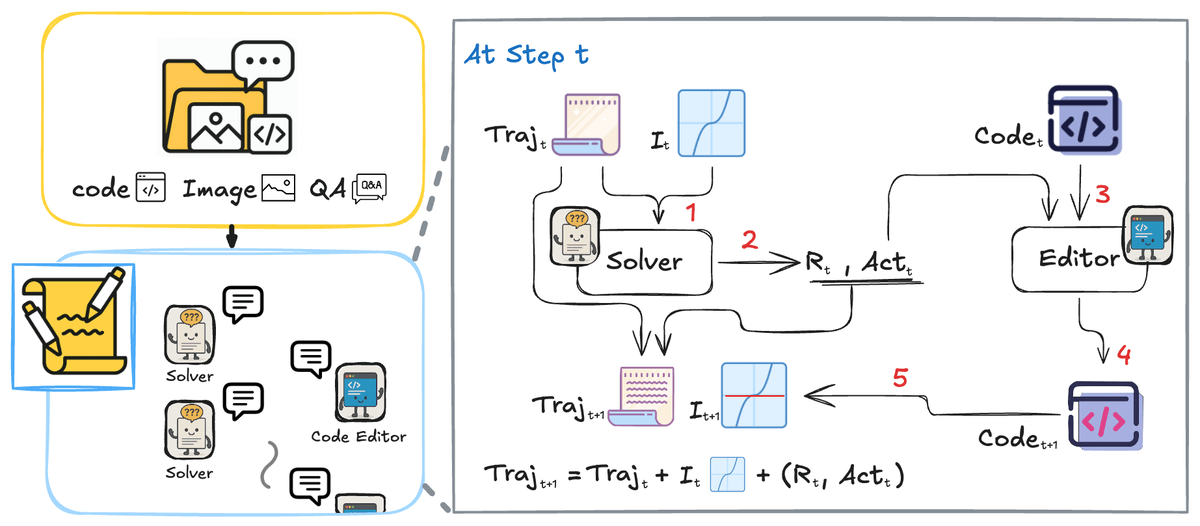
Vision language models have a bad habit that researchers politely call thinking over seeing. They produce long, confident chains of reasoning that often ignore what is actually in the image, sometimes hallucinating details that were never there. DeepSketcher, a new suite from Wuhan University and Meituan accepted to CVPR 2026 Findings, takes a different route: it teaches a model to edit images inside its own visual embedding space while it reasons, without ever calling an external tool.
The work bundles two artifacts: a 31k-sample interleaved image and text dataset built entirely from rendering code, and a self-contained 7B model that internalizes the whole draw-and-reason loop. On standard multimodal math benchmarks it beats its Qwen2.5-VL-7B base by 3.9 points on average, with 5.3 points on MathVision and 8.3 on LogicVista.
Why grounding keeps breaking
Recent thinking-with-images systems generally fall into two camps. Tool-calling models like DeepEyes or VILASR pick from a fixed set of actions such as zoom or crop and predict bounding-box coordinates for the region to operate on. Generation-based approaches feed the intermediate image to a diffusion model to actually draw the edit. Both routes struggle with noisy grounding: curated data seldom yields perfectly accurate annotations, and reinforcement-learning rollouts are similarly error-prone.
The team illustrates the failure mode plainly. When GPT-5 is asked to draw a bounding box on a geometry diagram, the box drifts. When Nano-Banana is asked to render an edited version of the same figure, the geometry warps. Neither result is reliable enough to feed back into a reasoning chain.