
WRDPG Catches What Standard Graph Models Miss by Reading Higher Moments
A new latent-space model extends spectral graph embedding to weighted networks, capturing higher-order moments so edges with equal means but different distributions become distinguishable.
 Pro
Takeaways
- WRDPG extends Random Dot Product Graphs to weighted networks using a sequence of latent positions per node.
- Inner products of the k-th latent vectors match the k-th moment of the edge weight distribution via MGFs.
- Can distinguish edge distributions with identical means but different variance or skewness, unlike prior nonparametric work.
- Estimator uses ASE on entry-wise powers W^(k); consistency and asymptotic normality proven under sub-Weibull tails.
- Generative framework covers discrete (Chebyshev-Vandermonde), continuous (primal-dual max-entropy), and mixed weight distributions.
- Code available at github.com/bmarenco/wrdpg; paper in Electronic Journal of Statistics.
Latent-space models like the Random Dot Product Graph (RDPG) have become a workhorse for statistical network analysis because they turn a messy adjacency matrix into a set of interpretable node embeddings. But classical RDPG only knows how to talk about edges in yes-or-no terms, and most real networks (bandwidth on a link, number of football matches between countries, correlations between neurons) carry weights that vary in richer ways.
A new paper published in the Electronic Journal of Statistics proposes the Weighted Random Dot Product Graph (WRDPG), a nonparametric extension that assigns each node a whole sequence of latent positions instead of one. The model assigns a sequence of latent positions to each node, and inner products of these nodal vectors specify the moments of their incident edge weights' distribution via moment-generating functions. The result is a model that can tell apart edges whose weight distributions happen to share a mean but disagree about variance, skewness, or higher moments.
Why one latent vector per node is not enough
Prior weighted extensions of RDPG fell into two camps. The parametric camp fixed a family (say, Poisson or Gaussian) for the edge weights and let the dot product of latent vectors control the parameter. That is restrictive when different edges follow different distributions. The nonparametric alternative by Gallagher et al. avoided the parametric assumption but only recovered the mean of the weight matrix, so it could not distinguish two communities whose edges have identical means but different spread.
The WRDPG fixes this by pushing the dot product structure all the way up the moment ladder. Each node is associated with an infinite sequence so that the expected k-th power of the edge weight equals the inner product of the k-th latent vectors, modeling not just mean structure but higher-order moments, enabling discrimination among edges with matching means but differing variance or skewness. Spectral embedding for each power k is used, with consistency and asymptotic normality established for latent moment estimation.
Estimation: spectral embedding, one moment at a time
The estimator is a direct generalization of the adjacency spectral embedding (ASE) used in vanilla RDPG. For each moment index k, you form the entry-wise k-th power of the weighted adjacency matrix, take its top-d eigendecomposition, and read off the estimated latent positions.

Concretely the pipeline is:
- Observe a symmetric weighted adjacency matrix W.
- Compute the Hadamard power W^(k) for k = 0, 1, 2, ...
- Run ASE on each W^(k) to get the estimate X_hat[k] = U_k D_k^(1/2).
The authors establish two theoretical guarantees that go beyond prior work. First, consistency holds even for unbounded sub-Weibull weights, with the error controlled in the 2-to-infinity norm rather than Frobenius. That distinction matters in practice: the 2-to-infinity bound controls the worst-case row error, so no single node's embedding can drift. Second, they prove asymptotic normality of the estimated latent positions and give an explicit covariance formula, which is what makes downstream hypothesis testing tractable.
The discriminative power in one picture
The clearest demonstration is a two-block SBM where one block has Gaussian edge weights with mean 5 and standard deviation 0.1, and the other has Poisson weights with rate 5.1. The means are nearly identical, so at k = 1 the two communities' embeddings collapse onto the same point. At k = 2 they start to separate. By k = 3 the 95% confidence ellipses no longer overlap and the communities become linearly separable. Methods that only look at the mean adjacency are structurally incapable of catching this.
Generating graphs from moments
Modeling is only half the story. The paper also solves the inverse problem: given a target sequence of latent positions (either prescribed or estimated from a real network), how do you actually sample a graph that respects those moments? The answer depends on whether the edge weights are discrete, continuous, or a mixture.

- Discrete weights: solve a Vandermonde linear system to recover the pmf from the first K moments. To dodge the notorious ill-conditioning of Vandermonde matrices, the authors reformulate everything in the Chebyshev polynomial basis, which stays well-conditioned as K grows.
- Continuous weights: apply the maximum entropy principle subject to moment constraints. They derive the convex dual and solve it with BFGS through SciPy's
minimize. In head-to-head tests against the existing PyMaxEnt tool (which uses Newton's method on the primal), their primal-dual approach converges to the true solution from every random initialization while PyMaxEnt often does not. - Mixed distributions: for sparse networks with a point mass at zero, they estimate the connection probability separately via ASE of the binarized adjacency, then run max-entropy on the nonzero part.
Football, community detection, and a reality check
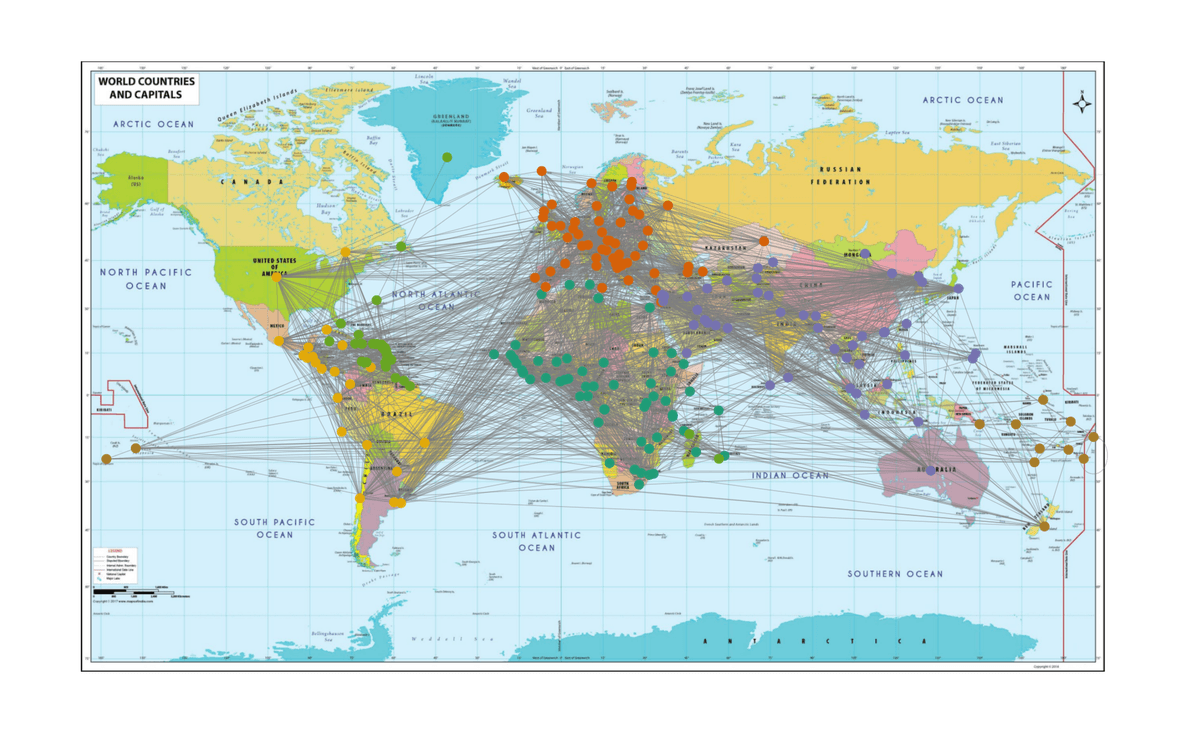
The applied showcase uses a network of international football matches from 2010 to 2016, where nodes are countries and edge weights count matches played. Fitting the mixed-distribution WRDPG and running Louvain clustering on synthetic replicates recovers the six real-world FIFA confederations, with one telling exception: CONMEBOL and CONCACAF get merged because North American teams frequently appear in the Copa America, inflating cross-confederation weights. The synthetic graphs match the real one on V-measure, Adjusted Rand Index, and Adjusted Mutual Information.
There is a genuine limitation the authors do not hide: higher-order moment estimators are noisy, and their variance grows fast with k. In their two-block experiments, k up to 4 is stable at N = 2000 nodes but degrades sharply at N = 200. So the model buys discriminative power at the cost of needing a decent amount of data per moment you want to trust.
Where this fits
The WRDPG is not a deep learning method and it is not competing with GNNs on node classification benchmarks. It sits in the statistical network analysis toolbox alongside stochastic block models and latent-space models, with the specific job of giving you interpretable embeddings plus a principled generative model you can sample from to build reference distributions for hypothesis testing on graph statistics. If your work involves testing whether an observed subgraph count, centrality, or spectral quantity is significant, or bootstrapping network statistics under a realistic null, this is directly useful.
Code implementing the estimator, the Chebyshev-based reconstruction, and the primal-dual maximum-entropy solver is available in the accompanying GitHub repository, which builds on Graspologic's RDPG implementation.