
Woofs to Words Lets a Robot Guide Dog Talk Blind Users Through Buildings
SUNY Binghamton researchers built a quadruped guide dog that talks back, combining LLMs with symbolic planning to help visually impaired handlers navigate collaboratively.
 Pro
Takeaways
- SUNY Binghamton researchers built a robotic guide dog with LLM-driven dialog for visually impaired handlers (paper).
- System combines plan verbalization before navigation with scene verbalization during it, backed by an ASP planner.
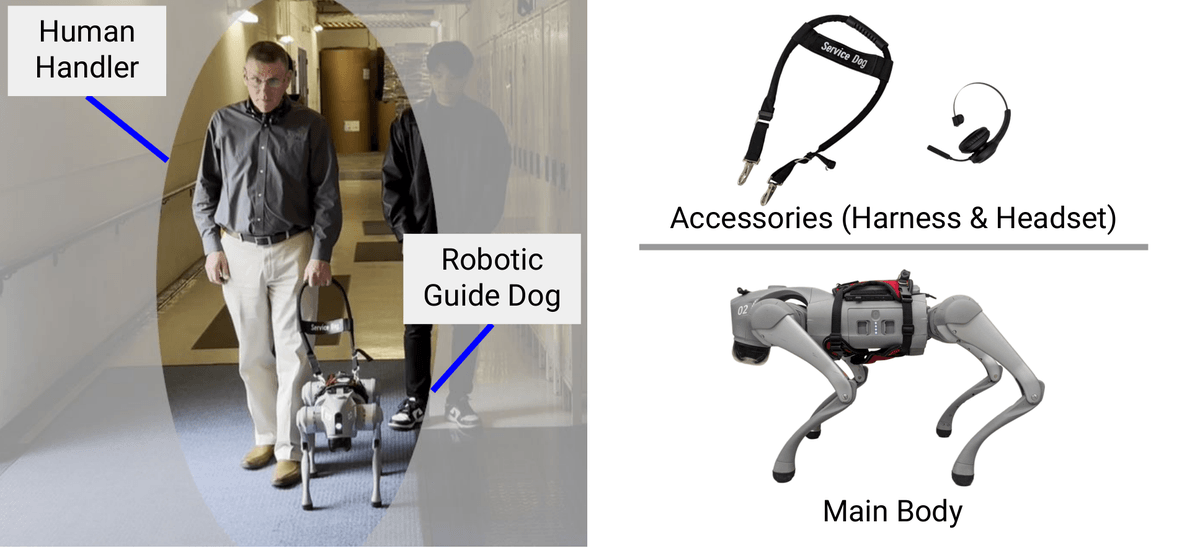
- Runs on a Unitree Go2 using Vosk speech-to-text and an LLM agent with format-constrained prompts.
- Human study with seven legally blind participants preferred combined plan and scene verbalization overall.
- Simulation over 77 tasks hit 94.8% accuracy and lost only 5.2% under heavy character noise.
- Project page with demos available at the Woofs to Words website.
A quadruped robot that can hold a real conversation with a blind handler about where to go, why, and what is coming up next has just been demonstrated in a study with legally blind participants. The system, called Woofs to Words, marries a large language model with a symbolic task planner so a Unitree Go2 can verbally propose routes, explain trade-offs, and narrate the scene as it walks.
Why guide dog robots need to talk
The motivation is bluntly practical. Only about 2% of the visually impaired in the U.S. use guide dogs, and there are only about 400 guide dogs for more than 10 million visually impaired people in China, largely because breeding and training a real dog takes years and washes out more than half of candidates. Robots are an obvious substitute, but earlier robotic guide dogs mostly communicated through leash tension, buttons, or a fixed list of voice commands.
The authors point out a subtlety that outsiders often miss: a visually impaired handler does not blindly follow a guide dog. The two work as a team, where the handler picks the route using tactile and echolocation cues and the dog handles obstacle avoidance. Any dialog system therefore has to support collaborative decision-making, not just command following.
The problem with bolting on a chatbot
Dropping an off-the-shelf LLM onto a robot dog runs into two specific failures. First, an LLM asked about a thirsty user might list a kitchen and a water fountain without knowing which is reachable, how long each takes, or whether doors are in the way. Second, LLMs are known to be weak at spatial reasoning, which is exactly what the handler needs to be strong.
Plan verbalization and scene verbalization
The core idea is to split the robot's speech into two modes tied to a symbolic planner. Before navigation, the LLM does plan verbalization: for each candidate destination it queries an Answer Set Programming planner in the background, then reads back concrete metrics like travel time and how many doors need to be opened. During navigation, scene verbalization kicks in when the robot crosses a semantic region boundary on the map or when the dialog goes quiet, announcing things like entering a corridor or approaching an office door.

Under the hood the loop is straightforward:
- Speech from a headset mic is transcribed with the Vosk speech-to-text model.
- An LLM agent, constrained by a system prompt that lists valid locations and output formats, either asks a clarification question or emits a
COMMAND goto <location>token. - For each candidate location, an ASP planner produces an action sequence over primitives like
approach(door_id),opendoor(door_id),gothrough(door_id), andgoto(location), minimizing total cost. - A safeguard layer intercepts malformed LLM responses and substitutes a fallback message rather than letting the handler act on hallucinated locations.
How it held up with real users
The team ran a within-subjects study with seven legally blind participants navigating to a conference room under three conditions: minimum verbalization, scene-only, and combined scene plus plan. For safety, the robot was driven by an expert operator in a Wizard of Oz setup, isolating the evaluation to the dialog strategies. The combined condition scored highest on interface utility, ease of communication, and preference over a real guide dog, though it dipped slightly on perceived safety, which participants attributed to unfamiliarity walking beside a robot.
Simulated stress tests
To get statistics the human trial could not deliver, the authors built a task library from 16 university students who wrote location-purpose pairs like a water fountain for thirst, yielding 77 unique tasks grouped into functionally equivalent buckets. GPT-4 then role-played a visually impaired user who never names the destination directly. Three headline numbers from the simulation runs:
- The full multi-turn LLM dialog hit 94.8% accuracy while staying more concise than a keyword-based baseline that had to enumerate every location.
- Under aggressive character-level noise (30% deletion, insertion, or substitution per character) the system lost only 5.2% accuracy, while the keyword baseline collapsed.
- Including planner cost information in dialog turns produced longer conversations (115.67 vs 84.83 units) but lower navigation cost (55.17 vs 73.00) and lower total task time (230.15 vs 277.27 seconds), because users picked closer functionally-equivalent destinations.
Where this fits and where it does not
The obvious use case is indoor assistive navigation where the environment map and semantic labels are known in advance, such as hospitals, university buildings, or offices. It is less applicable to open exploration, unfamiliar outdoor spaces, or recovery behaviors like a real dog helping a fallen handler back up, all of which the authors explicitly exclude from scope. The system also currently relies on a controlled autonomy setup for the human trials, so full autonomy in crowds remains future work.
The real conceptual contribution is showing that grounding an LLM's dialog in a symbolic planner's output, rather than in raw scene descriptions, is what turns chatty destination suggestions into decisions a handler can actually act on. That handoff between neural language understanding and classical planning is a pattern likely to generalize well beyond guide dogs, to any assistive robot where a human needs to weigh options they cannot see.