
Wisconsin and Google DeepMind's POLCA Makes LLM Self-Optimization Actually Work
A new priority-queue optimizer with semantic filtering beats GEPA and OpenEvolve at tuning agents, prompts, and CUDA kernels under noisy feedback.
 Pro
Takeaways
- POLCA introduces priority-queue memory plus epsilon-Net semantic filtering for LLM-driven optimization under noisy feedback.
- Achieves 95.2% compile pass on VeriBench, versus about 59% prior baseline on the same tasks.
- Outperforms GEPA and OpenEvolve on tau-bench, HotpotQA, VeriBench, and KernelBench under matched budgets.
- Proves convergence to near-optimal candidates and shows exponential gap over sequential refinement rules.
- Adds an LLM Summarizer that turns memory history into natural-language meta-gradients for the optimizer.
- Code released at github.com/rlx-lab/POLCA, implemented on top of the Trace workflow framework.
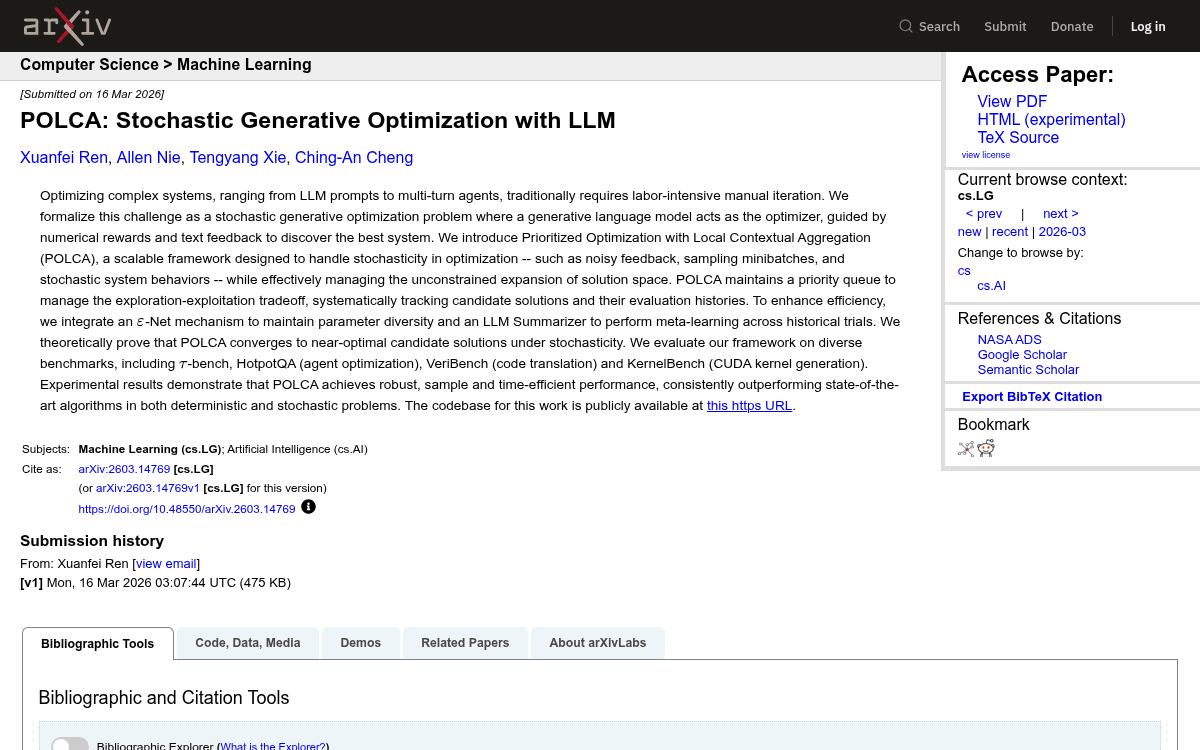
Using an LLM to optimize another LLM system, whether it is a prompt, a multi-turn agent, or a CUDA kernel, sounds appealing until you actually try it. The optimizer keeps proposing near-duplicates, the evaluation scores are noisy enough to reward the wrong candidate, and the search space balloons without producing anything useful. A team from the University of Wisconsin-Madison, Google DeepMind, and Google Research have released a paper introducing POLCA (Prioritized Optimization with Local Contextual Aggregation), a framework that attempts to make LLM-as-optimizer actually behave like a real optimization algorithm.
POLCA is a scalable framework designed to handle stochasticity in optimization, such as noisy feedback, sampling minibatches, and stochastic system behaviors, while effectively managing the unconstrained expansion of solution space. The codebase is public, and the authors report state-of-the-art results across four very different benchmarks.
Why LLM optimizers keep tripping over themselves
The setup is familiar: you have a parameterized program (a prompt, agent code, a kernel), a dataset of tasks, a guide that returns a numerical reward plus text feedback, and an LLM optimizer that proposes new parameters. Repeat. The problem is that every part of this loop is noisy.
- Minibatch noise: evaluating on all tasks every step is too expensive, so you sample.
- Program noise: the program itself is often an LLM, so identical inputs produce different outputs.
- Evaluator noise: LLM-as-judge feedback is subjective and inconsistent.
On top of that, LLM optimizers tend to propose semantically redundant candidates. The parameter space grows linearly while useful information does not, and verifying redundant programs costs additional evaluations. Existing approaches like GEPA (which maintains a Pareto frontier) and OpenEvolve (an open-source AlphaEvolve implementation using MAP-Elites) largely assume nearly deterministic evaluators, so they falsely reject good candidates when the score happens to be noisy on a given batch.
The two ideas doing the heavy lifting
POLCA is built around a priority queue of candidate parameters, each scored by its empirical mean reward across all evaluations it has ever received. Two components make this queue behave well:
1. An epsilon-Net semantic filter. Every parameter is embedded into a vector space. A newly proposed candidate is admitted to memory only if its embedding distance to every existing candidate exceeds a threshold epsilon. This keeps the queue diverse and bounds the total number of parameters that ever need evaluation. Prior work like AlphaCode and ShinkaEvolve used similar tricks heuristically; POLCA proves this is theoretically necessary under evaluation noise.
2. An LLM Summarizer for meta-gradients. A separate LLM compresses the entire history of successes and failures in the queue into a natural-language context that is fed to the optimizer alongside the current minibatch feedback. The authors compare this to gradient descent with momentum, where the summary acts as a stabilizing signal across iterations.

The loop is straightforward. Each iteration samples a minibatch, selects the top candidates from the priority queue, evaluates them, asks the optimizer to propose new parameters given local rollouts plus the global summary, filters those through the epsilon-Net, and evaluates the survivors on the same minibatch for fair comparison.
The theoretical part actually matters
Most LLM-optimizer papers are pure empirics. POLCA proves that a UCB-based version converges to near-optimal candidates under stochasticity, with a rate governed by two intuitive quantities: how often the optimizer manages a strict improvement (the oracle strength), and how noisy the reward is. In the deterministic case the sample bound collapses to depend only on the reward gap and optimizer efficiency, which matches intuition.
A separate theorem compares POLCA's rule of always improving from the current best against naive sequential refinement. Sequential updates need order (1/delta)^(B/gamma) steps to reach near-optimality, while POLCA needs only B/(gamma*delta). That is exponential versus linear in the reward horizon, essentially because sequential methods can get catastrophically reset by a bad proposal.
Numbers across four benchmarks
The authors tested on stochastic and deterministic problems. Baselines include DSPy, GEPA, and OpenEvolve.
| Benchmark | Task | POLCA result | Best baseline |
|---|---|---|---|
| tau-bench retail (115 tasks) | Agent prompt optimization | 0.439 pass@1 | 0.429 (GEPA) |
| VeriBench compilation (140 tasks) | Python to Lean 4 translation | 0.952 pass rate | 0.888 (DSPy) |
| HotpotQA | Multi-hop QA prompt tuning | Highest final score | Trailed POLCA |
| KernelBench (16 matmul tasks) | CUDA kernel generation | Highest fast_1.0 | Trailed POLCA |
The VeriBench result is striking. The best algorithm reaches a 95.2% compilation pass rate using a budget of 50 metric calls per task, significantly exceeding the baseline results, versus a prior published maximum of about 59.3% on a subset using sequential retry. On tau-bench, prompts trained on just the first 10 retail tasks generalized to give a roughly 13% improvement over the base prompt across all 115 tasks, including 105 held-out ones.
When it helps and when it doesn't
POLCA's design is a natural fit when evaluation is expensive and noisy, when you want to update from minibatches rather than the full task set, and when the optimizer is prone to churning out lookalikes. The parallel batch design gives it a big edge on wall-clock time. However, the paper is upfront about tradeoffs: sequential methods like DSPy can achieve greater search depth for the same total compute, so POLCA can trail on early-stage metric-call efficiency before pulling ahead. The epsilon parameter also matters. Setting it to zero (no filtering) consistently produces the worst results, and very large values cost you asymptotic performance from coarse discretization.
Practical implications
POLCA is implemented on top of Trace, using OptoPrime as the underlying optimizer, so if you already work with Trace-style workflow optimization the framework drops in. The design principle worth stealing even if you do not use the framework is simple: when your evaluations are noisy, do not let a single bad batch kick a candidate out of memory, and do not let semantic near-duplicates flood your search. An embedding-based accept/reject rule plus a persistent memory with running means handles most of the pathologies people have been reporting in LLM-driven optimization.