
Wichita State Researchers Expose Hidden Gender Bias in Audio Deepfake Detectors
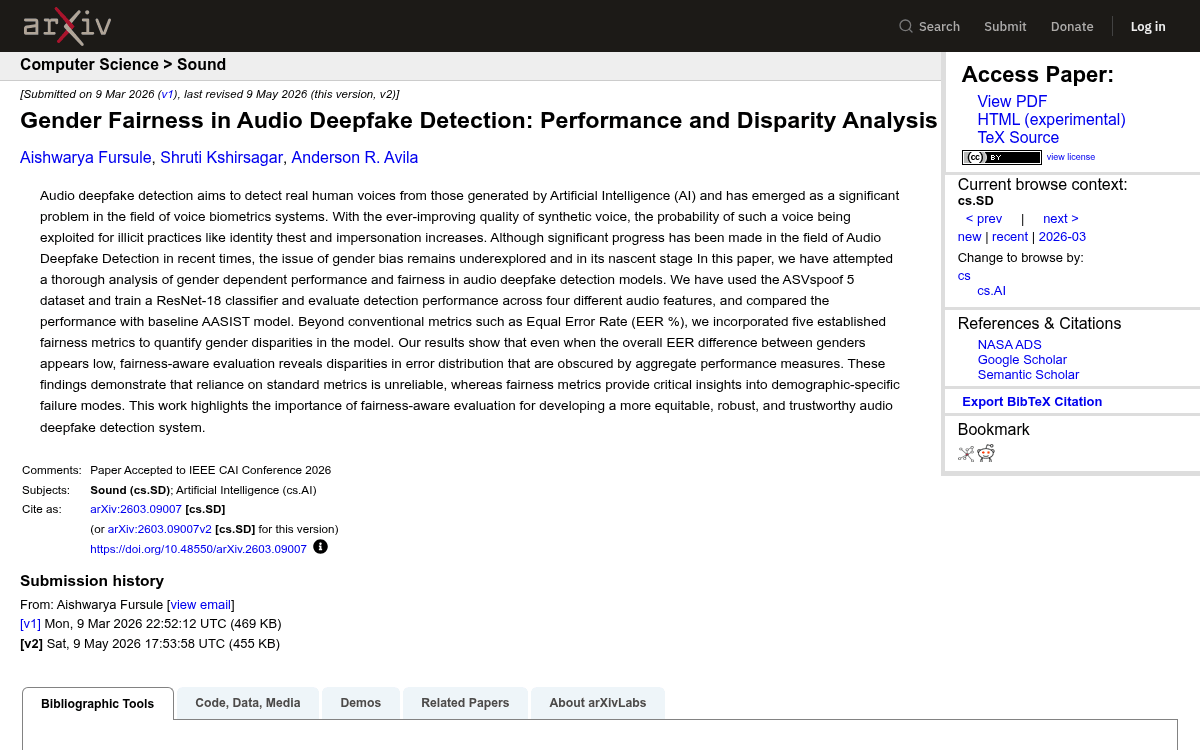
A new study reveals that standard EER metrics hide significant gender disparities in audio deepfake detectors, even when overall accuracy looks balanced.
 Pro
Takeaways
- A new study finds that audio deepfake detectors show statistically significant gender disparities that are hidden by standard Equal Error Rate (EER) metrics.
- Five group fairness metrics -- Statistical Parity, Equal Opportunity, Equality of Odds, Predictive Parity, and Treatment Equality -- were applied to expose these gaps.
- Predictive Parity consistently favored male speakers across all five models tested, meaning "spoof" flags are less reliable for female voices.
- The CQT feature showed the largest gap in Equal Opportunity (+0.114), meaning AI-generated male voices are significantly more likely to evade detection.
- Experiments used the ASVspoof 5 dataset with ~2,000 speakers and 32 attack algorithms, tested against ResNet-18 and AASIST baselines.
- A follow-up paper from the same team shows that per-gender threshold adjustment can reduce unfairness by 54-75% with no accuracy loss.
Voice authentication systems are quietly becoming a frontline defense against fraud, impersonation, and identity theft. But a new paper from researchers at Wichita State University and INRS Montreal is raising an uncomfortable question: when an audio deepfake detector performs well on average, does that mean it performs well for everyone? The short answer, it turns out, is no.
The study conducts one of the most systematic gender fairness analyses of audio deepfake detection to date, and its central finding is a warning shot for anyone deploying these systems in production: aggregate metrics like Equal Error Rate (EER) can mask serious demographic disparities that only become visible when you look at the right fairness metrics.
The Hidden Cost of "Good Enough" Accuracy
As deepfake audio becomes increasingly indistinguishable from authentic recordings, it presents significant threats to security, undermines media integrity, and challenges the reliability of digital authentication systems. The field has responded with a wave of detection models, most of which are benchmarked using EER -- the point where false acceptance and false rejection rates are equal. But EER is a single number that collapses performance across all speakers into one figure.
To date, fairness assessment has primarily focused on image and video modalities, and investigations in audio deepfake detection systems, particularly for gender bias, have only recently emerged. The handful of studies that have looked at this problem found troubling signals: higher detection accuracy for female voices across several configurations, providing empirical evidence that gender characteristics influence audio deepfake detection performance. Another analysis found existing detectors exhibit significant gender bias, with systematically higher false positive rates for male speakers compared to the female ones.
The reason this happens comes down to basic acoustics. Speech signals naturally differ between male and female speakers in pitch, vocal range, and speaking patterns. A model trained under the same regime for different voice types is expected to yield group-dependent performance. AI-generated speech tends to carry synthetic artifacts that are more pronounced in higher-pitched voices, which may make female deepfakes easier to catch -- but that asymmetry cuts both ways depending on the model and the feature representation used.
Five Models, Four Features, Five Fairness Lenses
The researchers built a clean, reproducible experimental setup. They trained a ResNet-18 classifier -- a well-known convolutional architecture originally designed for image recognition -- on four different audio feature representations, and compared results against AASIST, a state-of-the-art end-to-end anti-spoofing model that uses graph attention networks to jointly model spectral and temporal artifacts in speech.

The four feature types tested span a range from classical signal processing to modern self-supervised learning:
- LogSpec -- a log-magnitude spectrogram, capturing energy across frequency bands over time
- CQT (Constant-Q Transform) -- uses logarithmically spaced frequency bins that emphasize pitch and harmonic structure, making it particularly sensitive to synthetic speech artifacts
- Wav2Vec 2.0 -- a self-supervised model (meaning it learns from raw audio without labels) that produces rich contextual embeddings directly from the waveform
- WavLM -- another self-supervised model trained on large-scale speech corpora, encoding both acoustic and linguistic characteristics
All experiments used the ASVspoof 5 dataset, the latest edition of the long-running ASVspoof challenge series. It incorporates crowdsourced data from nearly 2,000 speakers recorded in diverse acoustic environments, and includes spoofed speech generated by 32 different algorithms covering both conventional and state-of-the-art TTS and voice conversion methods, as well as adversarial attacks. Crucially, compared to earlier editions like ASVspoof 2019 and ASVspoof 2021, ASVspoof 5 provides a near-balanced distribution of male and female speakers, enabling a detailed analysis of gender-related performance disparities.

Rather than relying on EER alone, the team evaluated each model through five group fairness metrics -- each measuring a different dimension of equitable behavior:
- Statistical Parity -- are spoof predictions made at the same rate for both genders?
- Equal Opportunity -- do actual deepfakes have the same chance of being caught regardless of speaker gender?
- Equality of Odds -- are both the true positive rate and false positive rate equal across genders?
- Predictive Parity -- when the model flags something as a deepfake, is that prediction equally reliable for male and female voices?
- Treatment Equality -- is the ratio of false positives to false negatives balanced across genders?
Statistical significance was assessed using z-tests with Holm-Bonferroni correction across all comparisons, ensuring that even small observed gaps were tested rigorously before being called real.
The Numbers Tell a Complicated Story
The results vary substantially by model and feature, but one pattern is consistent across all systems: Predictive Parity consistently favors male speakers. Across every model tested, a "spoof" prediction was more likely to be correct for male speech than female speech. The gap ranged from -0.007 for AASIST to -0.053 for Wav2Vec -- meaning that when the Wav2Vec-based model flags a female voice as a deepfake, it is wrong more often than when it flags a male voice.
The CQT feature showed the most dramatic disparities overall. Under Equal Opportunity, CQT exhibits the strongest disparity in true positive rate, favoring female speech (0.474) over male speech (0.360), with a difference of +0.114. This means AI-generated male voices are significantly more likely to slip past a CQT-based detector undetected.
Treatment Equality revealed another striking pattern. CQT and Wav2Vec exhibit very high Treatment Equality values, especially for females -- respectively 2.79 and 3.31 -- indicating that these systems generate substantially more false positives than false negatives for female speakers. In other words, real female voices are being incorrectly flagged as deepfakes at a much higher rate than real male voices.
AASIST, by contrast, showed the opposite error profile: its mistakes are dominated by missed spoofs (false negatives) rather than false alarms, with minimal gender difference in that ratio. But it still showed statistically significant disparities on Equality of Odds, with AASIST producing a substantially higher false positive rate for male speakers (0.358 versus 0.279), indicating that bonafide male speech is more frequently misclassified as spoof under this model.
Why This Matters Beyond the Lab
The practical stakes here are concrete. In a voice authentication system, a false positive means a real person gets incorrectly rejected -- locked out of their account or flagged as a fraudster. A false negative means a deepfake attack gets through. If those errors are distributed unevenly across genders, the system is not just inaccurate -- it is discriminatory in a measurable, legally relevant sense.
Audio deepfake detection systems are increasingly deployed in high-stakes security applications, yet their fairness across demographic groups remains critically underexamined. The paper's key practical recommendation is direct: EER alone is not enough. Any team deploying a deepfake detector in a real-world voice biometrics pipeline should be running all five of these fairness metrics -- broken down by demographic group -- before shipping.
The work also has a notable limitation: it uses binary gender labels derived from the ASVspoof 5 protocol files, which does not capture the full spectrum of speaker demographics. The authors flag this explicitly, noting that extending to non-binary gender representations remains important future work. No code or pretrained models are released alongside the paper, though the experimental setup is described in enough detail to be reproduced using publicly available tools.
A follow-up paper from the same team, "Towards Trustworthy Audio Deepfake Detection", goes further by diagnosing where the bias actually comes from and testing mitigation strategies. Their diagnosis shows that bias does not stem from imbalanced training data but from acoustic representation differences, gender leakage in learned features, and structural evaluation asymmetry. Adjusting the decision threshold separately per gender reduces unfairness by 54% to 75% at no cost to detection accuracy. That is a remarkably cheap fix -- and one that would be invisible without the fairness-aware evaluation framework this paper introduces.