
Why Frozen LLMs Keep Breaking and How Continual Learning Fixes Them
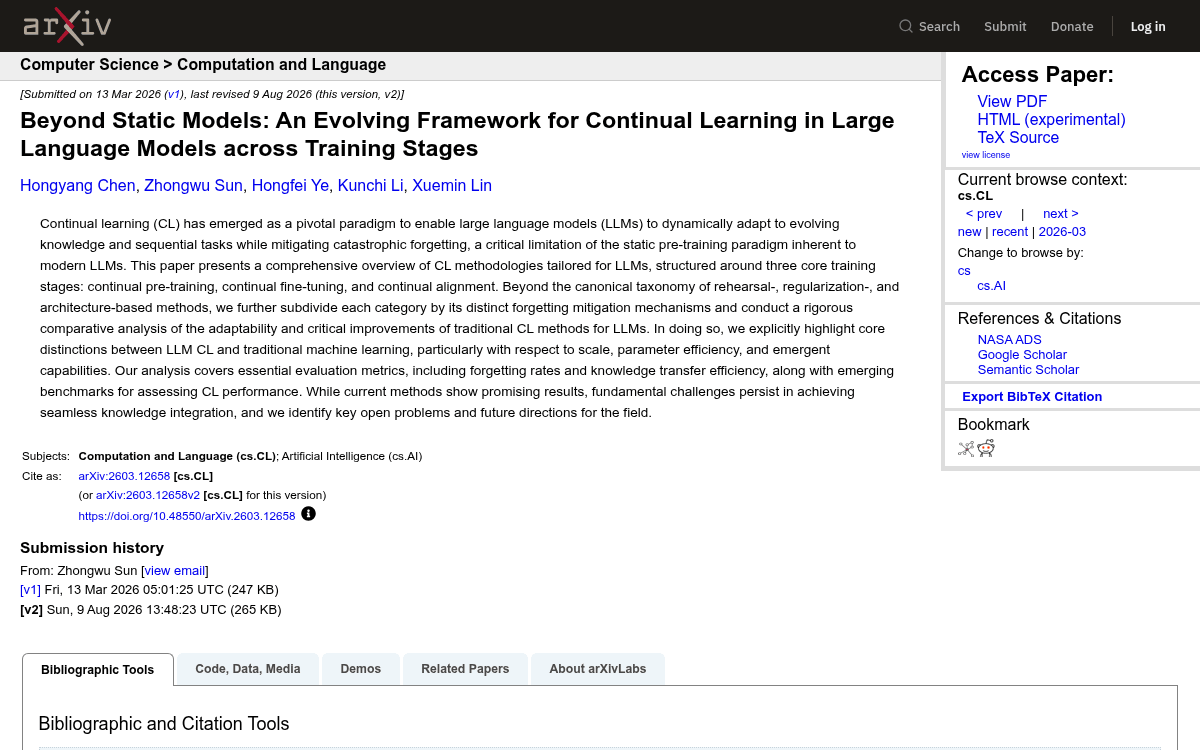
A new survey reframes continual learning across pretraining, fine-tuning, and alignment through a knowledge dynamics lens of collision, isolation, and fusion.
 Pro
Takeaways
- New survey maps continual learning for LLMs across pretraining, fine-tuning, and continual alignment.
- Introduces a knowledge dynamics lens: collision, isolation, or fusion between old and new representations.
- Data-mixture rehearsal with 5 to 15 percent prior data is the pretraining workhorse.
- PEFT-based isolation via LoRA variants like O-LoRA dominates continual fine-tuning benchmarks.
- Unified T5-Large comparison shows no single method wins across all task orders.
- Continual alignment remains the least mature stage, lacking dedicated benchmarks and methods.
Large language models arrive frozen. Once training finishes, the weights stop learning, but the world keeps moving with new events, new laws, new terminology, and shifting user preferences. A new survey argues that continual learning for LLMs cannot be treated as a single technique but as an evolving framework spanning three distinct training stages, each with its own forgetting dynamics and its own repair strategies.
The authors organize the field around continual pre-training, continual fine-tuning, and continual alignment, and push past the usual textbook taxonomy of rehearsal, regularization, and architecture-based methods. Instead, they introduce a knowledge dynamics view in which every new update either collides with prior knowledge, is isolated from it, or fuses with it. That framing turns what usually reads as a laundry list of tricks into a coherent map of design choices.
Why static models keep breaking
The success of LLMs is inherently contingent upon a static pre-training paradigm, which stands in sharp contrast to the dynamic, ever-evolving nature of real-world scenarios. The obvious fix, retraining from scratch, is not viable. Re-pre-training LLMs on updated data is prohibitively expensive, incurring substantial computational and financial burdens that render full retraining impractical for frequent knowledge updates. Continual learning aims to sidestep that cost by updating models incrementally, but doing so triggers catastrophic forgetting, the sharp collapse in old-task performance when new data is absorbed.
The survey highlights that this problem looks different depending on where in the training pipeline you are. Pretraining forgets factual and linguistic representations. Fine-tuning forgets behavioral patterns like instruction following. Alignment forgets normative commitments, which the authors argue is qualitatively harder because the target itself drifts.

The three-stage playbook
For each stage, the survey catalogs how method families behave in practice:
- Continual pre-training: Data-mixture rehearsal is the workhorse. Mixing 5 to 15 percent of prior-domain data with new corpora consistently preserves general capabilities, though the optimal ratio remains task- and model-dependent. Architecture methods like LLaMA Pro, which inserts new transformer blocks while freezing the originals, and MoE conversions such as LLaMA-MoE offer isolation at scale.
- Continual fine-tuning: PEFT-based isolation via LoRA variants dominates. O-LoRA introduces a new LoRA module for each task and imposes an orthogonality loss across modules, minimizing interference from new tasks on previously acquired knowledge. The new bottleneck is routing: MixLoRA, SwitchCIT, and L2R spend most of their design budget on deciding which module to invoke at inference.
- Continual alignment: The least mature stage. RL-free methods like COPR regularize DPO against prior policies, while RL-based methods like CPPO and LifeAlign extend PPO with retention-aware terms and preference memory.
A rare apples-to-apples comparison
Most CL papers use different backbones and benchmarks, making cross-paper claims unreliable. The authors run seven representative fine-tuning methods on the same backbone (T5-Large), the same two benchmarks (Long Sequence Benchmark and SuperNatural Instructions), and two task orders per benchmark, yielding four experimental conditions.
The results puncture a few narratives:
- The four architecture and PEFT methods simultaneously dominate both average performance and forgetting rate over the sequential baselines and regularization.
- Within the PEFT family, O-LoRA hits the lowest forgetting rate (9.13) via strict orthogonal isolation, while LFPT5 wins on average performance (50.69) via prompt-based task conditioning.
- Across the two Long Sequence task orders, SeqLoRA exhibits a 21-point AP swing, illustrating that task ordering has a disproportionate effect on simple sequential adaptation.
- No method wins across all conditions, which the authors take as a warning against generalizing rankings from individual papers.
The real reframe: knowledge dynamics
The most useful contribution is not the taxonomy but the vocabulary. The authors describe every method as regulating one of three interactions between old and new representations:
- Collision when updates overwrite decision boundaries that still matter
- Isolation when new modules or adapters shield prior weights
- Fusion when replay, shared attention, or memory selectively composes old and new
Framing methods this way makes cross-stage patterns visible. Sparse updates protect more than dense ones at every stage. Memory-augmented approaches consistently beat pure parametric updates. Stage-aware initialization, such as pre-instruction-tuning before continual pre-training, reduces the corrective updates needed downstream.
Where the field is stuck
The survey is candid about what does not work yet. Classical regularization approaches like EWC rely on per-parameter importance statistics whose cost scales linearly with model size, making them infeasible for billion-parameter models. Forward transfer, where prior knowledge accelerates new-task learning, is rarely reported and even more rarely optimized. Continual alignment lacks dedicated benchmarks: the existing benchmarks for alignment evaluation are small-scale and not yet widely adopted.
Perhaps the most interesting open question is coordination. The three stages are currently solved as independent pipeline steps, but they interact. A poorly designed continual pre-training can amplify forgetting during subsequent fine-tuning, and misaligned fine-tuning can corrupt alignment stability. The authors call for end-to-end protocols that jointly optimize the full pretraining, fine-tuning, and alignment pipeline against a unified retention-transfer metric, which would be a meaningful shift away from the isolated toolbox mindset that currently dominates.