
WGNO Makes Chip Manufacturing Simulations 200x Faster Without Losing Accuracy
A hybrid neural operator surgically replaces the slowest step in a classical waveguide solver, hitting 200x speedups on 3D EUV mask diffraction with machine-precision-adjacent accuracy.
 Pro
Takeaways
- New Waveguide Neural Operator accelerates EUV lithography mask simulation by replacing the classical solver's linear-system step with an MLP.
- Achieves 200x+ speedup over the rigorous waveguide method on 3D masks at both 13.5 nm and 11.2 nm.
- Relative L2 error hits 3.1 x 10⁻⁷ on 3D masks with training under 20 seconds on a GTX 1660 Ti.
- Outperforms a pure PINN baseline by roughly 4 orders of magnitude in accuracy on 2D masks.
- Generalization measure reaches 0.9992 on unseen absorber hole widths with only 50 training samples.
- Trained unsupervised via physics residual loss, no labeled field data required; code not released.
Simulating how extreme ultraviolet (EUV) light bounces off a lithography mask is one of the most expensive computations in modern chip manufacturing. A new paper from researchers at the University of Nizhny Novgorod proposes a hybrid neural operator that keeps the physics backbone of a classical solver but rips out its slowest linear-algebra step and replaces it with a small MLP. The result, called the Waveguide Neural Operator (WGNO), hits relative L2 errors around 10-7 on full 3D masks while running more than 200x faster than the rigorous reference solver.
Why EUV mask simulation is a compute sink
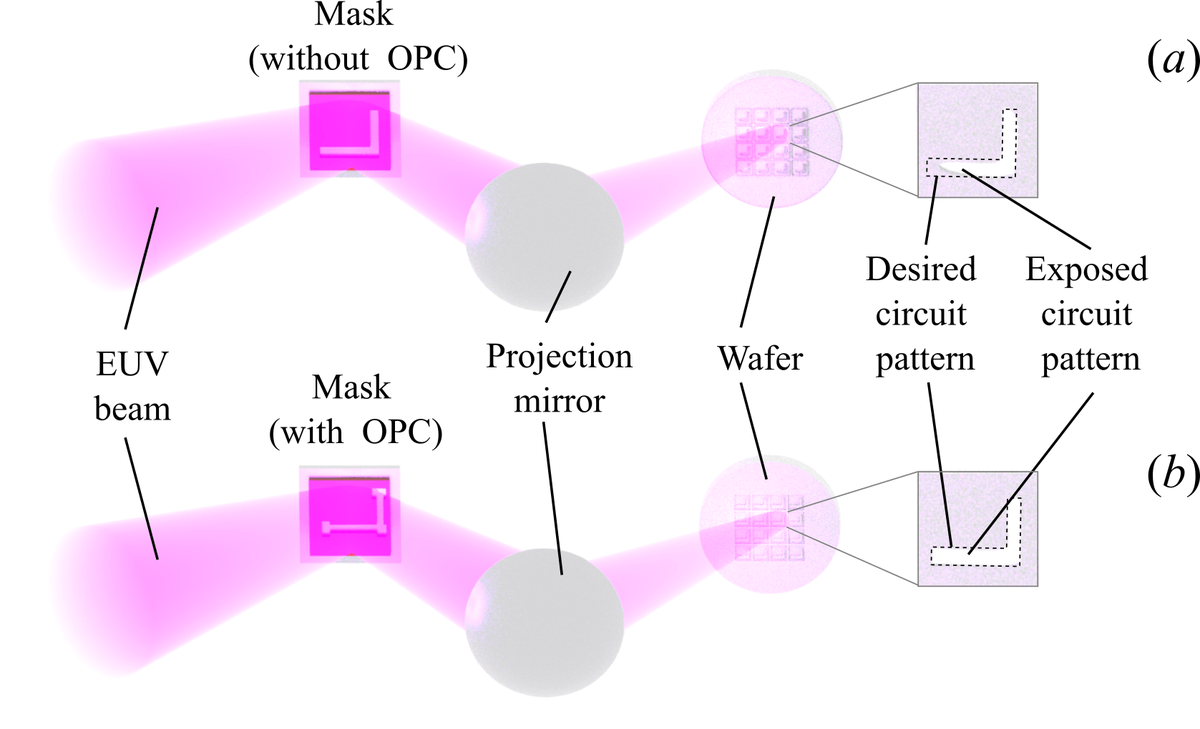
EUV lithography is the process that lets fabs keep shrinking transistors, using 13.5 nm light reflected off patterned masks onto silicon wafers. Modern integrated circuits require more than 80 different masks in their production, and because diffraction distorts the intended pattern, engineers rely on optical proximity correction (OPC) to reshape the mask so the wafer image comes out right. Every OPC iteration needs an electromagnetic field simulation of the mask, and these calculations require massive computational resources.
Existing accelerators like the M3D filter or domain decomposition method chop the mask into lower-dimensional patterns, but they ignore nonlocal EM interactions. Deep learning approaches using CNNs, GANs, and U-Nets have been tried, but these neural network approaches are based on supervised learning, require fairly extensive datasets, have a significant training time, and often do not demonstrate the necessary accuracy of the solution and the degree of its generalization.