
Westlake's Traj2Action Lets Cheap Human Video Train Robots 3.5x Faster
A new framework lets robots learn manipulation skills from cheap human hand videos, boosting a Franka arm's success rates by up to 27 percent.
 Pro
Takeaways
- Traj2Action transfers manipulation skills from human video to robots via 3D endpoint trajectories as a shared representation. Paper
- Built on the
π0VLA backbone with an added trajectory expert trained on human plus robot data. - Two experts denoise trajectory and action jointly via flow matching, with a hierarchical Task → Trajectory → Action attention mask.
- Boosts Franka performance by 27% on short-horizon and 22.25% on long-horizon tasks versus π0 baseline.
- Human capture is 3.5x faster than teleoperation and can substitute for robot data at lower cost.
- Failure mode: reaches target region reliably, but fine contact-level grasping still misses. OpenReview
Teaching robots to manipulate objects is bottlenecked by data. Teleoperated demonstrations, where a human puppets a robot arm through every skill you want it to learn, require expensive hardware, trained operators, and enormous amounts of time. Human video, by contrast, is everywhere. The catch is that a five-fingered hand and a two-finger gripper are so mechanically different that naively feeding human video into a robot policy tends to fail.
A team from Westlake University's MAPLE Lab and collaborators has published Traj2Action, a framework that sidesteps this embodiment mismatch by throwing away almost everything about the hand or gripper and keeping only one thing: the 3D path traced by the operational endpoint. A coarse trajectory plan then guides fine-grained actions through a co-denoising process, which the authors report outperforms prior methods on real-world robot tasks.
The morphological wall
Prior attempts to use human video have struggled in predictable ways. Pretraining on human data then fine-tuning on robot data creates a two-stage pipeline where the final policy is constrained by the mismatch. Joint training usually only works for humanoid or dexterous hands that structurally resemble a person. Directly aligning a human hand pose to a parallel gripper never quite makes physical sense, because the rotations mean different things on the two bodies.
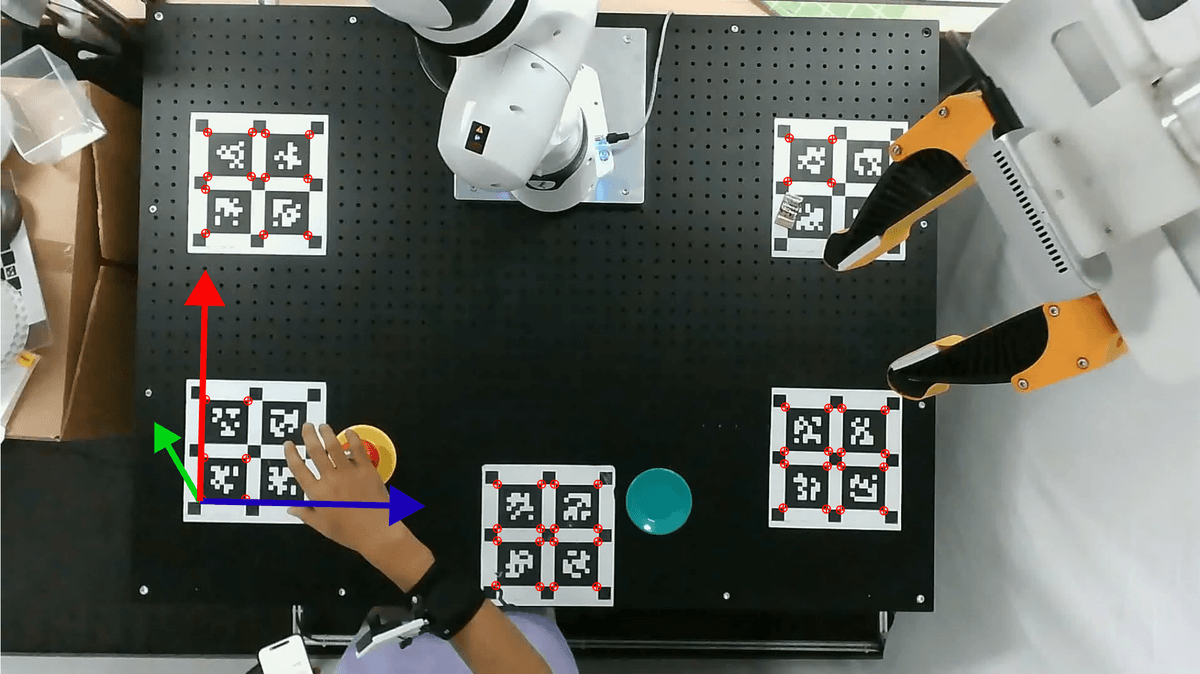
Traj2Action instead leverages 3D trajectories as a robust intermediate representation, following a coarse-to-fine action prediction paradigm where coarse trajectory planning derived from both human and robot demonstrations guides fine-grained robot action learning. Unifying human hand and robot end-effector positions in a single 3D trajectory representation shrinks the embodiment gap and lets abundant, cheap human data improve coarse trajectory planning. For a human, the trajectory is defined as the midpoint of the thumb and index finger. For the robot, it is the end-effector position. Everything else, finger articulation, gripper width, joint angles, is discarded at this level.