
Weizmann's Match-and-Fuse Edits 20 Photos Into One Consistent Story
A new zero-shot approach from Weizmann treats an image collection as a graph, letting text-to-image models edit whole photo sets while keeping shared objects visually consistent.
 Pro
Takeaways
- Match-and-Fuse is a zero-shot, training-free method from Weizmann for consistent editing of unstructured image sets, presented at CVPR 2026.
- It models the set as a graph where edges are two-image grid generations denoised jointly with feature fusion.
- Built on frozen FLUX with depth ControlNet and RoMA correspondences, no fine-tuning or masks required.
- Introduces DINO-MatchSim, a patch-level consistency metric that agrees with human raters 91.4 percent of the time.
- Scales to 20 images on an A100, beating FLUX Kontext, IC-LoRA and Edicho in 83-92 percent of 2AFC votes.
- Code, benchmark and Gradio demo available at github.com/kate-feingold/match-and-fuse.
Editing a single photo with a diffusion model is easy. Editing ten photos of the same dog so that it becomes the same LEGO dog in every shot, with matching fur pattern, ear angle, and eye color, is a very different problem. A new paper from the Weizmann Institute called Match-and-Fuse proposes a zero-shot, training-free way to do exactly that, and the authors have released code and data alongside the CVPR 2026 paper.
The method takes an unstructured set of images that share a common visual element, along with user prompts, and produces a new set that preserves cross-image consistency of shared content. Think product catalogs, real-estate listings, character concept sheets, or a storyboard sketched in ChatGPT that you want to turn into a coherent visual story.

The gap between one image and a video
Consistent generation is well studied for two extremes: single images, and densely sampled video frames. Image sets sit awkwardly in between. Unlike videos, which benefit from dense temporal sampling and continuity, image sets lack temporal cues such as continuous motion, making visual consistency difficult to enforce. The problem gets worse when subjects are deformable, like a person shifting pose between shots, because there is no stable 3D structure to anchor edits to.
Existing options each fall short in a specific way. Edicho addresses pairwise consistent editing by modifying one image and transferring the edit to a partner using 2D correspondences, but it remains strictly pairwise, causing coherence to degrade for views farther from the anchor. IC-LoRA enforces consistency by generating all images simultaneously on a single canvas with a fine-tuned LoRA module, but this design ties the method to a fixed grid, limiting scalability. 3D editing methods assume known camera parameters, and video editing methods assume temporal continuity that image sets simply do not have.
The trick hiding inside text-to-image models
The authors lean on an emergent behavior of large text-to-image models they call the grid prior. Although designed for single-image generation, these models produce coherent image grids when prompted with joint layouts like "Side-by-side views of...", establishing cross-image relationships within a single canvas.
The problem is that this trick breaks down quickly. The grid prior provides only partial consistency in appearance, shape, and semantics, deteriorates rapidly as more images are composed, and is bounded by the model's native resolution. Match-and-Fuse keeps the useful part of the grid prior and engineers away those limits.

Turning an image set into a graph
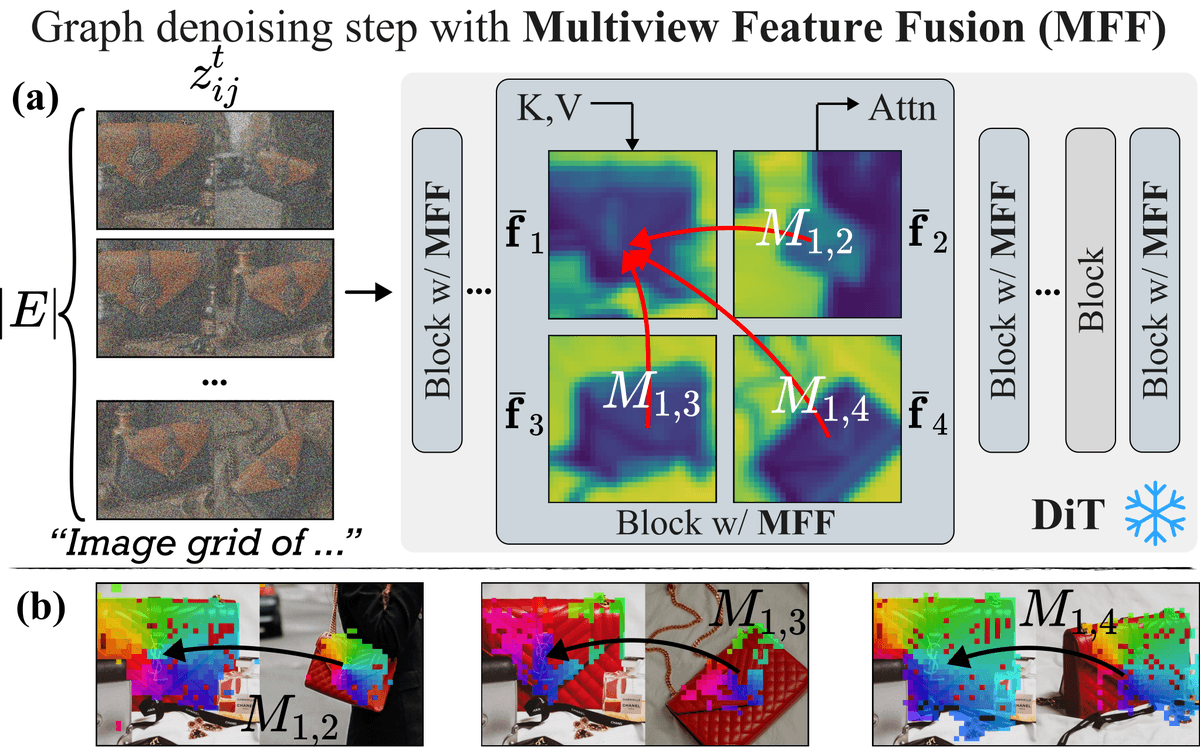
The core idea is to model the input set as a Pairwise Consistency Graph. Nodes represent images and edges connect all distinct image pairs; during generation each node is associated with a noisy latent, and each edge with a latent of a two-image grid formed by concatenating the two node latents. Instead of trying to squeeze N images onto one canvas, the method runs many two-image grid generations in parallel and stitches their information back together.
Here is roughly how a denoising step works:
- For every edge in the graph, form a two-image grid latent and denoise it with a frozen FLUX diffusion transformer conditioned on depth and edge maps.
- Inside selected transformer blocks, apply Multiview Feature Fusion that averages keys and values at matched pixel locations across all pairs the image participates in.
- Aggregate the multiple pairwise versions of each image latent back into a single per-image latent by averaging across adjacent edges.
- Run a light Feature Guidance step, using gradient descent on the latents to minimize the distance between matched features across pairs.
The correspondences themselves come from RoMA, used to extract source 2D matches filtered by a confidence threshold, and no object masks or manual annotation are needed. The authors note that Multiview Feature Fusion can be viewed as the analytical solution to the guidance optimization problem operating during inference, while guidance corrects remaining inconsistencies directly in latent space, which is a nice explanation for why the two stages complement each other rather than duplicating work.

Keeping the graph tractable
A fully connected graph over N images has O(N squared) edges, which would blow up runtime. The paper limits each node to at most four random neighbors. This yields full connectivity for N up to 5 and increasing sparsity thereafter, keeping runtime linear while preserving cross-image communication. On an A100 at 512x512 the system scales to up to 20 images with the full method, or 22 without Feature Guidance, and Feature Guidance can be dropped when latency matters more than fine details.
How it performs
Because no existing benchmark fits set-to-set generation, the authors built one. The evaluation set contains 400 edits over 149 distinct image sets of 3-15 images each, combining subject-driven benchmarks, frames sampled from 3D datasets, keyframes from public videos, and sketched storyboards generated by ChatGPT.
They also introduce DINO-MatchSim, a fine-grained consistency metric. Instead of measuring global similarity between output images, it computes patch-level nearest-neighbor correspondences in DINOv3 feature space on the source images, then measures cosine similarity at those same locations in the outputs. In an agreement study, DINO-MatchSim matched the users' majority vote 91.4 percent of the time, versus 84.3 for DreamSim and 84.9 for a VLM-based rater.
The head-to-head comparisons are lopsided. In 2AFC voting, human raters preferred Match-and-Fuse over FLUX 92 percent of the time, over IC-LoRA 90 percent, over FLUX Kontext 88 percent, and over Edicho 83 percent, with a GPT-5 judge tracking similar numbers. The method degrades gracefully with set size: it remains more consistent for 9 images than the baselines are for 2.
What it unlocks, and where it stumbles
Beyond straight consistent editing, the paper shows two extensions worth flagging:
- Storyboard visualization from sketches, turning hand-drawn or ChatGPT-generated frames into a coherent illustrated sequence.
- Localized editing by combining Match-and-Fuse with FlowEdit, which lets you edit only the shared object while keeping backgrounds untouched.
- Multi-cut video ads, where consistent keyframes are fed into an image-to-video model to produce a coherent commercial with multiple camera setups of the same product.
The limitations are honest. Performance depends on the quality and density of pixel correspondences, which can produce inconsistencies in largely unmatched or ambiguous regions such as disocclusions or symmetries. The method also inherits FLUX's occasional drift from the source depth conditioning, and extreme non-rigid deformation such as complex hand poses can trip it up. Extended attention as an alternative consistency mechanism was tested and found to produce artifacts in DiTs, which the paper documents in the appendix as guidance for future work.
Why this matters
The real breakthrough here is not another consistency trick, but framing set-to-set generation as a first-class task and showing you can solve it without fine-tuning, masks, or 3D supervision. Anyone who ships product catalogs, character sheets, or storyboards knows that current single-image editors force a manual reconciliation pass across every output. A graph-of-pairs formulation on top of a frozen diffusion transformer plus off-the-shelf correspondences turns out to be enough to close most of that gap, and the released implementation on GitHub means you can try it on your own image collections today.