
Weizenbaum Institute's FACET Uses Three AI Agents to Personalize Math Worksheets
A three-agent LLM pipeline builds math worksheets tuned to each student's knowledge and motivation, with an evaluator scoring quality automatically.
 Pro
Takeaways
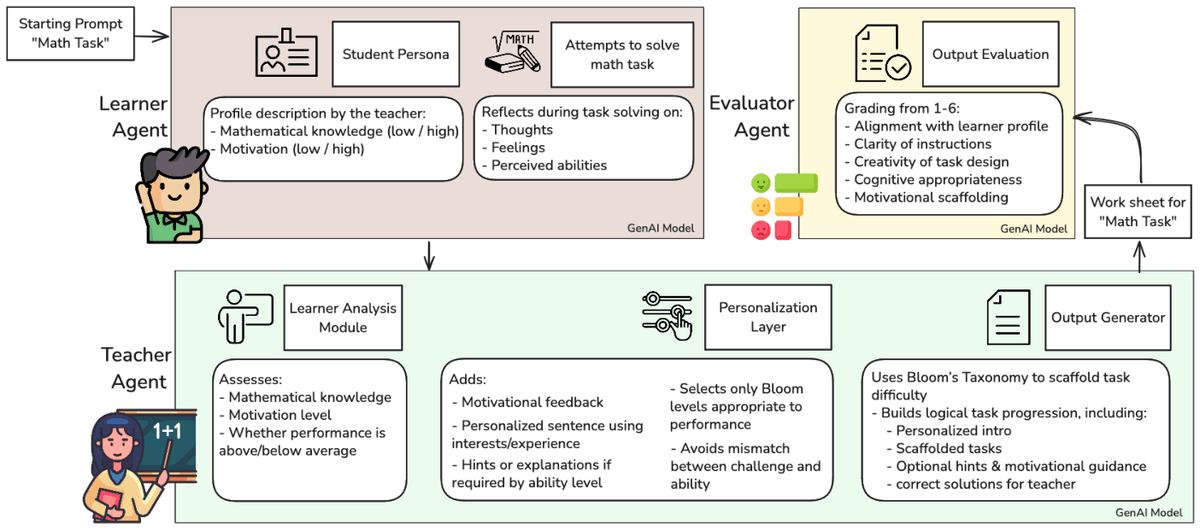
- FACET is a three-agent LLM system (learner, teacher, evaluator) that generates personalized math worksheets for teachers. Paper
- Learner agents simulate students along cognitive proficiency and intrinsic motivation from Self-Determination Theory.
- Teacher agent uses Bloom's taxonomy tiers to pick task difficulty and adds hints, scaffolds, and motivational comments.
- Uses GPT-4.1 for learner/teacher, GPT-4o for evaluator; supports 100+ models via LiteLLM.
- Across 10 iterations per profile, worksheets scored 5-6 on suitability and clarity with low variance.
- Teacher reviewers wanted more worked examples, narrative framing, and richer profiles beyond binary knowledge/motivation.
Building differentiated classroom materials that match how each student thinks, feels, and struggles is one of teaching's hardest chores. A team from the Weizenbaum Institute and Zuse Institute Berlin has proposed FACET, a multi-agent LLM system that automates the tedious drafting while leaving pedagogical control with the teacher. The framework pairs simulated learners with a teacher agent that writes worksheets and an evaluator agent that grades the result.
Across ten iterations per learner profile, the paper reports that generated grade-8 mathematics worksheets held up on structure, clarity, and fit to the target learner. Five in-service K-12 teachers rated the output favorably on the same dimensions.
Why average worksheets keep failing
In Germany, 58% of teachers report using LLMs to prepare teaching materials, and 65% cite significant benefits for personalizing learning experiences. Most existing tools remain narrow, adapting content based on quiz results or task completion metrics while neglecting motivational, emotional, and self-concept factors that shape learning outcomes. Mathematics is where this bites hardest: roughly 20% of girls and 10% of boys report anxiety in math instruction, with similar patterns for feelings of distress.
Audience is the other gap. Most current LLM systems offer no direct support for teachers, and existing teacher-facing tools tend to be static content repositories or basic customization features that require heavy manual work to tailor materials for individual students. FACET flips the audience: the teacher is the user, and the students are simulated.