
Wayne State's WalkGPT Spots Curbs and Hazards 25% More Accurately Than Rivals
A pixel-grounded vision-language model unifies segmentation, depth estimation, and dialogue to describe accessible paths and hazards from a single first-person image.
 Pro
Takeaways
- WalkGPT is a pixel-grounded LVLM producing dialogue, segmentation masks, and per-object depth from one pedestrian-view image.
- Two new modules: Multi-Scale Query Projector aggregates visual features across scales; Calibrated Text Projector aligns text to regions.
- Region Alignment Loss uses InfoNCE to keep 4096-dim LLM embeddings faithful when projected into 256-dim visual space.
- New PAVE benchmark: 41k pedestrian-view images with accessibility questions and depth-grounded answers built from SANPO.
- 13B model hits 20.16 mIoU and 48.95 depth accuracy, beating fine-tuned LISA, PixelLM, GLAMM, and Sa2VA baselines.
- Code and weights released on GitHub, accepted to CVPR 2026.
Most vision-language models can describe a sidewalk scene fluently, but ask them how far away the curb is or whether a wheelchair can get past that construction fence, and things fall apart. A team from Wayne State University, Henry Ford Health, and Ohio State has released WalkGPT, a grounded vision-language model that generates conversational navigation guidance for pedestrians, complete with segmentation masks over accessible and hazardous features and per-object distance estimates, from a single first-person photo.
Why pedestrian navigation breaks current LVLMs
Pedestrian routes often contain static and dynamic barriers such as stairs, uneven terrain, parked vehicles, and temporary obstructions, posing significant risks for individuals with mobility challenges, while most automated navigation systems are designed for vehicles. The gap is not just data, it is the type of reasoning required. Two failure modes hurt current LVLMs here:
- Object hallucination. Non-grounded models invent obstacles or miss real ones, which is dangerous in a navigation setting.
- Weak depth reasoning. Spatial-aware LVLMs like SpatialVLM or SpatialRGPT typically need user-provided anchor points or bounding boxes to estimate depth, which a pedestrian with a phone cannot supply on the move.
Grounded LVLMs such as LISA, GLAMM, and PixelLM improve spatial consistency by tying text to segmentation masks, but those masks are flat 2D, so the model still cannot tell you whether the pole is one meter or five meters ahead.
What WalkGPT actually outputs
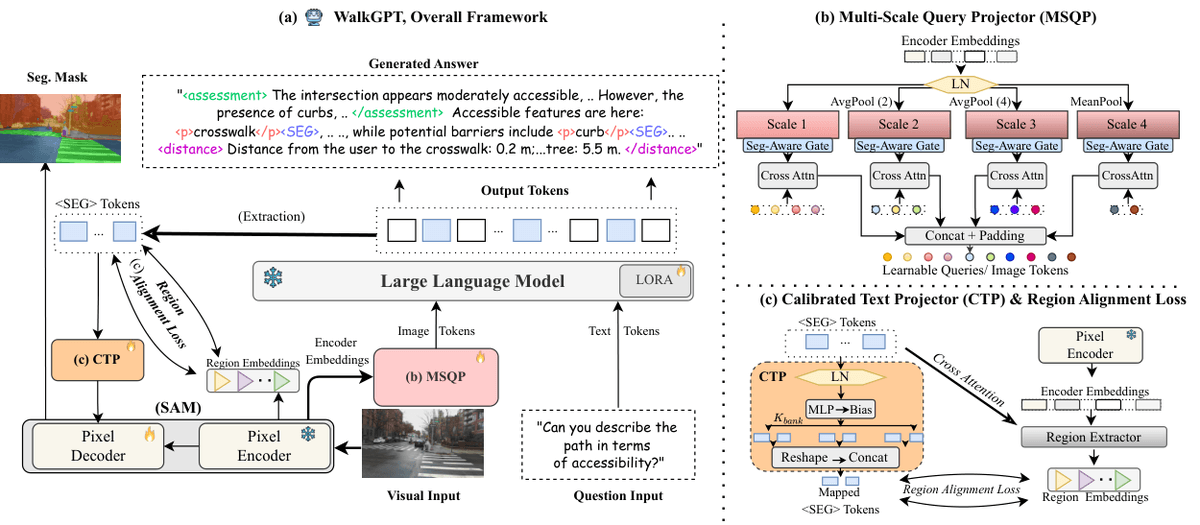
Given a pedestrian-view image and a natural-language query, WalkGPT generates a structured answer built around four special tokens: <assessment> for a qualitative walkability summary, <p> for phrase-level grounding of referenced objects, <SEG> for segmentation masks, and <distance> for per-object depth in meters. The <SEG> tokens are decoded by a SAM-based pixel decoder into masks aligned to the exact objects mentioned in the sentence.

Two new modules doing the heavy lifting
Architecturally, WalkGPT shares a single SAM ViT-H pixel encoder across both language generation and mask prediction, and adds two projectors that bridge the visual and language sides.
Multi-Scale Query Projector (MSQP). Instead of a standard MLP projector, MSQP pools encoder features at native, 2x, 4x, and global scales, then applies segmentation-aware gating and cross-attention with learnable query embeddings. The outputs from all scales are first concatenated and padded to a fixed length Q = 36 to ensure consistency across scales. The point is to preserve both fine boundary detail (needed for a curb) and global context (needed to judge overall walkability) in a compact token bundle handed to the LLM.
Calibrated Text Projector (CTP) with Region Alignment Loss. The <SEG> hidden states live in the 4096-dim LLM space but the pixel decoder expects 256 dims. A naive linear map loses too much. CTP expands each token into a small bank of calibrated sub-embeddings with learnable bias priors for objectness and boundary structure. To keep those embeddings semantically faithful, the authors add an InfoNCE-style Region Alignment Loss that pulls each projected <SEG> embedding toward the visual features of its true region and pushes it away from unrelated areas.
Where the depth actually comes from
There is no dedicated depth head. WalkGPT predicts distances as ordinary language tokens inside the <distance> span, supervised by minimum-depth values pulled from sensor depth maps during training. Because each object is already anchored to a <SEG> region earlier in the sequence, the autoregressive objective forces the model to associate the visual region with a numeric distance expression. Depth reasoning emerges from next-token prediction, no separate regression loss required, and the ablation shows removing the <distance> token collapses depth accuracy from 48.95 to 38.77 while barely touching segmentation.
PAVE: a 41k pedestrian-view benchmark
Because no dataset existed for this task, the team built one. PAVE is a large-scale benchmark of 41k pedestrian-view images paired with accessibility-aware questions and depth-grounded answers. It is derived from the real-image subset of the SANPO dataset (head-mounted stereo captures across San Francisco, Mountain View, Boulder, and New York) with panoptic masks converted into unified semantic maps and object-level minimum depth extracted per class. Questions and answers are generated by GPT-5-nano from structured scene metadata, then programmatically validated.

How it stacks up
The team compared 7B and 13B WalkGPT variants against grounded LVLM baselines (LISA, GLAMM, PixelLM, GSVA, OMG-LLaVA, Sa2VA) in both zero-shot and fine-tuned settings on PAVE.
| Model | CIDEr | mIoU | Depth Acc. | AbsRel |
|---|---|---|---|---|
| PixelLM-FT | 37.49 | 18.10 | 39.00 | 74.61 |
| Sa2VA-FT | 38.82 | 16.10 | 40.54 | 73.82 |
| OMG-LLaVA-FT | 38.01 | 18.02 | 39.02 | 75.01 |
| WalkGPT (7B) | 41.97 | 19.95 | 41.97 | 67.88 |
| WalkGPT (13B) | 41.17 | 20.16 | 48.95 | 70.66 |
Zero-shot baselines fail almost completely and cannot produce depth values even when given the <distance> token. WalkGPT-13B lifts depth accuracy roughly 25% over the best fine-tuned competitor and cuts hallucination rate (CHAIR_i) to 18.49 versus 22.16 for LLaVA-1.5 and 26.78 for Qwen-VL-Chat, while covering 83.66% of visible objects. On classic referring expression segmentation (RefCOCO/+/g) it still beats LISA and PixelLM by 3-4 points despite not being trained for that task, suggesting the grounding improvements generalize.
What it is good and bad at
WalkGPT is genuinely useful when you need a single model to produce interpretable, spatially grounded scene descriptions for assistive navigation, wheelchair routing, sidewalk audit tools, or robotics stacks that want language plus masks plus rough distances from one forward pass. The failure cases the authors highlight are also instructive: strong reflections on building facades get segmented as real obstacles, and transparent fences get read as open pathways. Motion blur, reflective surfaces, and severe class imbalance in dense urban scenes all remain challenging, and even specialized vision-only models like Swin-UNETR only reach around 20% mIoU on PAVE.
Getting your hands on it
The code is on GitHub and the PAVE dataset is on Hugging Face. The model uses SAM ViT-H plus a LoRA-tuned LLM (7B or 13B), trains for 10 epochs on the 8.5k-frame SANPO training split in about 6 hours on 8 GPUs, and runs inference at roughly 1k queries per hour. For anyone building accessibility tools or spatial reasoning agents, it is a compact recipe for coupling language, segmentation, and depth without needing anchor points from the user.