
Waterloo's Robot Swarm Controller Handles Coverage, Safety, and Battery at Once
A control framework couples the Fokker-Planck PDE with barrier functions so multi-robot fleets can chase coverage targets, dodge no-go zones, and never run out of juice.
Takeaways
- PDE-based multi-robot controller enforces coverage, safety, and energy sufficiency in one quadratic program.
- Fokker-Planck equation encodes localization and motion noise directly at the density level.
- Kinodynamic RRT computes safety-compliant paths to chargers, replacing straight-line energy estimates.
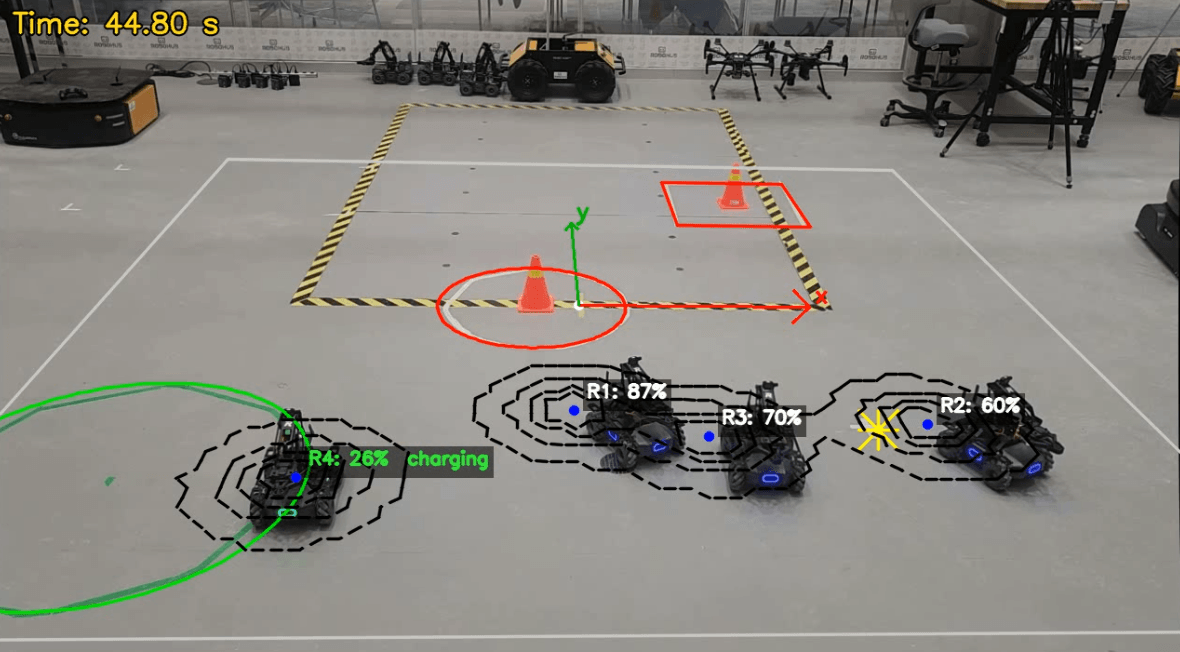
- Validated on four DJI RoboMaster EP robots with 65 millisecond control loops on an i7-1260P.
- 100 simulations with 10 robots showed zero safety or energy violations across all noise realizations.
- Code available at erablab GitHub; hardware demo video online.
Coordinating a swarm of robots that has to cover a service area, stay clear of hazards, and return to a charger before dying is one of those problems where every academic solution seems to handle two out of three constraints. A team from the University of Waterloo has proposed a controller that tackles all three at once, and does so at the density level rather than tracking each robot as an individual agent. Their paper, accepted to IEEE ITSC 2026, formulates multi-robot coordination as a partial differential equation (PDE) constrained optimization that runs in real time on commodity hardware.
Model the whole fleet as a probability density, evolve that density with physics, and shape it with three constraints that guarantee coverage, safety, and battery sufficiency. The whole thing collapses into a quadratic program small enough to solve in the control loop.
Why density-level control matters
Most safety-critical multi-robot controllers live in the ordinary differential equation (ODE) world, tracking each robot's state and imposing constraints on individual trajectories. That works until sensor and actuator noise starts nudging robots across supposedly safe boundaries, at which point ODE-level controllers begin producing unintentional safety violations.
The Waterloo team skips individual tracking and instead describes where robots probably are as a distribution. The Fokker-Planck equation, a PDE that governs how probability densities evolve over time under drift and diffusion, naturally incorporates both localization and motion noise at the density level. Each robot contributes a Gaussian belief kernel around its measured position, the team density is the sum, and control inputs shape how that density evolves.