
Waterloo's EvolveCoder Builds Smarter Tests That Make AI Code Better
A new adversarial test evolution pipeline builds harder verification signals for code RL, lifting Qwen3-4B by 4.2 points across four benchmarks.
 Pro
Takeaways
- EvolveCoder proposes adversarial, solution-conditioned test case evolution for code RL, replacing static verification suites.
- Iterative refinement drops pass@1 from 43.80 to 31.22, confirming tests get meaningfully harder each round.
- Training Qwen3-4B on EvolveCoder-22K gains 4.2 points average across four coding benchmarks.
- Two generators target strong solutions adversarially and split behaviorally identical solutions discriminatively.
- Round 3 model hits 49.0 average, beating Critique-Coder-4B and matching DeepSeek-V2.5-238B on several tasks.
- Code and dataset available at the TIGER-AI-Lab GitHub repo, Python-only for now.
Reinforcement learning with verifiable rewards, or RLVR, has quietly become the workhorse behind the current generation of coding LLMs. The recipe is simple: let the model write code, run the code against unit tests, and reward the model when the tests pass. But there is a catch that most public datasets ignore. If the tests are weak, the reward signal is weak, and the model learns to game shallow checks instead of actually reasoning about the program.
A team from the University of Waterloo, Vector Institute, and Harvard is attacking that bottleneck head-on with EvolveCoder, an adversarial test-case evolution pipeline and a companion 22K-problem RL dataset. The core claim is that iterative refinement substantially strengthens verification, with pass@1 decreasing from 43.80 to 31.22, and that training on the resulting harder tests yields consistent downstream gains.
Why static test suites break RL for code
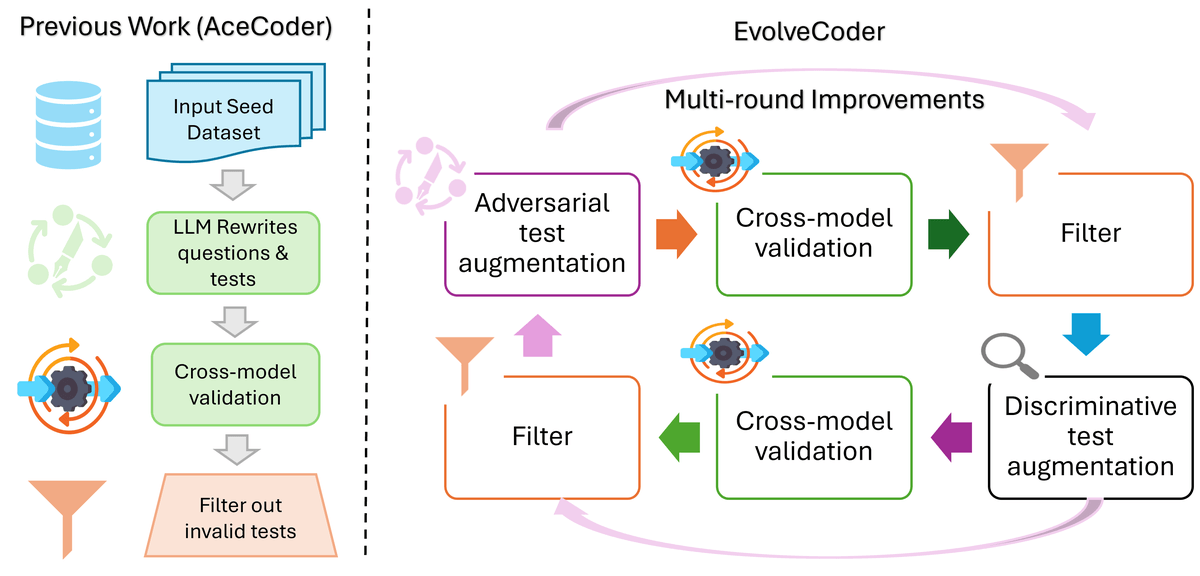
The authors group existing coding RL datasets into three failure modes. Human-annotated datasets like TACO, APPS, and CodeContests frequently fail to expose critical corner cases, resulting in weakly discriminative and incomplete reward signals. Automated augmentation approaches such as HardTest and rStarCoder generate additional inputs by executing reference solutions, but often lack principled filtering, leading to high verification cost and limited scalability. Single-pass pipelines like AceCoder produce tests without explicitly targeting model failure modes, so corner cases show up by luck rather than by design.
There is a second, subtler problem. RLVR suffers from vanishing advantage issues due to imbalanced task difficulty: when problems are either too easy or too difficult, policy models fail to generate solutions that meaningfully differ in reward outcomes, leading to weak or indistinguishable learning signals. As training proceeds, the model saturates on easy items and the gradient dries up.
Testing that fights back
EvolveCoder's insight is that test cases should be conditioned on the actual execution behavior of candidate solutions, not just on the problem statement. The pipeline runs a large pool of candidate programs, watches where they agree and disagree, and then generates tests that target those specific weaknesses.
To make sure the failure patterns are varied, the team samples generously from a zoo of open models. They use 8 independently trained open-source reasoning models, including the Qwen3 family (4B, 8B, 14B, 30B-A3B, and 32B), MiMo-7B-RL, Phi-4-Reasoning, and DeepSeek-R1-Distill-Qwen-32B. For each problem, each model generates 8 solutions, yielding a total of 64 candidates.
Every solution is run against every test, producing a binary pass matrix. Two complementary generators then operate on this matrix:
- Adversarial generator. It selects the two highest-pass-rate solutions together with three solutions exhibiting maximal pairwise disagreement in pass-fail patterns, measured by Hamming distance. New assert-based tests are synthesized to break the strong solutions and expose uncovered corner cases.
- Discriminative generator. It picks five solutions that look nearly identical under the current suite and writes tests under a split constraint: each test must be passed by at least one solution and failed by at least one solution. This directly attacks the vanishing-advantage problem by manufacturing tests where the RL reward will actually differ across rollouts.
A final filtering pass drops tests that almost nothing passes (likely buggy), collapses tests with identical pass vectors, and removes problems that are trivially solved. The result is not just more tests but sharper ones.
The dataset, round by round
Starting from a de-duplicated pool aggregated from TACO, APPS, PrimeIntellect's Synthetic-1, Codeforces, and CodeContests, the pipeline runs three rounds of evolution. The dataset expands from 18,803 problems in Round 0 to 21,642 problems in Round 3, while the average number of test cases per problem increases from 10.76 to 35.04. Difficulty climbs in lockstep: Pass@1, Pass@4, and Pass@8 decrease monotonically from Round 0 to Round 3, indicating that progressively refined test suites reject a larger fraction of partially correct solutions.
Does it actually train better models?
The authors fine-tune Qwen3-4B (Thinking) using GRPO on each round's data and evaluate on EvalPlus, BigCodeBench-Instruct, Aider-Polyglot, and LiveCodeBench v5. By Round 3, the model achieves the best overall results, reaching an average score of 49.0, representing a +2.4 improvement over the Round 0 model. Against external baselines, the final model consistently outperforms Qwen3-4B (Thinking) and Critique-Coder-4B across all evaluation metrics, and remains competitive even compared with substantially larger models such as DeepSeek-V2.5-238B.
The round-by-round numbers matter more than the headline average, because they isolate the effect of test quality with everything else held constant:
| Round | EvalPlus | BCB-Full | Aider-Polyglot | LCB-v5 | Avg |
|---|---|---|---|---|---|
| r0 | 88.3 | 41.2 | 24.4 | 56.0 | 46.6 |
| r1 | 88.8 | 42.4 | 24.4 | 57.2 | 47.2 |
| r2 | 88.8 | 42.8 | 27.1 | 59.6 | 48.5 |
| r3 | 89.0 | 43.4 | 27.4 | 59.7 | 49.0 |
What is actually new here
The real contribution is not the dataset size, it is the feedback loop. Prior work generates tests once from problem statements or reference solutions. EvolveCoder treats the candidate solution pool as a source of signal, letting the failures of today's models dictate the tests of tomorrow. The discriminative generator in particular is a direct answer to the vanishing-advantage problem: it manufactures tests where the reward signal is guaranteed to split rollouts, which is exactly what GRPO and PPO need to keep learning.
Caveats worth knowing
- Python only. The dataset construction and evaluation are limited to Python programs, motivated by the availability of mature execution tooling and sandboxing infrastructure. Extending to other languages requires new execution environments.
- No correctness guarantee. The pipeline does not provide a formal guarantee of the correctness of generated problems and test cases; while methods are employed to remove invalid tests, these procedures are empirical in nature. A small fraction of instances may still have specification ambiguities.
- Compute-heavy. Running 64 solutions per problem across eight models, three times over, is not cheap. Teams without that inference budget will find the released dataset more useful than the pipeline.
The code and dataset are open on the TIGER-AI-Lab GitHub repository, which makes EvolveCoder-22K a drop-in upgrade for anyone currently training on TACO, APPS, or AceCoder-style data. If your RL runs are plateauing because reward differences between rollouts are vanishing, this is the kind of dataset change worth trying before reaching for a bigger model.