
Waterloo's Critique-Coder 8B Beats OpenAI o1 by Teaching AI to Judge Wrong Answers
A new RL twist trains coding models to judge solutions, not just write them, boosting LiveCodeBench scores past GPT-o1 at 8B parameters.
 Pro
Takeaways
- Critique Reinforcement Learning rewards a model for correctly judging whether a given solution passes, not for writing it.
- Best recipe swaps 20% of standard RLVR data for critique data during GRPO training.
- Critique-Coder-8B hits 60.8 on LiveCodeBench v5, beating DeepCoder-14B and GPT-o1.
- Critique training on code transfers to logic: +6.1 average on BIG-Bench Extra Hard reasoning.
- 100% critique data underperforms the baseline; the model forgets how to answer.
- Code and dataset released at TIGER-AI-Lab/Critique-Coder and Hugging Face.
Standard reinforcement learning with verifiable rewards has become the default recipe for training reasoning models, but it has a blind spot: it only rewards the model for producing correct answers, never for spotting when an answer is wrong. A team from the University of Waterloo and the Vector Institute is proposing a fix called Critique Reinforcement Learning (CRL), and their Critique-Coder models suggest it is more than a marginal tweak. An 8B version reaches over 60% on LiveCodeBench v5, outperforming DeepCoder-14B and OpenAI's o1.
The reflection gap in RLVR
Standard reinforcement learning with verifiable reward (RLVR) has shown strong capabilities in improving models' problem-solving abilities, but this paradigm can hardly elicit the internal critique or reflection behavior on existing solutions. The model learns to emit a working answer, not to interrogate a broken one. Prior work like Critique Fine-Tuning (CFT) tried to close this gap by supervising models on teacher-written critique traces, but that turns critique into imitation.
CRL takes a different angle. The model is prompted with a question-solution pair to predict a binarized judgment label c in {True, False}, which is compared with the annotated label to derive a binary verifiable reward. This is in contrast to the standard RLVR algorithm, which incentivizes the model to predict a correct solution s to a given query q. In short: instead of asking the model to solve the problem, you show it someone else's attempt and reward it only if its final True/False verdict matches the ground truth.

Mixing critique into the RL loop
The training recipe is a hybrid. Concretely, we randomly assign 20% of the data from the dataset to be CRL data, with the remaining 80% consisting of standard RL data. Both streams feed into GRPO, the same group-relative policy optimization algorithm that DeepSeek popularized. For RL samples, reward is the fraction of test cases passed. For CRL samples, the model writes its verdict inside a \conclusion{} tag, and gets 1 if the label matches, 0 otherwise.
The critique data itself is generated in a deliberately non-teacher-forcing way. For each problem, the authors prompt Qwen3-Coder-30B-A3B-Instruct to generate outputs, from which they extract code blocks as candidate solutions. Despite its larger parameter scale, Qwen3-Coder-30B-A3B-Instruct lacks explicit reasoning capabilities, and its effective problem-solving performance is not stronger than that of smaller reasoning-enabled models such as Qwen3-4B (Thinking). Each candidate is executed against test cases, and candidate solutions are labeled as True if their test pass rate exceeds 80%, and as False otherwise. Because the labeler is not stronger than the student, this is not distillation, it is genuine reinforcement signal.
Training runs on a filtered version of the rStar-Coder seed dataset. The team pruned it aggressively: the average input characters decrease from 96,208 to 40, and the average number of cases drops from 87 to 24. They then use a two-phase context lengthening schedule, starting at 16k tokens and expanding to 32k once rewards stabilize.
The numbers
The gains are consistent across model sizes and benchmarks. Starting from Qwen3-4B, Critique-Coder achieves 59.0 accuracy on LiveCodeBench (v5), yielding +4.8 points over the base model and +2.4 points over the RL-only variant. The 8B version pushes further:
- LiveCodeBench v5: 60.8, beating DeepCoder-14B (60.6) and GPT-o1 (59.5)
- Aider-Polyglot: 35.6, a +7.2 jump over the Qwen3-8B baseline despite training only on Python
- BigCodeBench-Hard: 27.0, matching DeepSeek-V2.5-238B
- EvalPlus average: 87.7
More interesting is what happens off-distribution. On BIG-Bench Extra Hard, a logic reasoning suite, Critique-Coder consistently outperforms both the baseline Qwen3-4B and its RL-trained variant across all four reasoning subtasks, achieving an average improvement of +6.1 points over the base model. Time Arithmetic and Zebra Puzzles saw the biggest jumps (+8.0 and +7.5). Training on code critiques appears to transfer general reflective reasoning.
What the ablations tell you
The 20% mix ratio is not arbitrary. The authors ran the obvious sweep, and the shape is instructive:
| CRL data ratio | LiveCodeBench v5 | Average |
|---|---|---|
| 0% (RL only) | 56.6 | 45.7 |
| 20% (Critique-Coder) | 59.0 | 47.2 |
| 50% | 56.0 | 46.2 |
| 100% (CRL only) | 56.6 | 44.5 |
When RL data are completely replaced by CRL data, performance drops significantly across multiple benchmarks, resulting in an average score (44.5) lower than the baseline. Train a model exclusively to judge, and it forgets how to answer. CRL is a seasoning, not a main course.
Where it breaks
There is one clean negative result worth flagging. The team tried the obvious application: use Critique-Coder to score its own candidate solutions at inference for a best-of-N boost. It failed. On LiveCodeBench v5, Critique-Coder-4B was prompted to generate 10 candidate solutions per problem. Each solution, together with the original question, was then fed back into the model for critique, with 64 critique samples generated per solution, and the pipeline yielded no gains.
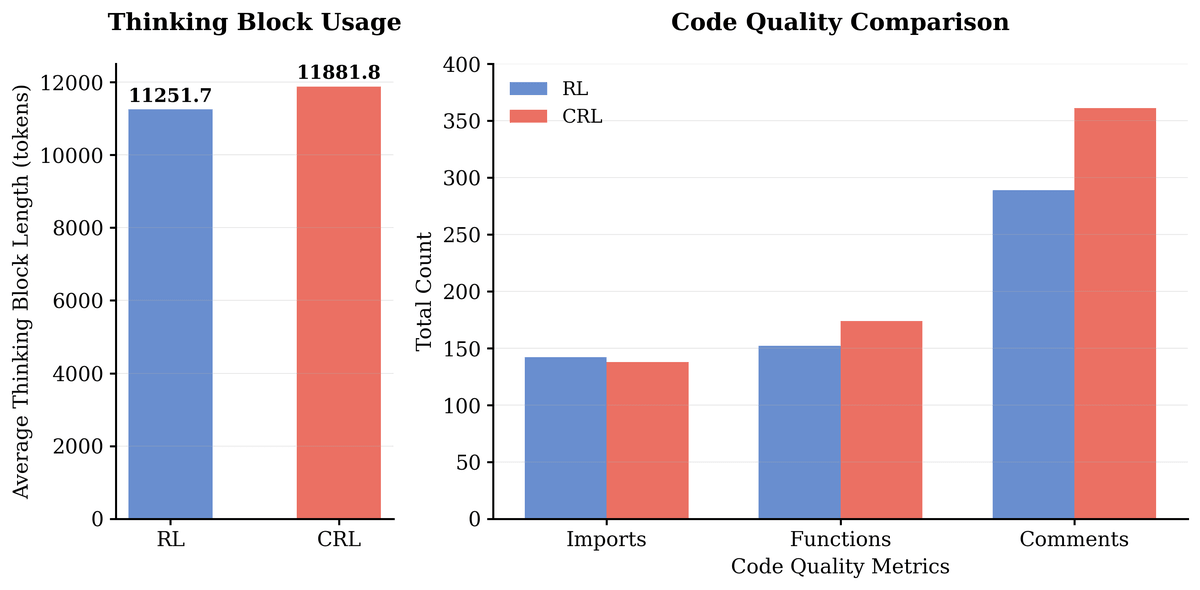
Their diagnosis is that CRL improves performance by internalizing critique-based judgment during training, enabling more thorough reasoning and refinement before the final answer is produced. Once the intermediate reasoning trajectory is gone, the model cannot reliably grade a finished answer any better than any other LLM can. Sequential test-time scaling (letting the model think longer) does work, pushing the 4B model from 59.0 to 62.0 on LiveCodeBench.
Getting the code
Both the training pipeline and the filtered critique dataset are open. The code lives on the TIGER-AI-Lab GitHub, built on top of the verl RL framework, and the rStar-Critique-Data is on Hugging Face. If you are already running GRPO on a coder model, swapping in a CRL slice is a small change to your data loader and reward function, which makes this one of the cheaper reasoning tricks to try in practice.