
Warsaw University's LumiMotion Separates Shadows From Materials With 23% Better Accuracy
A new two-stage Gaussian Splatting pipeline turns object motion into a supervisory signal, cutting albedo LPIPS by 23% under harsh lighting.
 Pro
Takeaways
- LumiMotion is the first Gaussian Splatting method that uses scene motion to disentangle lighting from materials in arbitrary scenes
- Achieves 23% better LPIPS on albedo and 15% better on relighting versus IRGS, GI-GS, and R-3DGS baselines
- Two-stage pipeline: dynamic 2D Gaussian geometry with static-dynamic separation, then physically based inverse rendering with ray tracing
- Introduces a synthetic benchmark of 5 scenes under 4 lighting conditions, in both static and dynamic variants
- Code, data, and paper available at github.com/joaxkal/LumiMotion, accepted as CVPR 2026 Highlight
- Limitations: struggles with intricate contact-surface dynamics and needs accurate camera poses; roughly 1.2 hours training per scene on an RTX 3090
Inverse rendering, the task of pulling apart geometry, materials, and lighting from a set of photos, has always been the awkward cousin of novel view synthesis. Gaussian Splatting can reconstruct a scene beautifully, but the color it stores is whatever the camera happened to see, shadows and all. Relighting the reconstruction is therefore out of reach, which is exactly what film, gaming, and AR pipelines need.
LumiMotion, a CVPR 2026 Highlight from Warsaw University of Technology, Microsoft, and collaborators, proposes a simple fix: stop training on static scenes. When something in the scene moves, the same surface passes through different lighting conditions, and that variation gives the optimizer the extra signal it needs to separate a dark material from a shadow.
Why static scenes break inverse rendering
Existing Gaussian-based relighting methods like IRGS, GI-GS, and Relightable 3D Gaussians all assume a static world. Without motion, it is hard to tell the intrinsic color of an object apart from the color observed under a particular incident light. Looking at a still image, you cannot easily determine whether a patch is darker because a shadow falls on it or because the material itself is dark.
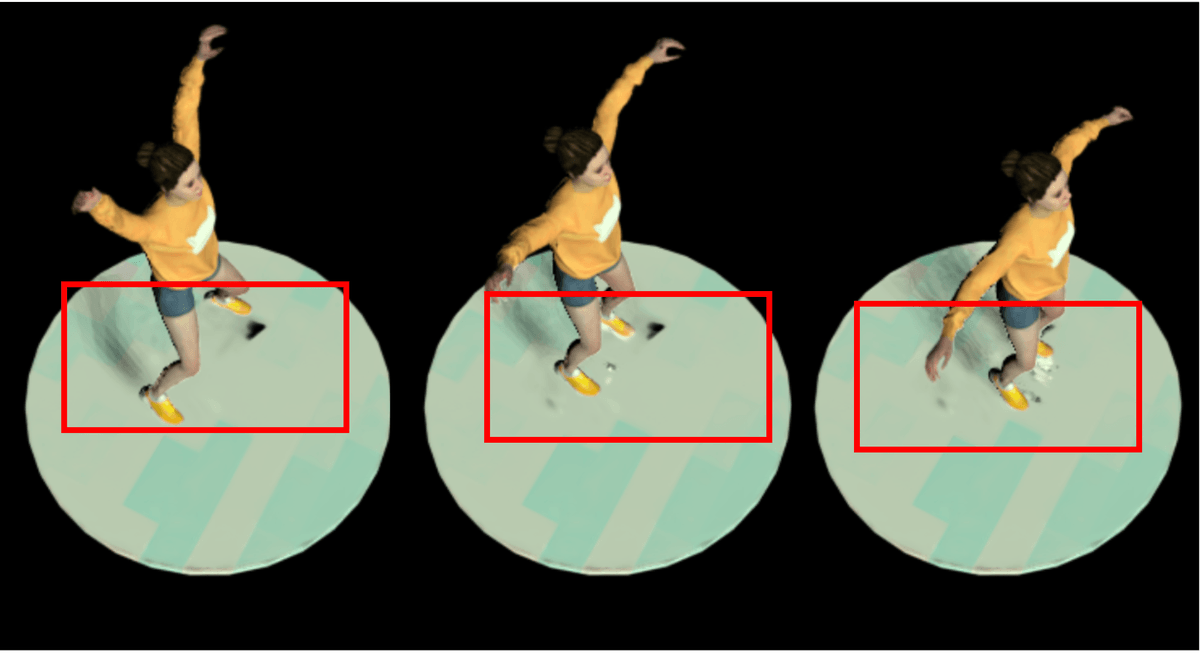
The consequence: shadows get baked into the estimated albedo. Relight the scene under a new environment map and those baked shadows follow you around, sitting on surfaces where no shadow should be. Prior work that does handle dynamic content, such as relightable codec avatars, works only for humans and typically needs known lighting or a controlled capture rig.