
Warsaw Researchers Prove One Pixel Error Grows Quadratically With Distance
New analytical work shows manual camera calibration errors don't just add up, they compound quadratically with distance, and simple fixes recover most of the accuracy.
 Pro
Takeaways
- New closed-form result: manual homography calibration errors produce distance errors that grow quadratically with range.
- Two correction methods evaluated, both needing only three ground-truth calibration points to run.
- Regression achieves 90% median improvement but has a heavy failure tail down to -135% in worst cases.
- Gradient descent on trapezoid vertices gives positive results in 98.8% of cases, worst 1st percentile at -3.8%.
- Massive evaluation: 19 million samples across 1,000 perturbed trapezoids in two Unreal Engine 5.4 scenes.
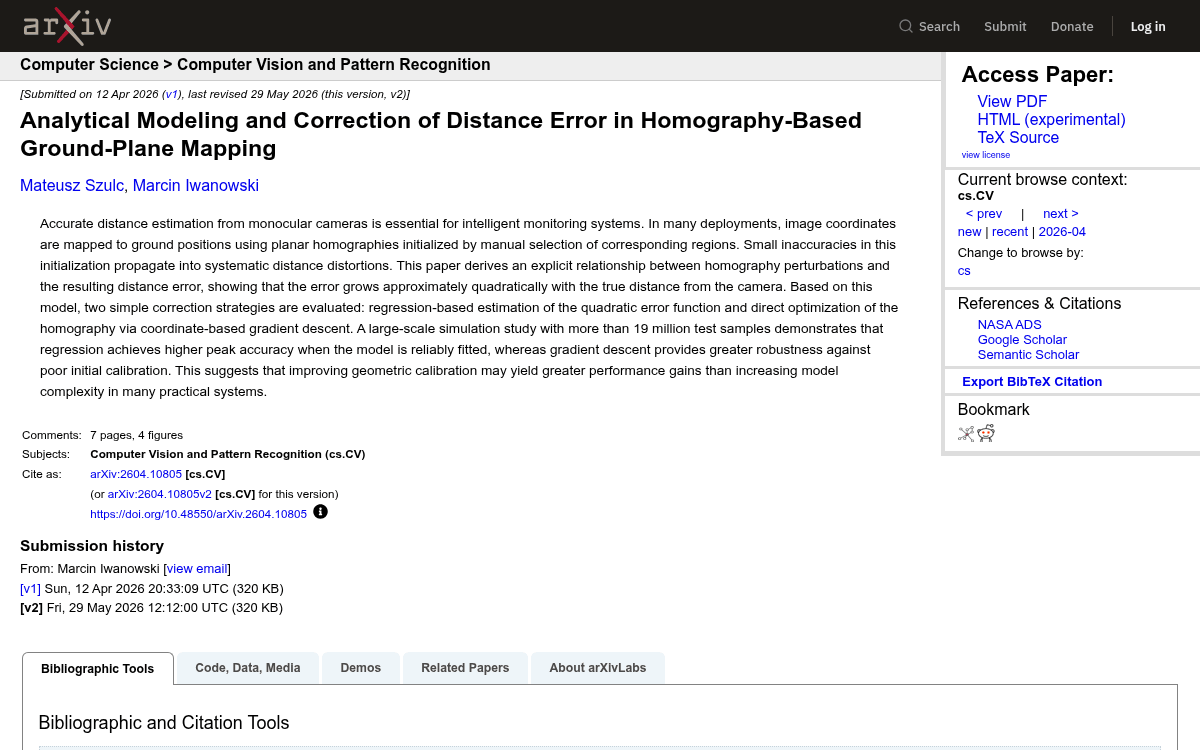
- Full paper on arXiv argues geometric calibration matters more than detector complexity.
If you have ever set up a monocular camera to measure real world distances by dragging a trapezoid onto a road surface, this paper explains why your far-field measurements go so badly wrong. Researchers at Warsaw University of Technology derived a closed-form relationship between manual homography setup errors and the resulting distance estimate error, and the result is uncomfortably simple: a one pixel slip in your calibration produces a distortion that grows quadratically with distance.
That single formula reframes a lot of practical monitoring work. Detection models get most of the blame when a traffic-analytics or surveillance system reports the wrong distance, but the paper argues the dominant error is geometric rather than algorithmic, and it lives inside the homography itself.
Where the error actually comes from
Many deployed systems use monocular cameras to map object positions from image coordinates to real-world distances on the road plane using planar homographies, valued for their low cost and ease of installation. The typical workflow is to click four points that form a trapezoid on the road and map them to a rectangle on a site map. Even small pixel-level errors cause substantial distortions at range, but until now that amplification has mostly been captured through general uncertainty propagation rather than as an explicit range-dependent law.

The derivation collapses the perspective mapping to a one-dimensional relationship