
Warsaw Researchers Fix the Blind Spot Quietly Breaking NLP Text Analysis
A new PCA sweep procedure removes an arbitrary knob from Supervised Semantic Differential, yielding stable, interpretable semantic gradients tied to psychological traits.
 Pro
Takeaways
- New PCA sweep procedure removes analyst discretion when choosing dimensionality in Supervised Semantic Differential pipelines.
- Sweep jointly scores interpretability, stability, and representation capacity across a range of K values.
- Case study on 349 AI-related posts found a clean Admiration gradient at K=15, none for Rivalry.
- Positive Admiration pole framed AI as collaborative and empowering; negative pole as deceptive and ridiculous.
- Counterfactual at K=120 gave higher R² but produced diffuse, semantically incoherent clusters.
- Code and desktop SSD app available on the first author's GitHub.
A team from IDEAS Research Institute, VIZJA University, Warsaw University of Technology, and the University of Warsaw has tightened up one of the fiddliest steps in Supervised Semantic Differential (SSD), a method that maps how the meaning of a concept in text shifts with a continuous outcome such as a personality score. Their contribution is a principled way to pick the number of PCA components used inside the pipeline, closing a small but consequential source of analyst discretion.
The knob nobody knew how to turn
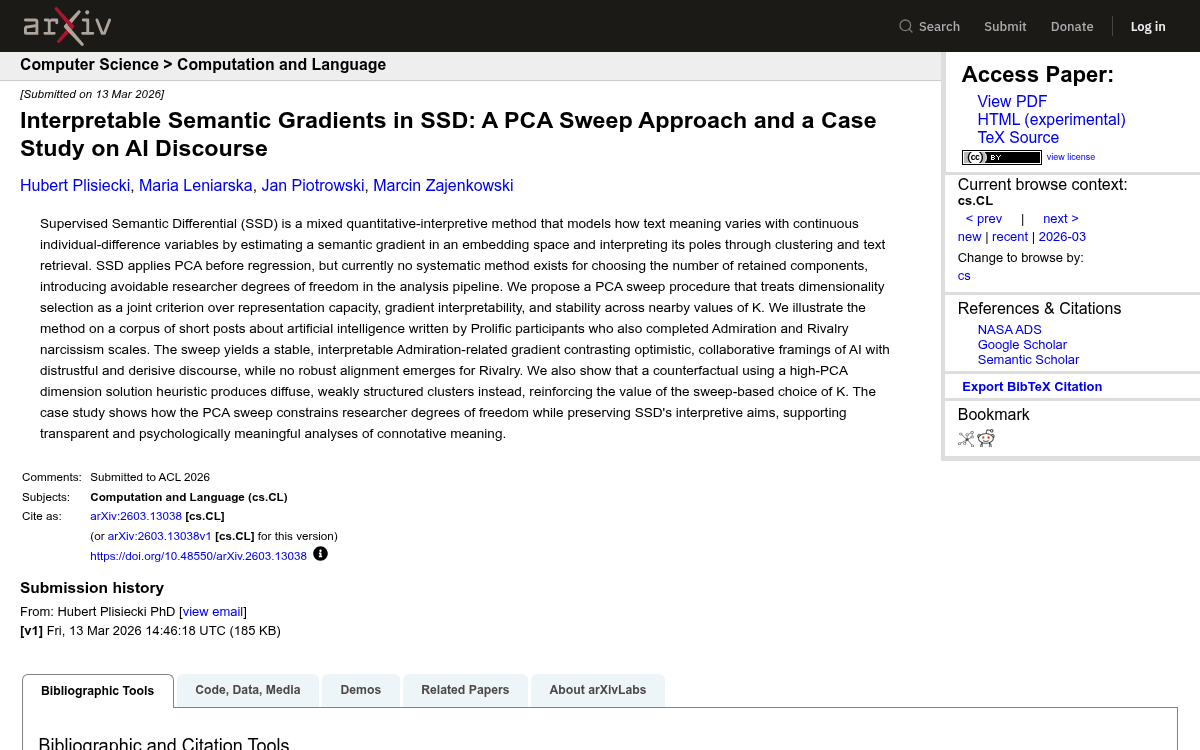
SSD is a mixed quantitative-interpretive method that models how text meaning varies with continuous individual-difference variables by estimating a semantic gradient in an embedding space and interpreting its poles through clustering and text retrieval. In practice, you embed each participant's writing, compress with PCA, fit a linear regression against a trait score, then read out the coefficient vector as a direction in embedding space whose two poles you interpret via nearest-neighbor clustering.
The catch: SSD applies PCA before regression, but currently no systematic method exists for choosing the number of retained components, introducing avoidable researcher degrees of freedom in the analysis pipeline. That flexibility is the kind of thing that quietly powers false-positive results in social science. Too few components and you collapse real semantic distinctions; too many and the gradient starts chasing lexical noise.
A sweep instead of a guess
The proposed fix runs SSD across a whole range of K values and scores each one on three axes: representation capacity, gradient interpretability, and stability across neighboring Ks. The PCA sweep procedure treats dimensionality selection as a joint criterion over representation capacity, gradient interpretability, and stability across nearby values of K.
Concretely, for each candidate K the sweep computes:
- Cumulative variance explained by the first K principal components, used only to detrend the other metrics (since it grows mechanically with K).
- Interpretability score: a size-weighted aggregate of cluster coherence and the cosine alignment between each cluster centroid and the back-projected gradient, then detrended against log variance explained and z-scored.
- Gradient change: 1 minus the cosine similarity between consecutive normalized gradients at K and K-1. Low values mean the direction has converged.
Both curves are smoothed with a local neighborhood average (called AUCK) so the procedure rewards broad plateaus rather than lucky spikes. The selection rule picks the smallest K that maximizes the average of the smoothed interpretability and stability scores, biasing toward parsimony.
What the case study found
To demonstrate, the authors ran SSD on 349 short posts about AI written by Prolific participants who also filled out the Narcissistic Admiration and Rivalry Questionnaire. Admiration measures assertive, status-seeking self-enhancement; Rivalry measures defensive antagonism. Posts were embedded with the 300-dimensional Dolma GloVe model using SIF weighting, and the sweep evaluated K from 1 to 119 in steps of 2.

For Admiration the sweep settled on K=15, where the model explained about 19% of adjusted variance (F=6.32, p<10⁻¹⁰). The positive pole of the gradient clustered around innovation, partnership, and empowerment language, framing AI as a collaborative and prosocial force. The negative pole grouped words like misleading, dishonest, ridiculous, and absurd, portraying AI and its creators as deceptive or ideologically driven. Rivalry, in contrast, produced no significant model (adjusted R²=.03, p=.095), so no gradient was interpreted.
Why the sweep actually matters
The most convincing part of the paper is the counterfactual. When the authors ignored the sweep and cranked K up to 120 (capturing 96% of the embedding variance), the regression fit was actually better on paper (adjusted R²=.234), but the resulting clusters became semantic nonsense: mixed animal vocabulary, gardening terms, Spanish function words, brand names. In other words, higher predictive fit bought worse interpretability, exactly the failure mode SSD is meant to avoid.
That is the real point beneath the methodological headline. In interpretive embedding methods, optimizing for variance explained or regression fit is the wrong target. Optimizing jointly for cluster coherence and gradient stability is what preserves the semantic story the method is supposed to tell.
When to reach for it, and when not to
If you are running SSD or a similar supervised-direction analysis on small text corpora paired with trait or attitude scores, the sweep drops in cleanly. Useful settings include:
- Psychology and political science studies relating open-ended text to survey-measured constructs.
- Small-sample corpus work where full-embedding regressions are unstable and PCA is already standard.
- Any interpretive pipeline where researcher degrees of freedom around dimensionality could be preregistration-relevant.
The limits are real too. The sweep only closes one lever; the choice of embedding model, lexicon, and window size all still bias results. The authors are explicit that SSD is not a predictive or profiling tool: it recovers weak, low-variance gradients meant for hypothesis generation, not for classifying individuals. And the case-study dataset is small and US-only, so the AI-discourse findings themselves should be read as illustrative rather than conclusive.
Code
The broader SSD toolchain is public. Lead author Hubert Plisiecki maintains a set of repositories including a desktop application for Supervised Semantic Differential analysis that finds interpretable semantic dimensions in text data linked to continuous outcomes or group labels. The paper itself points readers to associated code for reproducing the sweep configuration used in the AI case study.