
VUB Built a GPT-4o Pipeline That Audited 4,684 Courses for AI Cheating Risk
A research team at Vrije Universiteit Brussel published a case study showing how GPT-4o can classify nearly 5,000 course sheets by their exposure to student AI misuse.
 Pro
Takeaways
- VUB researchers published a case study using GPT-4o to classify course sheets by GenAI misuse risk.
- Four-phase pipeline: pilot, iterative prompting, production scan of 4,684 courses, longitudinal re-scan.
- Five prompt iterations lifted agreement with expert labels from 63% to 87%.
- Year 1 flagged 60.3% of courses as Clear risk; Year 2 dropped to 48.2% with prompt held constant.
- Main failure modes at scale: internships and practical courses with sparse documentation.
- Full production prompt and error taxonomy released in the paper's appendix.
A group of researchers from the Vrije Universiteit Brussel (VUB) has published a case study documenting how they built and validated an LLM pipeline to audit an entire university course catalog for vulnerability to generative AI misuse. The paper is a methodology write-up, not a policy rollout announcement: it describes how the team iteratively engineered a prompt, ran it across the catalog twice a year apart, and studied what worked, what broke, and what shifted between the two waves.
The interesting part for anyone building document-classification systems on institutional data is the honesty about failure modes at scale, and the explicit treatment of what happens when both your prompts and your source documents drift between measurement runs.
The problem underneath the paper
Course information sheets are public HTML documents accessible through the university's course catalogue system, and universities maintain thousands of them. They spell out learning objectives, assessment structure, teaching methods, and prerequisites. After ChatGPT, these sheets became a governance headache: if a course grades students primarily on take-home essays with no stated AI policy, that course is arguably no longer measuring what it claims to measure.
Manual review does not scale to catalogs of this size, and AI detection tools have proven unreliable and biased, particularly against non-native English writers. The authors frame their contribution as a way to turn a heterogeneous pile of HTML into structured, per-course intelligence that can be routed back to the teaching team that owns each course.
The four-phase pipeline
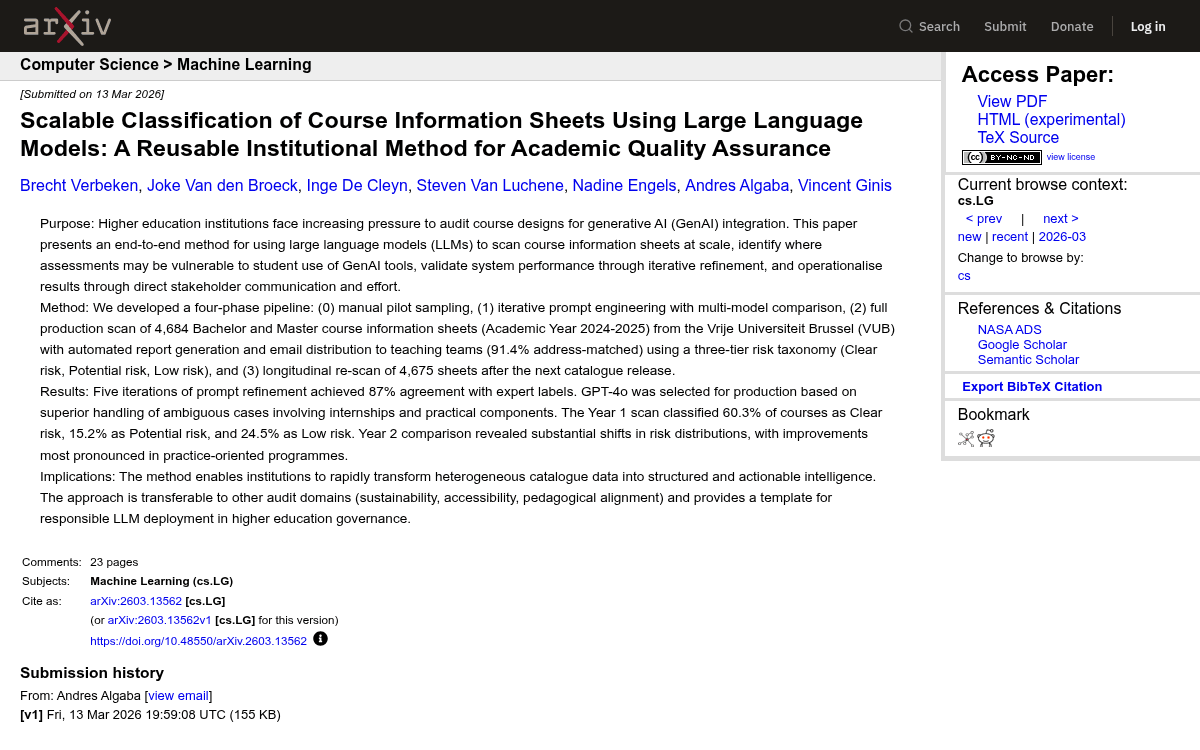
The authors describe their method as a four-phase pipeline: (0) manual pilot sampling, (1) iterative prompt engineering with multi-model comparison, (2) full production scan of 4,684 Bachelor and Master course information sheets (Academic Year 2024-2025) from the Vrije Universiteit Brussel (VUB) with automated report generation and email distribution to teaching teams (91.4% address-matched) using a three-tier risk taxonomy (Clear risk, Potential risk, Low risk), and (3) longitudinal re-scan of 4,675 sheets after the next catalogue release.
The taxonomy itself is deliberately simple:
- Low risk: assessment happens in controlled settings, or the sheet already spells out clear GenAI guidelines.
- Potential risk: some uncontrolled assessment components exist, but with limited weight or partial safeguards.
- Clear risk: significant assessment happens off-campus with no explicit AI policy and no verification mechanism.
Scraping used Python with BeautifulSoup. Every sheet was fed through the OpenAI API with default parameters, and the model returned both a category and a narrative report grounded in the specific course text. For courses appearing in multiple programmes, reports were consolidated before sending. Around 1% of outputs were manually spot-checked before distribution.
Why GPT-4o won the bake-off
The team compared GPT-4o, o3-mini, and DeepSeek R1 on a 30-course pilot sample covering medicine, humanities, engineering, and social sciences in both Dutch and English. GPT-4o was selected for production based on superior handling of ambiguous cases involving internships and practical components.
Two other factors mattered: GPT-4o produced more consistent output formatting (less post-processing), and its Dutch prose was notably more natural, which was essential since the majority of VUB Bachelor programmes are taught in Dutch. o3-mini classified acceptably but generated stilted Dutch, and DeepSeek R1 produced verbose outputs that did not fit the email format.
The prompt-engineering loop, made explicit
One of the more useful contributions here is that the authors treat prompt iteration as a documented empirical procedure rather than a black box. They ran five refinement cycles against the pilot set, and the reported agreement climbed from 63% to 87% across those iterations. The changes were not clever tricks; each iteration targeted a specific systematic error:
- Clarified supervision criteria (fixed over-classification of internships).
- Added grade-contribution guidance (fixed misweighting of practical components).
- Strengthened language requirements (fixed Dutch/English mixing).
- Refined Low-risk criteria (fixed excessive caution).
- Stabilised for production.
The final system prompt, printed in the appendix, is a long structured document with role definition, explicit definitions for each risk tier, monitoring/verification rules, tone calibration (address teachers as jullie), and a report template with line-count budgets per category.
The numbers, and what they do not mean
The Year 1 scan classified 60.3% of courses as Clear risk, 15.2% as Potential risk, and 24.5% as Low risk. When the pipeline was re-run against the next year's catalog (with the prompt held constant), the Clear-risk share dropped to 48.2% and Low-risk climbed to 29.9%. A matched-course sensitivity analysis on 3,892 courses present in both years pointed in the same direction, with the largest movement in practice-oriented programmes like physical education, physiotherapy, and urban planning.
The authors are careful about what those shifts mean. The classification assesses documentation contained in course information sheets, not actual classroom practice; a course may have stronger or weaker GenAI integration in practice than its sheet reflects. A course could improve its rating simply by writing a better AI-policy paragraph, without changing anything about how it actually evaluates students.
Where the classifier reliably breaks
Two error modes only appeared at production scale, because a 30-course pilot could not cover them:
- Internships and clinical placements. The model kept flagging off-campus location as inherently high-risk, missing that supervised internships have documented mentor evaluation. The real risk lives in the reflection papers and case reports attached to the placement, not the placement itself.
- Physical and practical courses. Lab work, physical education, and applied arts get penalised because their sheets mention written components, even when the primary graded work is supervised physical demonstration.
The authors note that these cases share a root cause: sparse documentation. When a teaching team writes two lines about their internship, the classifier has nothing to ground on. They also observed that the same course sheet occasionally received different classifications in separate processing runs, suggesting inherent stochasticity in LLM outputs that institutions should account for when deploying such systems.
What is actually reusable here
There is no released repository or model artifact. What the paper does provide, and what is most likely to be useful outside VUB, is the full production system prompt in the appendix, the error taxonomy, the iteration log, and a set of practical recommendations for anyone thinking about deploying an LLM against institutional documents.
The authors are explicit that the same infrastructure is portable to other audit domains: sustainability integration, accessibility compliance, assessment diversity, and work-integrated learning. The recipe is domain-appropriate taxonomy, expert-labelled pilot, iteration against systematic errors, and validation of error rates against the intended use. It is a reminder that, for a lot of institutional NLP work, the interesting engineering is not the model choice but the loop around it.