
VTC-Bench Exposes Gemini 3.0 Pro Struggling at 51% on Visual Tool Planning
A new benchmark chains 32 OpenCV tools across 680 vision problems, and even Gemini 3.0 Pro clears just 51 percent.
 Pro
Takeaways
- VTC-Bench introduces 680 visual reasoning problems requiring chained OpenCV tool calls to solve.
- Top model Gemini 3.0 Pro reaches just 51.2 percent, exposing severe compositional planning gaps.
- Benchmark ships 32 OpenCV tools spanning geometry, enhancement, feature extraction, and drawing.
- Open-source tool-use models frequently degrade when tools are added; closed models gain up to 9.56 percent.
- Even given oracle toolchains, models cannot reliably synthesize correct multi-step execution logic.
- Code, data, and reference trajectories are available on GitHub.
A new benchmark called VTC-Bench puts a hard ceiling on how well today's multimodal models can actually use visual tools. The top performer, Gemini 3.0 Pro, manages only 51.2 percent on tasks that require chaining together classical computer vision operations, and most open-source models get worse when given tools at all.
The paper's core argument is that current agent benchmarks let models off easy. Existing frameworks typically rely on limited tool-sets and simple invocations, rarely testing the complex combinations required for advanced visual reasoning, while real-world tasks often demand chaining multiple distinct operations together to form a successful execution plan. VTC-Bench is designed to close that gap by giving the model a full OpenCV toolbox and asking it to plan.
A toolbox that looks like a real CV pipeline
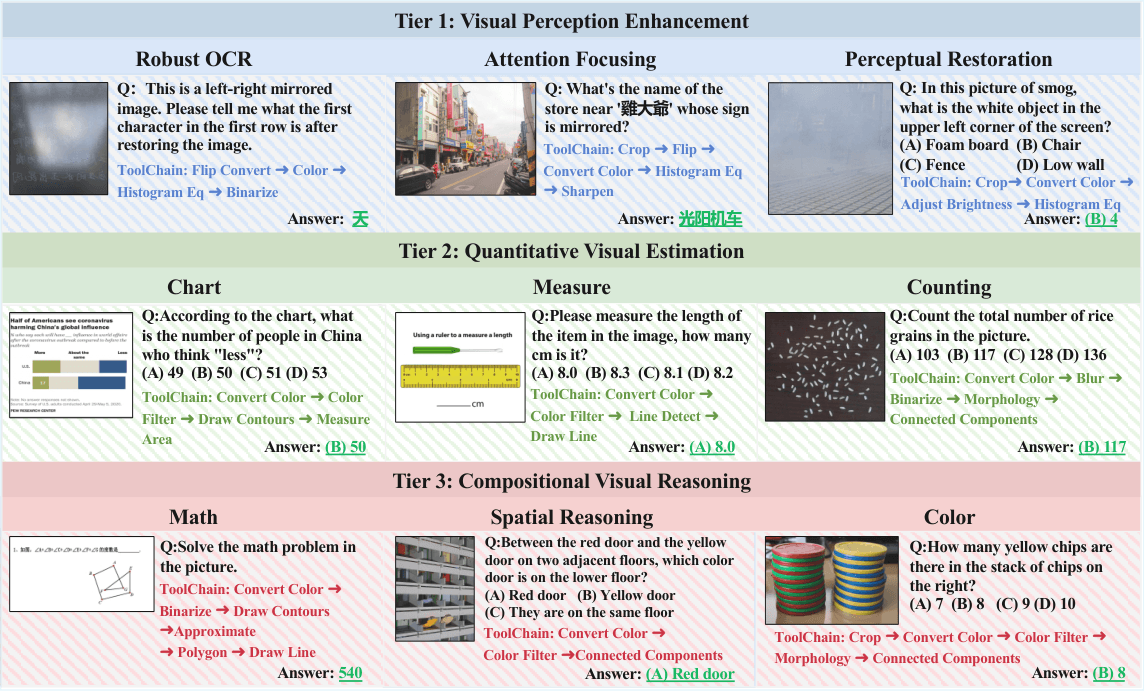
The benchmark ships with 32 diverse OpenCV-based visual operations, enabling extensive combinations that assess multi-tool composition and long-horizon, multi-step plan execution. The tools are grouped into four modules that mirror how a human engineer would approach a vision problem:
- Geometry: resize, rotate, translate, flip, crop, zoom, pyramid
- Enhancement: color space conversion, in-range color filtering, blur, denoise, threshold, morphology, histogram equalization, brightness, inpainting
- Feature Extraction: Canny edges, Sobel/Laplacian gradients, watershed, GrabCut, flood fill, connected components, SIFT/ORB keypoints, Hough lines and circles, template matching, DFT
- Drawing: contours, polygon approximation, lines, circles, contour area, arc length

On top of that toolkit sits a three-tier task hierarchy of 9 categories: Tier 1 covers perception recovery (robust OCR, dehazing, rotation correction), Tier 2 handles quantitative estimation (measurement, color extraction, counting), and Tier 3 targets compositional reasoning (charts, geometry math, spatial reasoning under noise). VTC-Bench features 680 curated problems structured across a progressive nine-category cognitive hierarchy, and every problem is paired with a ground-truth execution trajectory designed to facilitate fine-grained diagnostic analysis of the models' intermediate planning and tool-calling behaviors.
The dataset averages 5.04 tool calls per question with chain lengths from 1 to 10, and it supports two interaction paradigms: raw Python code with a cv2 interpreter, or a structured function-calling interface. That dual setup lets researchers separate a model's coding skill from its planning skill.
The scoreboard is grim
The team ran 19 mainstream MLLMs, spanning proprietary tool-use models (GPT-o3, GPT-o4-mini), general-purpose proprietary models (GPT-5.2, GPT-4o, Gemini 2.5/3.0 Pro and Flash), specialized open-source agents (DeepEyes, DeepEyes-v2, Thyme, V-Thinker), and Qwen3-VL variants from 8B to 235B. Even with tool access, the ceiling is low: Gemini 3.0 Pro tops out at 51.18 percent, Gemini 3.0 Flash reaches 50.74, and most models cluster around 30 percent.
Two patterns stand out. First, closed models actually benefit from tools while open ones often don't: GPT-4o gains +9.56 percent under the interface setting and GPT-5.2 gains +8.53 under code, but several Qwen3-VL variants and specialized open agents lose accuracy when tools are attached. Second, contrary to conventional wisdom, code execution is not consistently better than a constrained interface. Three of the five proprietary general-purpose models score higher with the interface than with raw Python.
Models pick a few favorite tools and stick to them
The deeper finding is about how models fail. Models struggle to formulate efficient execution plans when facing complex tasks, relying heavily on a narrow, suboptimal subset of familiar functions rather than selecting the optimal tools. Across Gemini and GPT series, the most-invoked operations are almost always Zoom In, In-Range Color, Rotate, Histogram, and Connected Components, regardless of the actual task.
The efficiency numbers make this concrete. Tool Usage Efficiency, defined as the ratio of effective calls to total attempted calls, collapses for the strongest reasoners:
| Model | Pass Rate | Avg calls | MAE vs GT | Efficiency |
|---|---|---|---|---|
| Gemini 3.0 Pro | 51.03% | 5.04 | 3.87 | 36.51% |
| Gemini 3.0 Flash | 50.74% | 1.89 | 3.26 | 63.49% |
| GPT-5.2 | 40.74% | 13.23 | 9.96 | 16.78% |
| GPT-o3 | 36.76% | 9.77 | 6.98 | 17.20% |
| GPT-4o | 33.82% | 2.26 | 3.91 | 61.06% |
GPT-5.2 issues an average of 13 tool calls when the ground truth needs closer to 5, and only about one in six of those calls actually contributes to the answer. That is trial-and-error, not planning.
Two failure modes worth watching
Qualitative case studies pin down two recurring bugs in agent behavior:
- Strategic misselection. The model picks tools that do not fit the task (for example, invoking Draw Circle and Draw Line based on eyeballed coordinates instead of first extracting them with feature detection).
- Blind trust in tool output. The model runs one operation, reads the intermediate result, and treats it as ground truth without cross-checking against the original image.

A prompt ablation drives the point home. Even when the authors hand the model the correct reference toolchain as an oracle, gains are modest for Gemini and Qwen and essentially nonexistent for DeepEyes. Giving a model the right tools is only half the problem; the models still cannot reliably synthesize the multi-step execution logic to use them.
Why this matters for anyone building visual agents
For teams shipping vision agents on top of GPT, Gemini, or open-weight VLMs, VTC-Bench is a useful stress test because it isolates planning from perception. It also delivers a concrete diagnostic finding: current specialized tool-use models over-call tools while neglecting their own perception, and general-purpose models under-call and shortcut. Both trajectories miss the ground truth.
The code and data are on GitHub, including the 32-tool OpenCV wrapper, the 680 annotated problems, and reference trajectories. If you are training a tool-use policy or evaluating an agent framework, the reference toolchains are especially useful because they let you score intermediate planning steps rather than just final-answer accuracy.