
vS-Graphs Cuts Robot Mapping Error 15% by Making Rooms Optimize Themselves
A new open-source VSLAM system builds hierarchical 3D scene graphs of rooms and walls in real time, cutting trajectory error 15% while matching LiDAR-grade scene understanding from RGB-D alone.
 Pro
Takeaways
- vS-Graphs is a real-time RGB-D SLAM framework that builds optimizable hierarchical 3D scene graphs of walls, floors and rooms.
- Achieves 15.22% average trajectory error reduction versus ORB-SLAM 3.0 across ICL, OpenLORIS, ScanNet, TUM-RGBD and SMapper datasets.
- Matches LiDAR-based S-Graphs in room and wall detection accuracy using only visual and depth features.
- Runs at 22 FPS with two new threads for building component and structural element recognition on top of ORB-SLAM 3.0.
- Handles non-Manhattan room layouts through parallelism, perpendicularity and centroid consistency constraints in a unified factor graph.
- Open-source code at github.com/snt-arg/visual_sgraphs, results at snt-arg.github.io/vsgraphs-results.
Most Visual SLAM systems are excellent at knowing where a camera is, but terrible at explaining what it is looking at. They build clouds of 3D points that are geometrically accurate yet semantically flat, with no notion that a set of points is a wall, that a group of walls is a room, or that a cluster of rooms belongs to the same floor. A team from the University of Luxembourg and Universidad de Zaragoza has just released vS-Graphs, a real-time RGB-D SLAM framework that fixes this by embedding a hierarchical 3D scene graph directly inside the optimization loop.
Why flat point clouds are holding robots back
Scene graphs represent an environment as a hierarchy that captures objects, their attributes, and inter-relationships, giving a higher level of abstraction for scene understanding. Prior scene-graph builders like Hydra and HOV-SG produce these hierarchies but do not estimate camera trajectories, and HOV-SG in particular requires ground-truth semantics and an entire-environment map to construct its graph offline. On the SLAM side, LiDAR-based S-Graphs incorporates scene graphs into the SLAM pipeline using planar surface extraction inside a unified optimization system, but has no support for visual input. Vision-only competitors like ORB-SLAM 3.0, GS-SLAM and SplaTAM either ignore semantics or represent them at a purely object level.
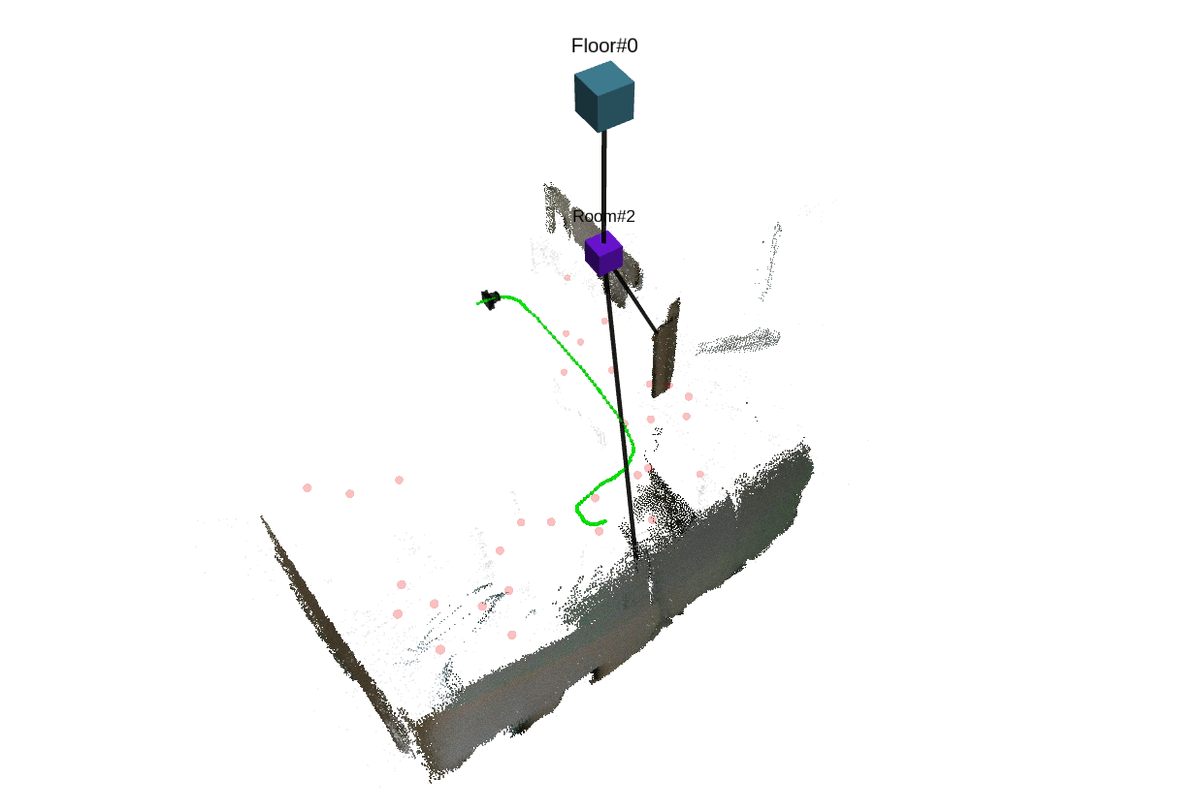
vS-Graphs closes that gap. It tightly couples scene-graph construction with VSLAM through joint optimization in a unified factor graph, operating in real time on visual and depth data. The system infers two layers of environment structure: building components (walls and ground surfaces) detected from KeyFrames, and structural elements (rooms and floors) inferred from how those components fit together.

How the pipeline actually works
vS-Graphs is built on top of ORB-SLAM 3.0. The system introduces substantial modifications to the baseline's core modules and adds new threads for robust scene analysis and reconstruction. The two new threads are the interesting part:
- Building Component Recognition runs at the KeyFrame level. Visual data is passed through a panoptic segmentation network, and the current release integrates Panoptic-FCN and YOSO by default for their balance between accuracy and real-time performance. Pixels labeled as walls or ground are used to filter the point cloud, which is then down-sampled, distance-filtered, and passed through RANSAC plane fitting. Geometric sanity rules (walls must be vertical, ground must be horizontal) discard bad detections.
- Structural Element Recognition runs on a fixed two-second interval to detect rooms and floors. A room here is defined as a spatially enclosed area bounded by at least two walls, with the free space between them computed from depth points using Voxblox signed distance fields. Each candidate wall is checked with proximity and directionality constraints so that its normal actually faces the enclosed free space.
Crucially, rooms are not constrained to rectangular Manhattan layouts. The formulations detect convex n-wall rooms with arbitrary wall orientations by enforcing that adjacent walls face the enclosed cluster. When parallel or perpendicular wall pairs are detected, extra geometric cost terms nudge them toward exact alignment; when they are not, only a centroid-consistency term is active, preserving flexibility for asymmetric spaces. All of these entities then become nodes in a factor graph, jointly optimized with KeyFrame poses and map points during local bundle adjustment.
Numbers that matter
The team evaluated vS-Graphs against ORB-SLAM 3.0, DROID-SLAM, ElasticFusion and BAD SLAM on ICL, OpenLORIS, ScanNet, TUM-RGBD and their own SMapper dataset. SMapper covers roughly 44 minutes of operation and 620 meters of trajectories across diverse indoor scenarios.
The headline is a 15.22% reduction in Absolute Trajectory Error against the ORB-SLAM 3.0 baseline when the full pipeline with structural element recognition is enabled. Gains are largest in looped and multi-room sequences where geometric consistency between walls and rooms compounds across time. On mapping quality, vS-Graphs achieves lower median RMSE than ORB-SLAM 3.0 while generating roughly 10.15% fewer map points, because environment-driven constraints produce a more coherent reconstruction.

The most striking result is on scene understanding. Benchmarked against LiDAR-based S-Graphs and vision-based Hydra on multi-room SMapper sequences, vS-Graphs matches or exceeds S-Graphs in room and wall detection despite using only RGB-D. On the largest sequence (MR03), it detected 23 of 22 walls (one false positive) and all 6 structural elements, with recall of 1.00. Runtime holds up too: vS-Graphs runs at 22 plus or minus 3 FPS, above the 20 FPS real-time threshold, versus 29 plus or minus 3 FPS for the ORB-SLAM 3.0 baseline on the same hardware.
What is genuinely new here
The real breakthrough is not scene graphs, and it is not visual SLAM. It is that room and floor entities become optimization variables in the same factor graph as camera poses and 3D points. Detecting that four walls form a room is not just a labeling exercise; it introduces geometric constraints (parallelism, perpendicularity, centroid consistency) that pull the underlying trajectory into better alignment. Semantics improve geometry, and vice versa.
Where it shines and where it breaks
- Best for: indoor, structured environments like offices, apartments and warehouses where walls and floors dominate. Service robots, indoor drones and AR mapping applications that need both a trajectory and a query-able map are the natural targets.
- Not great for: low-texture scenes such as uniformly painted corridors, which hurt feature matching and propagate errors into structural detection. Environments with curved walls also expose the planar-surface assumption. Rapid motion combined with noisy depth (as in some SR01 runs) can degrade the building-component-only variant.
- Fiducial markers optional: an appendix module lets you drop ArUco markers into rooms and attach human-readable labels like "corridor-A" through a JSON database, without making the SLAM pipeline depend on them.
The full source code lives at github.com/snt-arg/visual_sgraphs under CC BY 4.0, along with a results page containing extended evaluation media. For anyone building indoor robots or spatial AI systems, it is a rare example of a semantic SLAM contribution that improves both the map and the trajectory at once, without demanding a LiDAR budget.