
Vrije Universiteit Brussel Cuts Math Grading Time 23% With AI
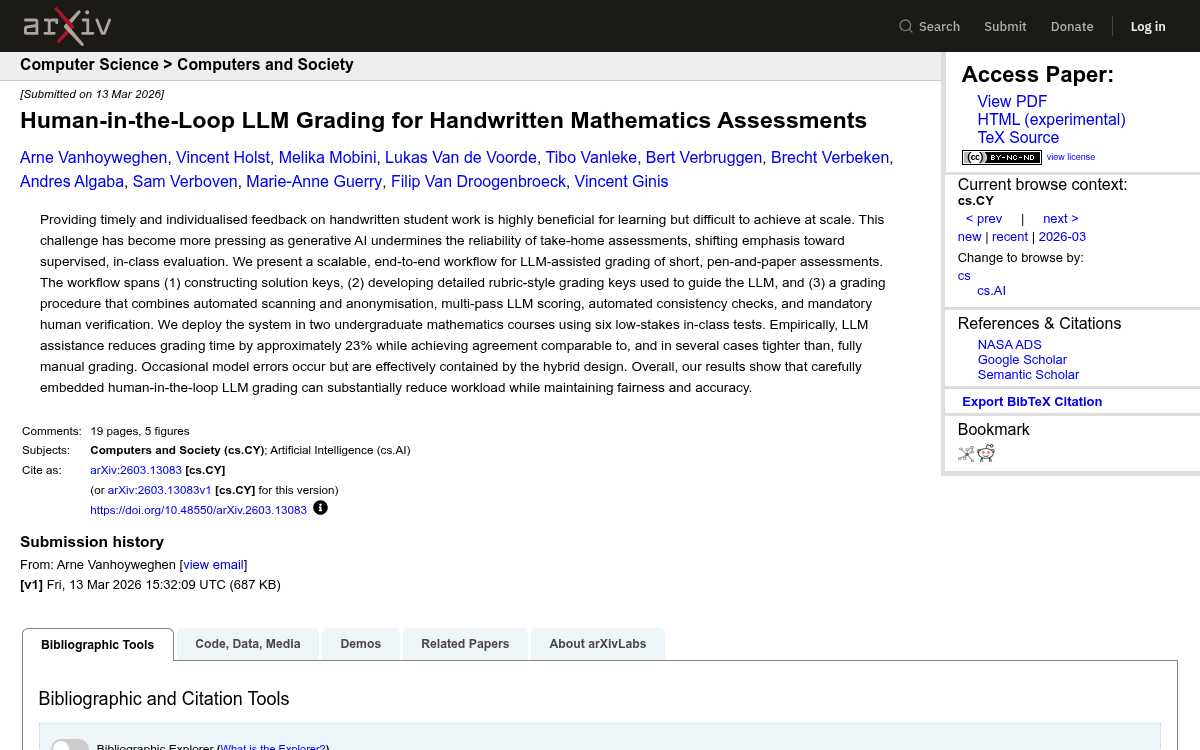
Researchers at Vrije Universiteit Brussel built a hybrid pipeline that cuts handwritten math grading time by roughly 23% while matching human agreement.
 Pro
Takeaways
- VUB researchers present a human-in-the-loop LLM grading workflow for handwritten math, cutting grading time by ~23%.
- Pipeline scans sheets, anonymises answer boxes, and runs five independent LLM scoring passes per response.
- Agreement with humans matches or exceeds inter-annotator agreement, measured by quadratically weighted Cohen's kappa.
- The rubric is the most sensitive component: small enumerated steps and explicit alternatives are key.
- Roughly 3% of cases produce large outliers, caught by mandatory human verification before grades ship.
- Full code is open source at GitHub; paper on arXiv.
A team from the Data Analytics Lab at Vrije Universiteit Brussel has released a paper describing an end-to-end workflow that uses a vision-capable large language model as a first-pass grader for handwritten mathematics tests, with humans keeping the final say. Deployed across six in-class quizzes in two undergraduate math courses, the pipeline shaved about 23% off grading time while producing scores that agreed with human graders at least as tightly as human graders agreed with one another.
Why handwritten grading is suddenly a hot problem
The motivating tension is one every instructor has felt lately. Research has shown that frequent, low-stakes assessment improves student understanding and motivation, and that active, feedback-rich learning environments yield significant performance gains. But handwritten work is especially time-intensive to grade and digitise, and generative AI has made take-home assignments unreliable as evidence of independent understanding. That has pushed instructors back toward supervised, pen-and-paper tests, which reintroduces the grading bottleneck the field spent years trying to avoid.
Multiple choice is the usual escape hatch, but the authors argue it hides the intermediate reasoning that partial-credit rubrics are designed to reward. Their bet is that multimodal LLMs, which can do OCR and contextual analysis in one pass, can turn the problem on its head and act as a scalable first grader for handwritten scripts.
How the pipeline is stitched together
The workflow has three main components: a fully worked LaTeX solution key, a rubric-style grading key that decomposes the answer into small scored steps, and an automated scan-and-grade loop. Students filled in a row of bubbles corresponding to the digits of their university-issued student number, then wrote answers in two clearly delineated boxes on a standardized sheet designed for OCR parsing. Post-processing crops each answer box, strips identifying regions, and sends only the anonymised handwriting to the model.

To manage stochasticity, each student's response was graded independently five times, and automated consistency checks flag cases with wide dispersion. The provisional score presented to the human reviewer was the maximum of the five runs, a deliberately student-favoring choice. Interestingly, the authors report that no reliable threshold emerged to automatically separate noisy stochastic variation from genuine grading errors, which is exactly why humans stay in the loop.
The single most sensitive component turned out to be the rubric itself. The authors landed on a few practical principles worth borrowing:
- Break each solution into small, explicitly enumerated steps, typically worth 2 to 3 points out of 10 each, so no single interpretive call dominates the grade.
- List acceptable alternative solution paths in the key rather than hoping the model will infer them.
- Avoid vague phrases like "partial credit" in favor of concrete, operational criteria, including what should not cost points.
- Instruct the model to ignore steps that do not follow from sound reasoning, to counter the tendency to award credit whenever it spots something resembling the final answer.
The numbers
Six experienced graders each scored two questions under a counterbalanced design (some graded manually first, others digitally first) after a 15-response warm-up to remove learning effects. Aggregating per question instance under the counterbalanced order design, the geometric-mean digital-to-manual ratio was 0.767, corresponding to an average time reduction of 23.3% for LLM-assisted grading relative to manual grading. This pattern was observed across graders with different baseline grading speeds, indicating that the effect was not driven by a small subset of fast or slow annotators.
On agreement, measured with quadratically weighted Cohen's kappa, human-vs-LLM alignment matched or exceeded human-vs-human alignment on almost every question. In the digital setting, deviations are more tightly concentrated near zero than in the manual setting, reflected in substantially lower median absolute deviation values. The authors read this as an anchoring effect: the model's structured explanation gives human graders a stable reference to react to, so their typical disagreement shrinks.
Where it breaks, and what is bundled
The model is not error-free. Roughly 3% of cases produced larger outliers than any observed between human graders, driven by hallucinations or overly literal reading of the rubric. Those are precisely the ones the human verification step is designed to catch. A pilot test also showed instruction language did not matter (kappa of 0.97 between English and the local language), so the team standardized backend grading on English.
The authors flag two important caveats. First, the study only covers short mathematics questions with tightly structured rubrics; more open-ended tasks or disciplines without clean grading keys are still an open question. Second, the bubble-based student ID scheme was fragile under OCR errors, and they suggest replacing student numbers with codes designed to maximize pairwise Hamming distance so a partially filled bubble can still be recovered.
The complete implementation, including sheet processing, anonymisation, LLM scoring, and feedback generation, is available in the Integrated-Intelligence-Lab GitHub repository. For anyone running weekly quizzes in a STEM course, that plus the rubric-design principles is probably the most immediately useful takeaway: the recipe for the rubric matters more than which model you plug in.