
Vrije Universiteit Brussel Builds a 40,000-Rule Grammar AI Can Actually Explain
A new method induces networks of tens of thousands of human-readable grammar rules from annotated text, offering a transparent alternative to neural language models.
 Pro
Takeaways
- New method learns construction grammars of 40,688 rules from PropBank-annotated corpora, released via fcg-net.org/fcg-propbank.
- Trained on OntoNotes and English Web Treebank: 154,391 utterances with 440,528 roleset instances.
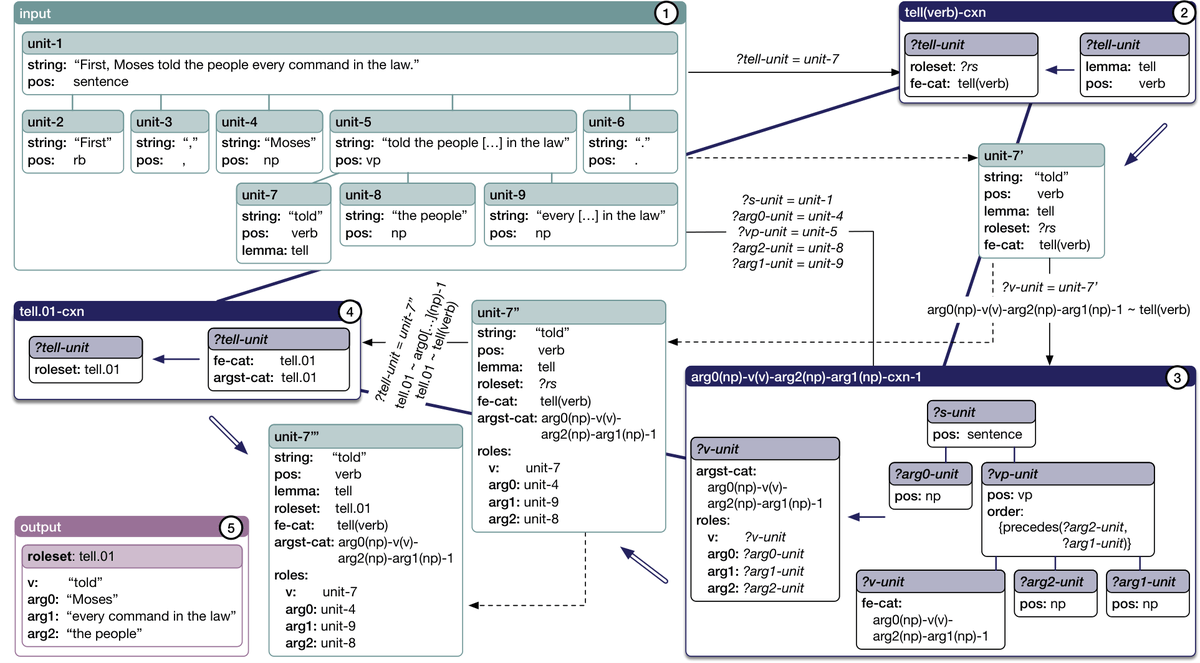
- Builds three linked constructions per example: frame-evoking, argument structure, and roleset.
- Achieves 76.25 F1 on roleset extraction and 79.96 F1 at the frame level, unoptimised.
- Construction frequencies follow Zipf's law, even for purely schematic argument structure patterns.
- Usable through the PyFCG Python library with downloadable pretrained English grammars.
Large language models can parse almost anything you throw at them, but nobody can point to a specific rule inside GPT-style weights and say this is why the model treated a sentence as a ditransitive. A new paper from the Vrije Universiteit Brussel and the Université de Namur takes the opposite route: it automatically learns a construction grammar from annotated corpora, producing tens of thousands of explicit, inspectable rules that map syntax to meaning.
The approach sits inside the Fluid Construction Grammar (FCG) framework, and the authors argue it corroborates a long-standing claim from cognitive linguistics: that broad-coverage grammars can be bootstrapped from usage data without hand-engineered rules or opaque neural weights.
Why construction grammar has been stuck at toy scale
Constructionist theories model all linguistic knowledge as a network of form-meaning pairings called constructions, with no strict split between lexicon and grammar. A long-standing criticism has been that the scalability of precise and testable models of construction grammar remains an open challenge. Prior computational work has either relied on hand-crafted seed grammars or on learning algorithms whose coverage was too narrow to touch real-world text.
The contribution here is a learning procedure that reads a corpus of sentences annotated with two things: a constituency parse (the syntactic tree) and PropBank rolesets (the frame-semantic annotation that says, for a given verb, which spans play which roles).
Three constructions per training example
For every roleset instance in the training data, the algorithm emits three interlinked constructions:
- Frame-evoking construction: matches on a lemma and part-of-speech tag (for example, the verb
tell) and flags it as capable of evoking a frame, without yet committing to which one. - Argument structure construction: captures the syntactic pathway between the verb and its arguments (the noun phrases that fill arg0, arg1, arg2), including precedence constraints where ordering matters, such as separating the ditransitive gave Mary a book from the prepositional dative gave a book to Mary.
- Roleset construction: fires only when a compatible frame-evoker and a compatible argument structure co-occur, and then commits to a specific PropBank sense such as
tell.01(pass along information) versustell.02(distinguish, determine).
The three constructions are wired together with categorial links whose weights track co-occurrence frequency. If the algorithm would build a duplicate, it adds a link instead. The result is a network where you can literally query which verbs prefer which argument structures.
What the learned grammar looks like
The authors trained on OntoNotes plus the English Web Treebank, spanning news, weblogs, telephone speech, reviews, and Q&A. Together the combined corpus contains 154,391 utterances annotated with 440,528 roleset instances. The resulting grammar is a network of 40,688 constructions: 9,800 frame-evoking, 22,568 argument structure, and 8,320 roleset constructions.
Construction frequencies follow a Zipfian distribution, mirroring the frequency law observed for lexical items in natural language. Almost half the constructions appear only once, a pattern familiar from word-frequency studies. Interestingly, the same short-head long-tail shows up even for argument structure constructions in isolation, which are not tied to any specific lexical item.
Because links are weighted, the network doubles as a corpus-analysis instrument. Query the double object construction and you get give.01 (650 hits), tell.01 (128), show.01 (62), and so on, but not explain.01. Query the frame-evoking constructions nearest to tell(verb) and you get ask, remind, and teach. These are exactly the kinds of distributional facts that construction grammarians have long argued for by hand.
How well does the pure grammar parse new text?
On 1,000 held-out utterances, the grammar was evaluated on semantic frame extraction:
| Task | Precision | Recall | F1 |
|---|---|---|---|
| Roleset (exact sense, e.g. tell.01) | 76.15 | 76.36 | 76.25 |
| Frame (verb sense unspecified) | 79.85 | 80.07 | 79.96 |
These numbers are a baseline for a raw, unoptimised grammar. There is no fine-tuning, no pruning of greedy low-frequency constructions, and no neural heuristics on top. The authors explicitly frame this as a coverage demonstration rather than a competitive SRL leaderboard entry.
Where the method breaks
The pipeline depends on an external constituency parser (spaCy's implementation of the Berkeley Neural Parser). When that parser produces trees where a PropBank role does not correspond to a clean constituent, the method cannot recover. The system also only picks up what PropBank annotates, and PropBank ties rolesets to specific lexical anchors. That means non-substantive constructions where the meaning comes from the pattern itself, such as the caused-motion construction in the teacher shouted the children into a queue, remain invisible to the learner.
Extending the approach to Universal Dependencies or Abstract Meaning Representation, and to languages other than English, is listed as open work.
Trying it
The method ships as the fcg-propbank subsystem of FCG, usable through the PyFCG Python library. Pretrained English grammars are downloadable, and you can also train your own from a CoNLL file:
import pyfcg as fcg
fcg.init()
agent = fcg.PropBankAgent()
f = fcg.load_resource('pb-en.fcg')
agent.load_grammar_image(f)
agent.comprehend("Margaret Thatcher was elected Prime Minister of Britain.")
For anyone building interpretable NLP pipelines, doing corpus linguistics on argument structure, or looking for a symbolic scaffold to combine with neural embeddings, a 40k-construction network you can actually read is a genuinely different tool from a frozen transformer checkpoint.