
VNU Builds a Squid-Powered Submarine That Monitors Lakes for $123
A research paper presents a squid inspired underwater robot that swims with water jets, dives on demand, and costs about $122 to build.
 Pro
Takeaways
- Researchers designed a squid-inspired miniature submarine using pump-driven water jets for propulsion, steering, and buoyancy.
- Total hardware bill of materials comes to roughly $122.5 using an ESP32, IMU, GPS, and LoRa.
- Ballast cylinders double as water sampling chambers, saving mechanical complexity.
- Pool tests show roll within plus or minus 2 degrees and 2 second heading rise time.
- Field trial in a lake reached 2.5 m depth with steady state error under 0.1 m.
- Paper available on arXiv; no code release mentioned.
A new arXiv paper walks through the design, dynamics, and pool-to-lake testing of a miniature submarine that swims like a squid and costs about the same as a mid range mechanical keyboard. The authors, from VNU University of Science, Fulbright University Vietnam, and VinUniversity, propose it as a reproducible platform for water quality monitoring in lakes and rivers where conventional autonomous underwater vehicles are overkill or unaffordable.
Most underwater robots used for environmental sensing are built for industrial or oceanographic missions, and their cost and mechanical complexity make them impractical for routine freshwater monitoring or classroom use. To close that gap, the authors design a compact vehicle around off the shelf hobby electronics and validate it end to end, from a decoupled dynamics model to a lake sampling run. The paper is on arXiv.
Why squids beat propellers here
Instead of a screw propeller, the vehicle borrows the jet propulsion trick that cephalopods use. A squid draws water into its mantle cavity and forcefully expels it through a narrow funnel, generating a reaction force in the opposite direction according to Newton's third law. The submarine reproduces this with electric pumps that intake and expel water to produce thrust, which keeps the mechanical structure compact and avoids exposed spinning blades that can foul on weeds or debris.

The hull is a transparent acrylic cylinder with two 12V propulsion pumps at the ends, two 5V steering pumps mounted laterally near the rear, and two water intake cylinders driven by DC motors for buoyancy. Forward and reverse thrust comes from the end pumps, yaw comes from differential thrust between the left and right steering pumps, and vertical motion comes from varying the total water volume inside the cylinders. Creating a volume difference between the front and rear cylinders tilts the pitch angle. That yields four degrees of freedom without any servos or control surfaces.
The math behind the motion
The authors model the vehicle as four decoupled first order equations, one each for surge, yaw, heave, and pitch, under the assumption of small roll and pitch angles and weak coupling between axes. Surge acceleration is driven by the sum of the two propulsion pump speeds, yaw rate by the difference between the two steering pumps, heave by the sum of the two cylinder volume changes, and pitch by their difference, each opposed by a hydrodynamic damping term. The model is deliberately simple, and it maps cleanly onto the actuator layout, which is what makes the whole controller cheap to implement on a microcontroller.
Inside the $122.5 bill of materials
The brains are an ESP32 microcontroller that manages sensor acquisition, actuator control, and system coordination, paired with L298N and L298 mini H bridge drivers for the six motor channels. For sensing and navigation, the vehicle carries a BNO055 9 DoF IMU over I2C, a BMP280 style pressure sensor read through the ESP32's 12 bit ADC for depth, and a u blox GPS module parsed with TinyGPS++ for surface positioning. Communication with shore uses a LoRa module, which remains effective at the vehicle's shallow operating depth of 2 to 3 m even though radio attenuates quickly underwater.

The full bill of materials totals roughly $122.5. A few of the more notable line items:
- Acrylic hull, 100 mm OD, 750 mm long: $8
- Two 12V 9W thruster pumps: $10
- 12V 6Ah battery: $15
- Three 12V ballast pumps plus 200 ml syringes: $16.5
- BNO055 IMU: $19.5
- u blox Neo M10 GPS with ceramic antenna: $15
- ESP32 S3 MCU: $6.5
- SX1278 433 MHz LoRa transceiver: $4.8
The software runs a continuous loop that polls sensors synchronously and handles LoRa commands asynchronously. Buoyancy cylinders are guarded by hardware limit switches wired to falling edge interrupts on the ESP32, so if a piston bottoms out the ISR immediately kills the motor. Telemetry packets containing GPS, Euler angles, quaternion, acceleration, angular velocity, velocity, and displacement are pushed to the shore controller every two seconds.
How well it actually behaves in water
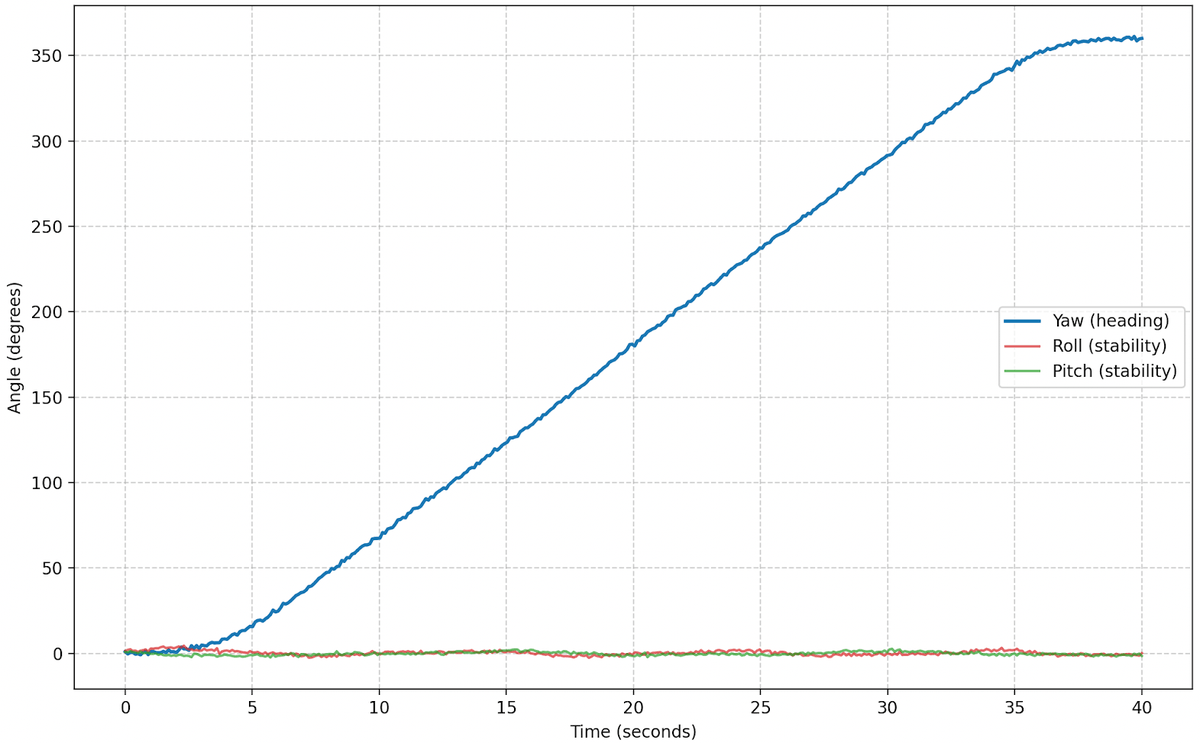
The authors report pool tests and a field trial in a lake. In a full 360 degree surface yaw rotation over 40 seconds, the reported deviations stay small. Maximum roll deviation was approximately plus or minus 2 degrees, and maximum pitch deviation remained within plus or minus 1.5 degrees. That matters because a wobbling platform blurs IMU integration and adds noise to any water sample tied to a specific depth.
For heading control, commanding a step from 90 to 180 degrees produced a rise time of about 2 seconds with a small overshoot of about 5 degrees, then convergence to steady state within roughly 4 to 5 seconds and a steady state error below 2 degrees. Depth regulation was tested by diving to 2.5 m. The descent started at about t = 5 s and reached target depth within about 8 to 10 s, with steady state depth error inside plus or minus 0.1 m and pitch bounded within plus or minus 3 degrees during the transition. In the lake, the vehicle drove about 35 to 40 m out from shore, submerged, drew water into the ballast cylinders as a sample, and returned while staying in LoRa contact.
What is actually new here
The individual ingredients, jet propulsion, ballast cylinders, ESP32, and LoRa, are all well trodden. The contribution is the integration: a single pump-and-cylinder mechanism that serves as buoyancy control, pitch trim, and sample chamber simultaneously, wrapped in a dynamics model simple enough to control with cheap hardware and a BOM that a school or small lab can actually afford. The authors position it as a platform contribution rather than a new locomotion result, and the paper reads that way.
Where it fits, and where it does not
Useful cases based on the reported envelope:
- Shallow freshwater monitoring in lakes and ponds at 2 to 3 m depth, where LoRa still reaches the surface station.
- Point sampling missions where a student or researcher wants a georeferenced water grab at a specific location and depth.
- Educational robotics and undergraduate research, given the sub $125 BOM and Arduino IDE toolchain.
- A reproducible baseline for teams working on bio inspired propulsion or low cost AUV control.
Limitations are equally clear. The dynamics model assumes small angles and decoupled axes, so aggressive maneuvers are out of scope. LoRa breaks down at deeper depths, ruling out ocean or reservoir work. There are no chemistry sensors on board yet, only physical state sensors, so water quality inference still depends on lab analysis of the retrieved sample. The authors flag integrating additional water quality sensors and improving autonomous navigation as future work.
Availability
The paper is on arXiv with the full HTML version including circuit diagrams, the motion equations, and the bill of materials table. No public code repository or CAD release is referenced in the manuscript, so anyone rebuilding it will be working from the parts list, wiring diagram, and equations in the text.