
VLAJS Cuts Robot Training Steps in Half by Firing Its AI Teacher
A new method uses vision-language-action models as sparse early hints for PPO, cutting robot training interactions by over 50% on manipulation tasks.
Takeaways
- VLAJS uses a pretrained VLA as sparse, transient hints to jump-start PPO for robotic manipulation.
- A cosine directional loss aligns action direction with teacher hints without copying magnitude.
- Reward-trend heuristic anneals and permanently disables VLA queries once learning takes off.
- Cuts required environment interactions by over 50% on several ManiSkill tasks versus PPO.
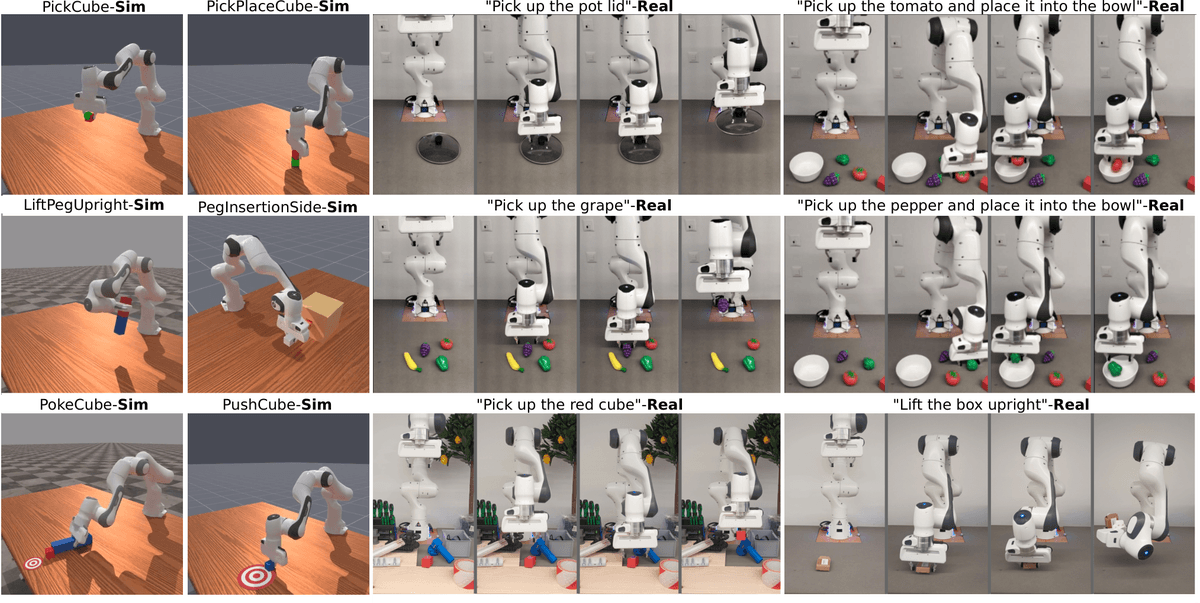
- Zero-shot sim-to-real on a Franka Panda, robust to clutter and human perturbations.
- Works with weak or OOD VLA teachers like OpenVLA and Octo; full paper on arXiv.
Reinforcement learning is great at teaching robots precise, high-frequency motor skills, but it can spend millions of steps flailing before it stumbles onto a reward. Vision-language-action models know a lot about the world, yet run too slowly and too imprecisely to close the control loop on real hardware. A team from IDSIA-SUPSI, USI, and Politecnico di Milano has proposed a way to combine them: use the VLA as a coach that whispers hints early in training, then walks away once the RL agent gets going.
Their method, Vision-Language-Action Jump-Starting (VLAJS), augments PPO with sparse, transient guidance from a pretrained VLA such as OpenVLA or Octo. On six ManiSkill manipulation tasks, it cuts the environment interactions needed to reach reliable success rates by more than half in several cases, and the resulting policies transfer zero-shot to a real Franka Panda arm.
Where standard RL breaks down
The paper zeroes in on two failure modes of on-policy RL for manipulation. Learning complex behaviors often requires long training times, careful reward engineering, and large amounts of interaction data. When episodes are long or rewards are sparse, credit assignment gets weak: the agent can't tell which of its thousand recent actions actually mattered.
VLAs seem like an obvious rescue, but they come with their own problems. Reliance on large expert datasets limits scalability and adaptation, and transformer-based architectures typically operate at low control frequencies, restricting their ability to handle precision requirements, disturbances, and long-horizon closed-loop behaviors. You can't just drop a VLA into a 100 Hz control loop and expect it to insert a peg.
Prior attempts to combine the two, like Refined Policy Distillation (RPD), lean on the VLA at every timestep with an MSE action-matching loss. That works in ideal conditions but is expensive and can drag the student down to the teacher's ceiling.