
VLA-Thinker Teaches Robots to Look Twice, Hits 97.5% Task Success
Researchers teach robot policies to zoom into their own camera feed mid-task, hitting 97.5% success on LIBERO by treating perception as a callable reasoning tool.
 Pro
Takeaways
- VLA-Thinker makes visual perception a callable tool inside a robot policy's chain-of-thought reasoning.
- Two-stage training: SFT on synthetic CoT data, then GRPO reinforcement learning on task success.
- Hits 97.5% on LIBERO, a +6.5 point gain over the OpenVLA-OFT backbone.
- Long-horizon RoboTwin 2.0 tasks improve most, suggesting active perception curbs error accumulation.
- Only a zoom-in tool is implemented; grounding and segmentation are left as future work.
- Code and weights available at GitHub and Hugging Face.
A new Vision-Language-Action (VLA) model called VLA-Thinker is trying to fix a subtle but important flaw in how robot policies reason about the world. Instead of glancing at a camera frame once and then talking to itself in text until it produces an action, the model can pause mid-reasoning, zoom into a specific region of the image, and use that new visual evidence to decide what to do next. The result is a policy that hits 97.5% average success on LIBERO and posts double-digit gains on long-horizon dual-arm tasks in RoboTwin 2.0.
Why static vision is a problem for robots
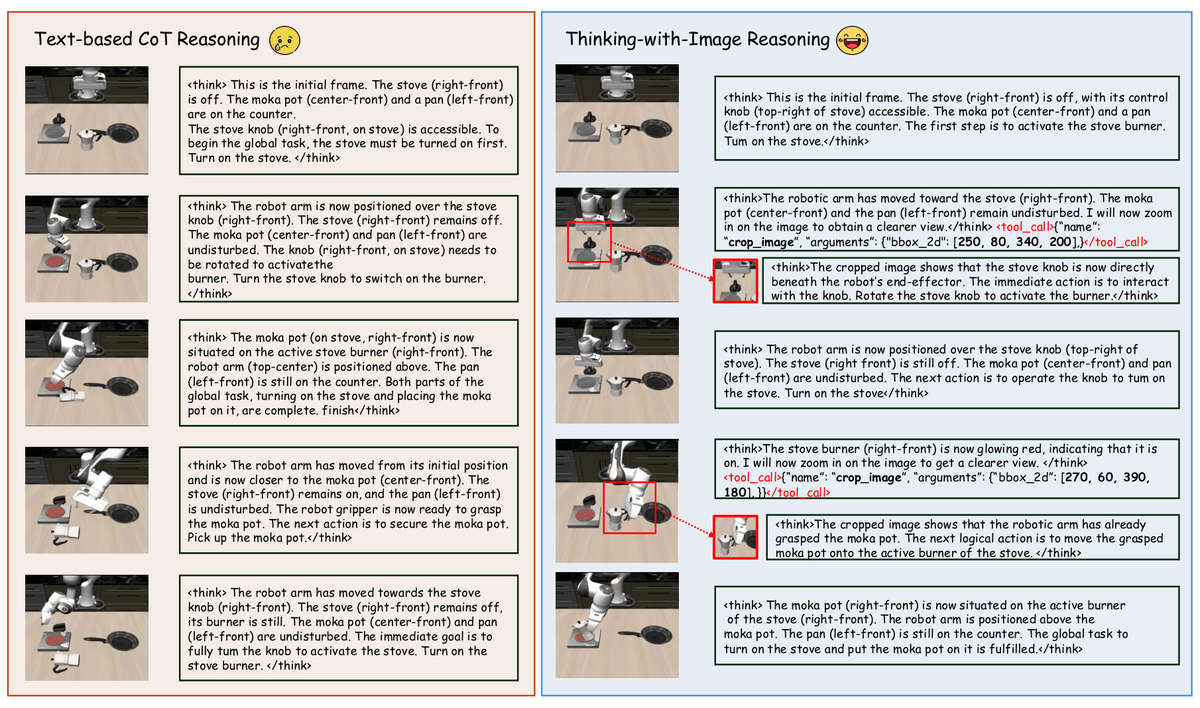
Most reasoning-enhanced VLAs bolt a Chain-of-Thought on top of a vision-language backbone. In such approaches, visual inputs are encoded once into static embeddings and treated as fixed context throughout the reasoning process. Consequently, reasoning unfolds primarily in the language space, while perception becomes a passive, one-shot observation. That is fine for a single grasp, but it breaks down when a robot has to track subgoals across hundreds of steps, recover from a fumbled grip, or disambiguate two objects that look similar from the current camera angle.
Humans dynamically revisit the environment, selectively attend to task-relevant regions, and adapt visual focus when uncertainty arises. VLA-Thinker's authors argue that a robot policy needs the same loop: reason a little, look again, reason some more, then act.
Perception as a callable tool
The core reformulation is elegant. Rather than treat the image as fixed input, the model outputs an interleaved trajectory of thoughts, tool calls, and returned sub-images before finally emitting an action. During reasoning process, the model can actively request task-relevant visual information (Relevant sub-image) through tool invocation, enabling perception to be interleaved with reasoning steps and action generation.
In this first version there is exactly one tool, crop_image, which takes a 2D bounding box and returns a zoomed sub-image. In this work, we consider one type of visual tool: ZOOM-IN, which is used to inspect fine-grained details within a specified region of the target image. The primary objective of this study is to validate the fundamental effectiveness of the interleaved perception-reasoning-action paradigm. Therefore, we employ the zoom-in mechanism as a representative instance to verify the end-to-end pipeline and demonstrate its potential for boosting VLA performance. The framework is designed so that grounding, segmentation, or even web search could be plugged in later.

Teaching a robot when to look twice
Training this behavior is the hard part, because public robot datasets do not come with annotated reasoning traces or tool calls. The team addresses this with a two-stage pipeline:
- SFT cold start. They generate synthetic Chain-of-Thought data with Qwen3-VL-30B. Specifically, we first identify semantically meaningful keyframes within each trajectory by detecting changes in the gripper state. Such state transitions typically correspond to subtask boundaries, enabling an effective decomposition of embodied tasks into hierarchical structures. Keyframes get full reasoning traces with tool calls; intermediate frames get pure-text CoT so the trajectory stays continuous.
- GRPO reinforcement learning. Using Group Relative Policy Optimization from DeepSeek R1, the model samples groups of trajectories and gets a sparse reward only when the task actually succeeds, plus a small bonus for keeping the
<think>/<tool>format clean. GRPO computes advantages relative to other trajectories in the same batch, so no separate value network is needed.
The ablations show both stages matter. SFT alone gets 95.0% on LIBERO, GRPO alone collapses to 88.2%, and combining them lands at 97.5%. Direct RL without a supervised warm-up is unstable under sparse rewards, which matches what most recent reasoning-LLM work has found.
What the numbers actually say
The base model is OpenVLA-OFT, a 7B LLaMA2-based policy with action chunking and parallel decoding. VLA-Thinker uses only a single-view image plus proprioception, whereas the official OpenVLA-OFT baseline additionally uses a wrist camera.
On LIBERO, VLA-Thinker improves the OpenVLA-OFT backbone from 91.0% to 97.5% average success, with the biggest jumps on the Spatial suite (+7.1) and the Long suite (+10.4). It beats a stack of recent competitors including π₀, GR00T N1, UniVLA, and CoT-VLA.
The RoboTwin 2.0 results are where the case for active perception gets strongest. For long and extra-long horizon tasks (280-650 steps), VLA-Thinker achieves 64.6% average success, with notable gains on tasks such as Handover Block and Stack Bowls Two. Importantly, the relative performance advantage becomes more significant as task horizon increases, suggesting that thinking-with-image reasoning effectively mitigates error accumulation in long reasoning-action chains.
| Horizon | OpenVLA-OFT | DeepThinkVLA | VLA-Thinker |
|---|---|---|---|
| Short (100-130 steps) | 21.3% | 55.0% | 62.3% |
| Medium (150-230 steps) | 47.1% | 65.3% | 70.7% |
| Long / Extra-long (280-650 steps) | 46.5% | 57.8% | 64.6% |
The interesting behavior learned during RL
One nice qualitative finding: over the course of RL training, the average reasoning length goes down. During SFT, the model imitates verbose traces and calls the zoom tool even when it does not need to. Reward-based training reshapes this into something more parsimonious. The policy learns when a zoom-in is worth it and when the current view is already enough, which is the sort of test-time compute allocation people have been chasing in LLM reasoning research.
Costs, limits, and what to watch
The extra reasoning is not free. On average, VLA-Thinker requires 19% more execution time than OpenVLA-OFT, primarily due to its autoregressive reasoning process. Despite this moderate increase in inference time, the proposed embodied reasoning mechanism,serving as a form of test-time scaling,substantially improves downstream task performance. For teleoperation or high-frequency control this overhead may matter; for household manipulation where a task takes seconds anyway it is a fine trade.
Two honest limitations from the authors:
- Only one tool (zoom-in) is implemented. Grounding, segmentation, or open-vocabulary detection could plug into the same slot.
- The system inherits MLLM hallucination. If the vision-language backbone misidentifies an object or spatial relation, that error propagates into the action.
Availability
Code, dataset, and model weights are open. The team has published the VLAThinker repository on GitHub and dataset plus checkpoints on the VLA-Thinker Hugging Face org. The project page collects benchmark visualizations and the training pipeline diagram. If you are already fine-tuning OpenVLA-OFT for manipulation, this is a low-friction upgrade to try, particularly if your tasks involve small objects, cluttered scenes, or long action chains where the current policy loses track of subgoals.