
Virginia Tech Study Finds Emoji Captions Help ADHD but Frustrate Deaf Students
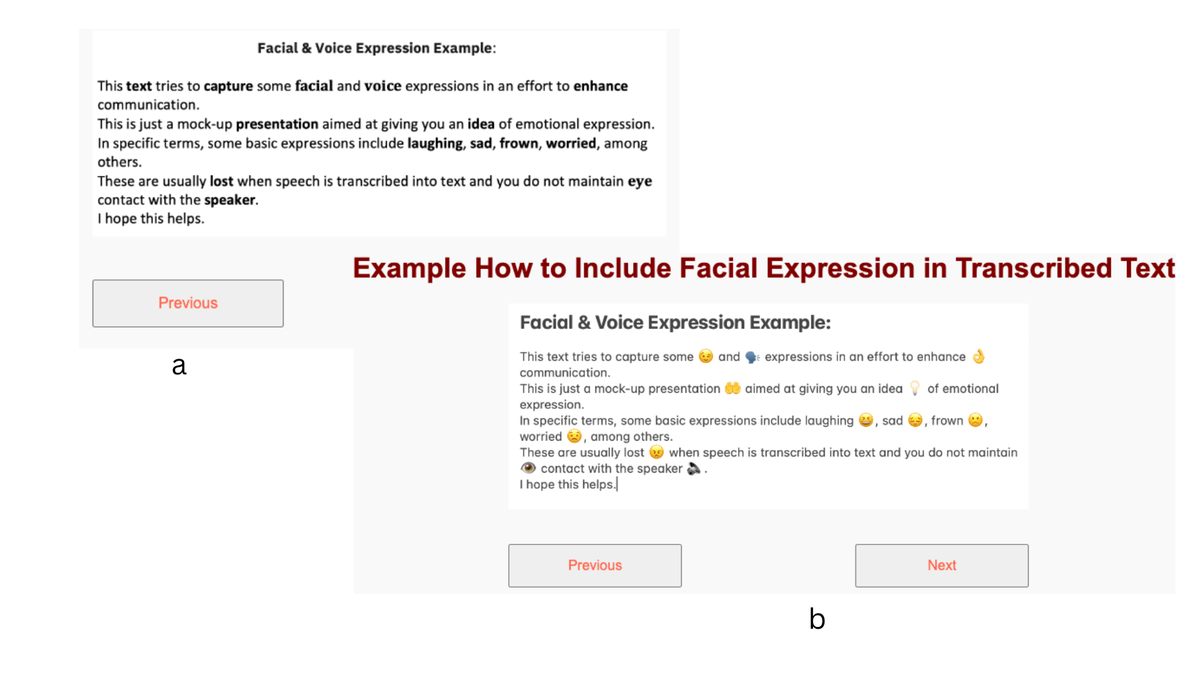
Virginia Tech researchers built four captioning prototypes that layer emojis, keyword highlights and speaker video into STEM lectures, then tested them with 24 users.
 Pro
Takeaways
- Virginia Tech researchers designed four emotive captioning prototypes for DHH and neurodivergent STEM learners.
- Prototypes mix speaker video, overlays, keyword highlighting, minimal animation and emoji or discipline icons.
- Study ran on 24 participants using NASA-TLX cognitive load ratings plus comprehension quizzes.
- Overlaying captions on the speaker (P2) drove the highest mental demand; minimal highlighting (P3) the lowest.
- Deaf users leaned to richer cues, HoH users preferred simplicity, ADHD users liked keyword highlights.
- Authors flag small samples, content confounds, and no code release; call this a design exploration.
A team at Virginia Tech has published a design study asking a deceptively simple question: what happens if real-time captions carry more than just words? Their paper, accepted at the 2025 International Conference on Affective Computing and Intelligent Interaction (ACII), walks through four caption prototypes that layer facial video, keyword highlighting, subtle animation and emoji onto STEM lectures, and evaluates them with 24 participants including Deaf, Hard of Hearing (DHH), ADHD and dyslexic users.
The work is an HCI design exploration rather than a technical benchmark, and the authors frame it that way. The interesting takeaways concern how different user groups react to affective caption designs, not a new model or accuracy score.
Why plain captions fall short in a lecture hall
Standard text-only captions can be cognitively taxing and still fail to convey vital non-verbal cues such as vocal tone, body gestures, and emotional emphasis. In a STEM classroom, that gap matters. Emotional cues and prosodic emphasis often signal difficulty or importance, and learners with ADHD may particularly benefit from captions that highlight emotional context and key phrases. Prior work on affective captioning has mostly focused on entertainment content like TikTok or YouTube, leaving live technical lectures underexplored.
Four prototypes, four philosophies
The researchers built a web-based captioning tool in HTML, CSS and JavaScript that segments a transcript into words and annotates them with color, animation or icons. From that base they produced four variants, each pairing with a short lecture from a different STEM domain:
- P1, Text + Speaker Video: plain captions beside the instructor's video, no extra emphasis.
- P2, Caption Overlay: captions painted directly on top of the speaker.
- P3, Highlighting + Minimal Animation: key terms bolded or colored, with subtle text-rising animation to hint at prosody. No emoji.
- P4, Emojis + Discipline Icons: P3 plus small emojis and domain icons like lab flasks for chemistry.
How the study ran
After a five-person pilot, the main study recruited 33 people, with 24 completing all study phases, of whom 33.3% identified as Deaf or Hard of Hearing, 29.2% reported ADHD, and 4.2% reported dyslexia. Each participant watched a baseline lecture with raw ASR captions, then experienced the four prototypes in randomized order, answering short comprehension questions and filling out NASA-TLX cognitive load ratings after each.
What the numbers say, with caveats
Comprehension scores were higher on the enhanced prototypes than on the baseline, but the authors are explicit that this is confounded: the baseline used a different lecture, was always shown first, and participants may have adapted to the format. The jump from baseline to prototypes is a signal worth investigating rather than a clean accuracy comparison.
The NASA-TLX results carry more weight because every participant rated every prototype. The baseline condition (M=44.0) and Prototype 2 (M=68.3) had relatively high Mental Demand ratings, whereas Prototype 3 was the lowest (M=32.5). Participants noted that the overlaid captions in P2 frequently obscured the speaker's mouth and gestures, penalizing lip-readers. Frustration peaked under Prototype 4 (approximately 70), while P3 elicited moderate frustration (approximately 50). Effect sizes were small (partial eta-squared around 0.001), which the authors flag honestly.

Preferences split along accessibility lines
The qualitative results tell a richer story. Deaf participants mostly selected captions as Always and leaned towards Prototypes 3 and 4 because they effectively conveyed emotional tone and context, although they pointed out that excessive distractions, like emojis, were a drawback. HoH respondents valued simplicity, with Prototype 1 receiving significant praise for its clarity and the way it separates text from video. Neurodivergent participants liked features such as keyword highlighting in Prototype 3 and found Prototype 4 easy to read, often mentioning accessibility and cognitive clarity as important factors.

That split is the real design finding. Prior work has noted that some Deaf users perceive emojis as childish or visually distracting, and this study reinforces that while showing ADHD users often find those same glyphs useful for tracking emotional tone. No single "best" caption style works across these groups.
What is useful, and what is not
For anyone building accessibility tools, the practical takeaways are worth extracting:
- Subtle emphasis like keyword highlighting appears to lower perceived mental effort compared to plain text.
- Overlaying captions on the speaker's face is a bad default. It breaks lip-reading and reliably spikes cognitive load.
- Emojis are polarizing. Ship them as an opt-in toggle, not a default.
- Customization is not a nice-to-have. Over half of participants explicitly asked for it.
Limits worth naming
The authors do not oversell. The DHH subgroup was only 8 people, videos were 3 to 4 minutes long, comprehension was measured immediately rather than at delayed retention, and each prototype used a different STEM topic, which introduces content-based variance. There is no released code or model, and the prototype ran on pre-recorded transcripts rather than live ASR. Treat this as an early design probe pointing toward adaptive, user-controllable emotive captioning systems, not a finished product.