
Vienna Researchers Crack Why AI Optimization Plans Confuse Humans
Researchers identify three measurable properties that make AI optimization solutions feel intuitive to humans, enabling interpretability-aware solvers.
 Pro
Takeaways
- Researchers identified three measurable properties that predict whether humans find an AI optimization solution interpretable, even when solutions are equally optimal.
- The three metrics are: heuristic alignment (HC), compositional simplicity (CC), and visual ordering (VC) -- each independently shifts human preference.
- A one-standard-deviation increase in heuristic complexity reduced the odds of a solution being chosen as "easier to understand" by 27%; visual disorder reduced it by 31%.
- Heuristic alignment also sped up decision-making by ~4% per SD, suggesting it reduces cognitive load beyond just shifting preference.
- The findings enable interpretability-aware optimization: sort displays, prefer greedy-aligned solutions, and penalize complex bin compositions as secondary objectives.
- Code, data, and materials are publicly available on OSF; the paper is on arXiv.
When an AI solver hands you the optimal schedule, the optimal allocation, or the optimal packing plan, it rarely hands you the most understandable one. Optimality and interpretability are different objectives, and until now, nobody had a precise, quantifiable account of what makes one equally-optimal solution easier to grasp than another. A new paper from the University of Vienna and TU Darmstadt takes a concrete step toward fixing that.
The work, "Unpacking Interpretability: Human-Centered Criteria for Optimal Combinatorial Solutions", studies the bin-packing family of problems -- the same class of combinatorial optimization that underpins nurse scheduling, cloud resource allocation, and capital budgeting. The key insight: when two solutions are tied on objective value, humans reliably prefer the one that scores lower on three measurable structural properties.
The gap nobody was filling
Explainable AI research has spent years explaining predictions: why did the model classify this image as a cat? Far less attention has gone to explaining plans and allocations: why should I pack items this way instead of that way? Many optimization problems admit multiple solutions that are equally optimal but differ substantially in their structure and presentation. The open question is which structural properties make one solution easier for a human to work with.
This matters practically. Packing problems require assigning items of varying sizes to capacity-limited bins under hard constraints, and this class is foundational in operations research with high-impact applications in resource allocation and logistics. Hospitals assign patients to nurses, companies allocate budgets across projects -- in all these cases, a human needs to understand, communicate, and potentially modify the machine's output.
Three levers of interpretability
The researchers focused on the Multiple Subset Sum Problem (MSSP) -- a variant of bin packing where the goal is to maximize total packed size across a fixed number of bins. They generated thousands of problem instances, each with at least two distinct optimal solutions, and ran a preregistered behavioral experiment with 73 participants who judged which of two side-by-side solutions was "easier to understand."
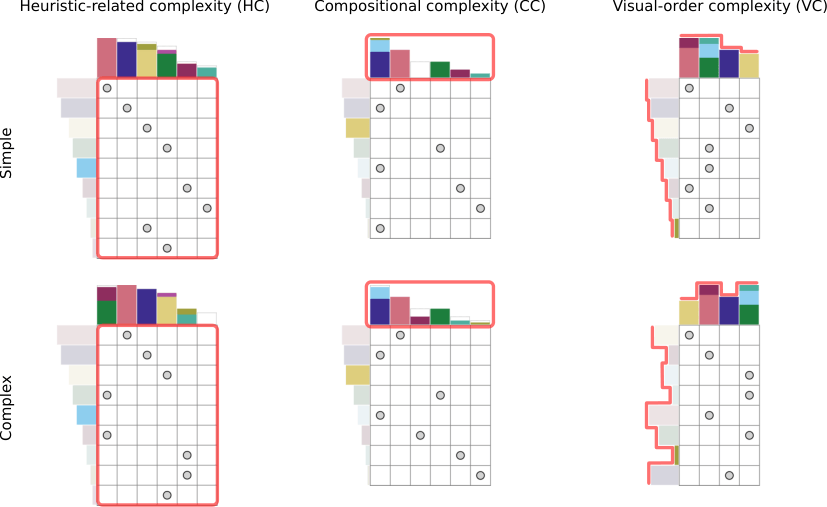
From this, they derived three quantifiable complexity metrics:
- Heuristic-Related Complexity (HC): How far does the solution deviate from a greedy reference? The greedy baseline uses a "Largest Bin First, Largest Item First" strategy. HC is computed as the graph edit distance between the given solution and this greedy reference -- more edits means higher complexity.
- Compositional Complexity (CC): How hard is each bin to parse at a glance? Bins that are nearly full or nearly empty with few items are simple; bins that are half-filled with many items of mixed sizes are complex. CC is formalized as the negative log-probability of a bin's composition under a generative model that favors extreme fill levels and few items.
- Visual-Order Complexity (VC): How disordered is the visual layout? VC uses an adapted Kendall's tau rank correlation to measure how far the displayed ordering of bins and items deviates from a sorted (ascending or descending) arrangement.
What the experiment showed
Participants' choices consistently favored the solution with lower complexity along all three predefined metrics. An increase of one standard deviation in the difference reduced the odds of selecting the more complex solution by 27% for HC, 21% for CC, and 31% for VC. The effect held across 1,668 observations from 73 participants in the confirmatory study, and replicated directionally in a separate exploratory cohort.
The reaction-time data added a nuance: larger heuristic differences were associated with faster evaluations, consistent with the idea that familiar construction reduces decisional conflict. In contrast, differences in bin compositions and order did not reliably shorten decisions. This suggests HC does something deeper than just shifting preference -- it actually reduces the cognitive work of comparing two options.
The webcam-based eye-tracking component, however, came up empty. Aggregate side-wise dwell did not reliably vary with complexity under webcam-based tracking, and the results suggested a modest left-gaze tendency. The authors attribute this to the limited spatial precision of browser-based eye tracking and the possibility that brief attentional asymmetries get washed out in aggregate.

Why heuristic alignment is the strongest signal
Of the three metrics, HC produced the most consistent effects across both the choice data and reaction times. The authors argue this is because participants may be applying familiar heuristics even when evaluating completed solutions, not only when generating them -- extending the heuristic literature, which has largely focused on solution construction, to the evaluation of precomputed solutions.
In plain terms: when a human looks at a packing solution, they unconsciously ask "could I have built this with a simple rule?" If the answer is yes, the solution feels transparent. If the answer is no -- if the assignments look arbitrary -- the solution feels opaque, even if it's mathematically optimal.
From metrics to actionable design
The practical payoff is a set of design principles for any system that presents combinatorial solutions to humans:
- Sort before displaying. Ordering bins by capacity and items by size (largest first) directly reduces VC at zero computational cost.
- Prefer heuristic-aligned solutions. When multiple optimal solutions exist, use HC as a tiebreaker -- pick the one closest to what a greedy algorithm would have produced.
- Penalize complex bin compositions. In multi-objective formulations, add a soft penalty for bins that are half-filled or contain many items of mixed sizes.
Embedding complexity metrics as secondary criteria -- for example, tie-breaking among equal-value optima or soft penalties in multi-objective formulations -- would let optimizers return solutions that are both high in value and easy to understand. The code, materials, and data are all publicly available at the OSF repository.
Where it falls short
The study has real limitations worth noting. The problem instances were deliberately small -- 4 to 6 bins and 7 to 9 items -- and the applicability of these results to larger, more complex problems or alternative human-plausible heuristics remains to be determined. The greedy reference is also a single fixed strategy (largest-bin, largest-item first); whether HC generalizes to other heuristic baselines is an open question.
There is also an ecological validity concern. The controlled environment, which involved participants judging fully computed optimal solutions without time pressure, deviates from real-world resource allocation and design tasks, which often entail partial solutions, dynamic constraints, risks, and deadlines. Whether the same three properties dominate under time pressure or with domain expertise is unknown.
The bigger picture
Most XAI work treats interpretability as a property of a model's internals -- attention weights, SHAP values, feature importances. This paper treats it as a property of a solution's structure, which is a meaningfully different framing. It means interpretability can be engineered directly into the output of an optimizer, without touching the model architecture at all.
The longer-term vision the authors outline is a unified cognitive model that combines HC, CC, and VC into a single interpretability score, validated against out-of-sample predictions and physiological process measures. If that holds up across problem domains beyond bin packing, it could become a standard secondary objective in any solver that needs to work alongside humans.