
VideoChat-A1 Beats GPT-4o on Long Videos Using Only 7% of Frames
A new video agent breaks long clips into shots and reasons through them step by step, matching GPT-4o with a fraction of the frames.
 Pro
Takeaways
- VideoChat-A1 introduces chain-of-shot reasoning for long videos, accepted to AAAI 2026.
- Hits 77.0 on VideoMME (w/ subs) and 70.1 on EgoSchema, beating InternVL2.5-8B and InternVideo2.5-8B baselines.
- Matches GPT-4o and Gemini 1.5 Pro accuracy using only 7% of input frames and 12% inference time.
- Five-step loop: video glance, key info, shot selection, coarse-to-fine partition, and confidence-based reflection.
- Works with Qwen2.5-VL-7B, InternVL-2.5-7B, or InternVideo-2.5-8B as backbones via EVA-CLIP-8B features.
- Code available on GitHub with straightforward conda-based install and inference script.
Multimodal LLMs have gotten sharp at answering questions about short clips, but stretch the runtime past a few minutes and they tend to drown in their own context. A new agent called VideoChat-A1, accepted to AAAI 2026, takes a different route: instead of dumping frames into a model and hoping for the best, it reasons through a long video shot by shot, the way a human editor would scrub through footage looking for the relevant beat.
The long-video bottleneck
Current video MLLMs struggle with longer content because uniformly sampling frames from a 30-minute clip either misses the moments that matter or floods the context window with redundant frames. Recent work has tried wrapping MLLMs in agent loops that retrieve extra context, but most existing agents ignore the key fact that a long video is composed of multiple shots. Without that structure, the agent chases noisy segments and burns tokens on stretches of video that have nothing to do with the question.
The team behind VideoChat-A1 argues that the natural unit of reasoning for a long video is the shot, not the frame. Answering a question like "why does the mother bird bring fish to a fox" requires locating the specific scene where that happens, then examining what leads up to it, then reflecting on whether that evidence is actually sufficient.
Chain-of-shot reasoning
The agent runs a five-step loop that mirrors how a person would investigate a clip:

- Video glancing. A cheap first pass over sparse frames to get the gist.
- Key info summary. The model condenses what the question is actually asking about.
- Shot selection. It picks the shots most likely to contain the answer.
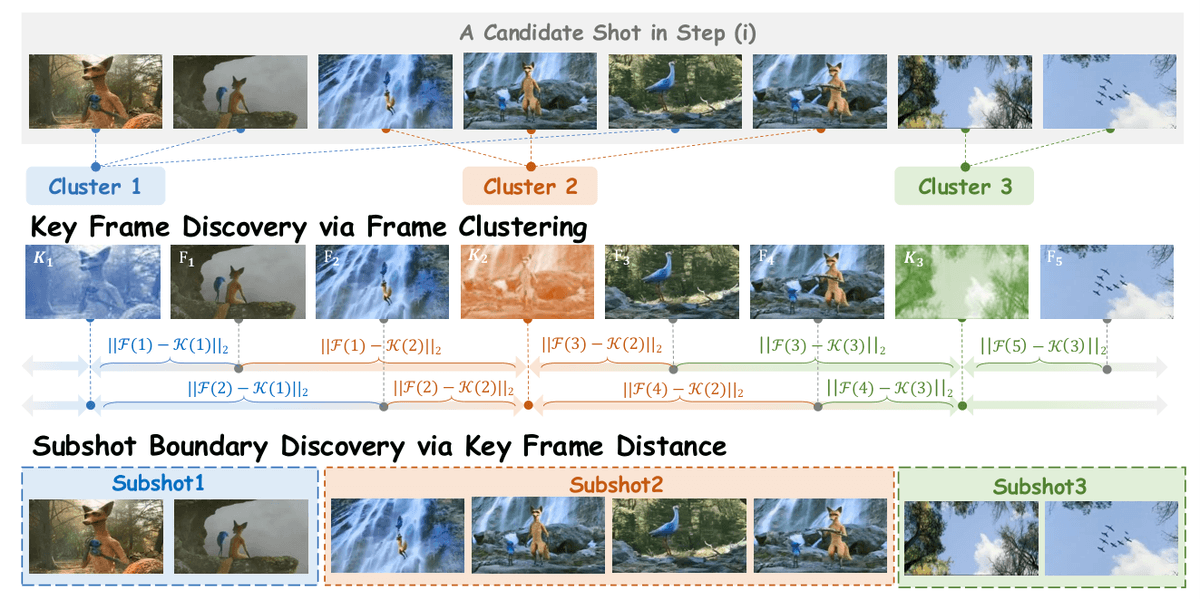
- Shot partition. Selected shots are subdivided in a coarse-to-fine way, zooming in on the frames that matter.
- Shot reflection. The agent checks its own confidence and, if it isn't sure, loops back to grab more shots or partition them further.
The reflection step is where the "chain-of-shot" name earns its keep. Rather than a one-shot retrieve-and-answer pipeline, the agent keeps a running confidence score and votes across iterations, similar in spirit to self-consistency for text reasoning but grounded in visual evidence.
Results on the long-video benchmarks
The team tested on the standard long-video QA suites: VideoMME, EgoSchema, LongVideoBench, and MLVU. VideoChat-A1 achieves 77.0 on VideoMME (w/ subs) and 70.1 on EgoSchema, outperforming its strong baselines InternVL2.5-8B and InternVideo2.5-8B by up to 10.1% and 6.2%. The more striking number is the efficiency comparison against frontier closed-source models: compared to GPT-4o and Gemini 1.5 Pro, VideoChat-A1 offers competitive accuracy, but only with 7% input frames and 12% inference time on average.
That efficiency gap is the real headline. Long-video inference on frontier APIs is expensive because token cost scales with frames processed. If a chain-of-shot agent can hit similar accuracy while feeding the model roughly one-fourteenth of the frames, the economics of running video QA at scale shift substantially.
What it is and isn't good for
The pattern plays to VideoChat-A1's strengths when a question has a clear answer localized in specific scenes: causal questions about a character's action, identifying an object that appears briefly, or reasoning about the ordering of events. It is a natural fit for surveillance analytics, sports moment retrieval, meeting recap tools, and any pipeline where you already have shot boundaries or can compute them cheaply.
The approach is less obviously helpful for questions that require integrating information smoothly across an entire video, like summarization or aesthetic judgments about pacing, where the shot-selection heuristic can throw away context the model actually needs. It also inherits the mistakes of its underlying MLLM: if the base model misreads a shot, the reflection step can vote to confirm the wrong answer rather than correct it.
Getting your hands on it
Code is on GitHub under the SpXace/VideoChat-A1 repo. The setup is straightforward: create a Python 3.12 conda environment, install requirements, and point the config at the datasets and base models you want to use. The repo supports plugging in Qwen2.5-VL-7B, InternVL-2.5-7B, or InternVideo-2.5-8B as the underlying MLLM, and uses EVA-CLIP-8B for frame feature extraction with a sampling strategy borrowed from VideoTree.
conda create -n a1 python=3.12
pip install -r requirement.txt
bash inference.sh
The interesting takeaway isn't just the benchmark numbers. It's that structured, iterative retrieval over shot boundaries can close a large chunk of the gap to closed frontier models without a bigger backbone or more training data, purely by giving the agent a better search strategy over its own input.