
Vi-CD Finds Vision Transformer Circuits 10x Sparser Than Existing Methods
Researchers introduce Vi-CD, the first edge-based circuit discovery method for vision transformers, exposing how ViTs route information and enabling targeted steering against typographic attacks.
Takeaways
- New paper introduces Vi-CD, the first edge-based mechanistic circuit discovery method for vision transformers.
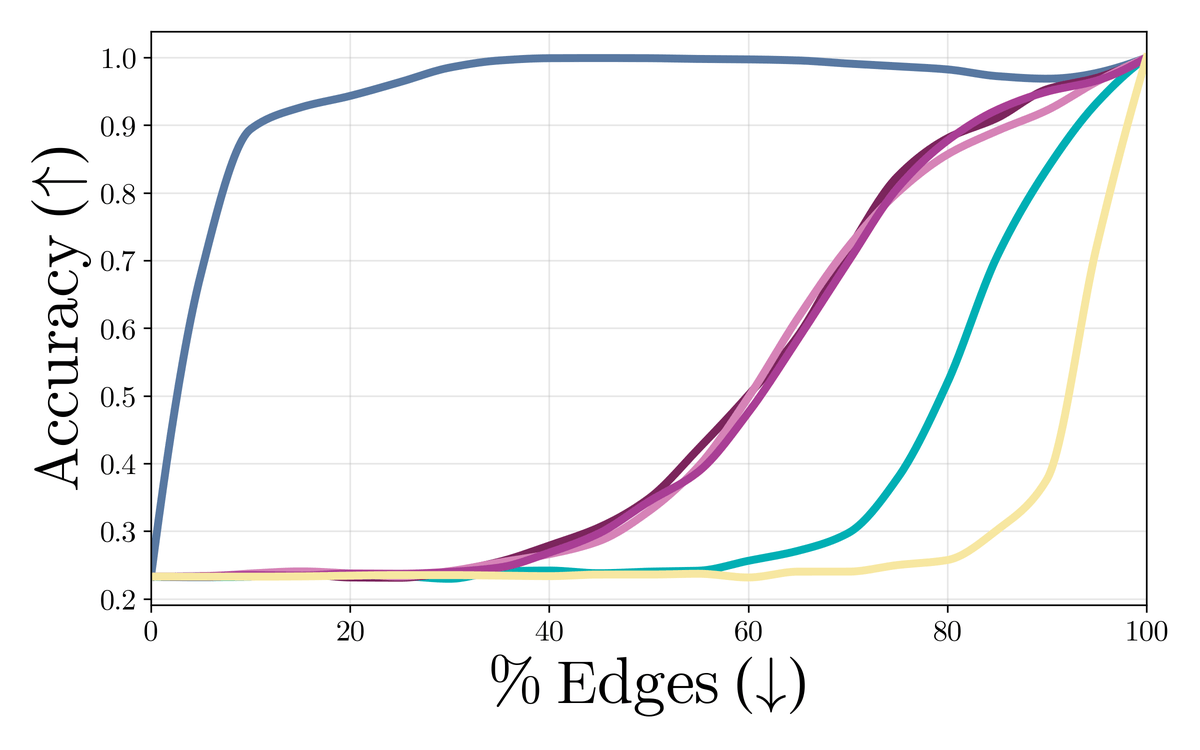
- Recovers class-specific computational subgraphs roughly 10x sparser than gradient baselines EAP and EAP-IG at matched faithfulness.
- Evaluated on supervised ViT-B on ImageNet and OpenCLIP ViT-B/32, using the ViTPrisma library.
- Related classes share more circuit edges than unrelated ones, measured via Jaccard similarity on edge sets.
- Circuit ablation defends CLIP against typographic attacks and RoCOCO danger caption manipulation with minimal clean accuracy loss.
- Authored by Żukowska, Stammer, Schiele, and Fischer; released as an arXiv preprint.
Mechanistic interpretability has become one of the most active corners of AI safety research, but until now it has been largely a language-model story. A new paper, Seeing Through Circuits: Faithful Mechanistic Interpretability for Vision Transformers, drags that toolkit into the vision world by proposing Vi-CD, an automatic method for finding edge-based computational circuits inside vision transformers.
The team behind it, Nina Żukowska, Wolfgang Stammer, Bernt Schiele and Jonas Fischer, argues that vision interpretability has been stuck one level too shallow. Edge-based circuits are well-defined for large language models, yet vision work so far has focused on neuron-based circuits, which reveal what information is encoded without showing how it flows through the wiring of a network. Vi-CD is their attempt to recover that routing.

Why edges beat neurons
In a transformer, a neuron-based circuit tells you which attention heads or MLP units light up for a task. An edge-based circuit is more ambitious: it identifies which connections in the residual stream, meaning which head reads from which earlier head or MLP, actually carry the signal that drives a prediction. Think of the gap between listing the components in a machine and drawing the wiring diagram.
Applied to language models, the approach has produced striking results, showing that specific tasks like indirect object identification live inside tiny subgraphs of the network. Circuit discovery, one main thread in mechanistic interpretability, aims to identify a computational subgraph responsible for a specific task. Porting the idea to vision transformers means treating patch tokens, attention heads and MLP blocks as nodes and searching over the edges between them.