
VGGT-World Beats Video AI on Geometry While Running 5x Faster
Researchers ditch pixel generation entirely, forecasting frozen VGGT geometry features to cut depth error up to 32% while running 5x faster than Cosmos.
 Pro
Takeaways
- VGGT-World forecasts frozen VGGT geometry features instead of generating future RGB video frames.
- Reduces AbsRel by 21% on KITTI and 32% on Cityscapes over the strongest prior baselines.
- Runs 3.6 to 5x faster than Cosmos-12B and Gen3R with only 0.43B trainable parameters.
- Uses z-prediction (clean-target) instead of velocity prediction to handle 1024-D feature space.
- Two-stage flow-forcing curriculum with annealed mixing coefficient mitigates autoregressive drift.
- Forecasting future tokens even improves geometry estimation of the currently observed frame.
World models built on video generation have a dirty secret: they burn most of their capacity rendering textures, lighting, and appearance details, then produce futures that are geometrically broken. Cars drift into impossible positions, walls fragment into floating sheets, and the underlying 3D scene collapses under the weight of photometric plausibility. A new paper from the University of Queensland and Beijing Jiaotong University proposes a sharp alternative: skip video generation entirely and forecast the geometric feature space itself.
The system, called VGGT-World, repurposes the frozen latent tokens of VGGT, Meta's CVPR 2025 best-paper geometry foundation model, as the world state. A lightweight transformer then autoregressively predicts how those tokens evolve over time. The result: it outperforms baselines on depth forecasting while running 3.6 to 5 times faster with only 0.43B trainable parameters.
Why video-latent world models keep hallucinating geometry
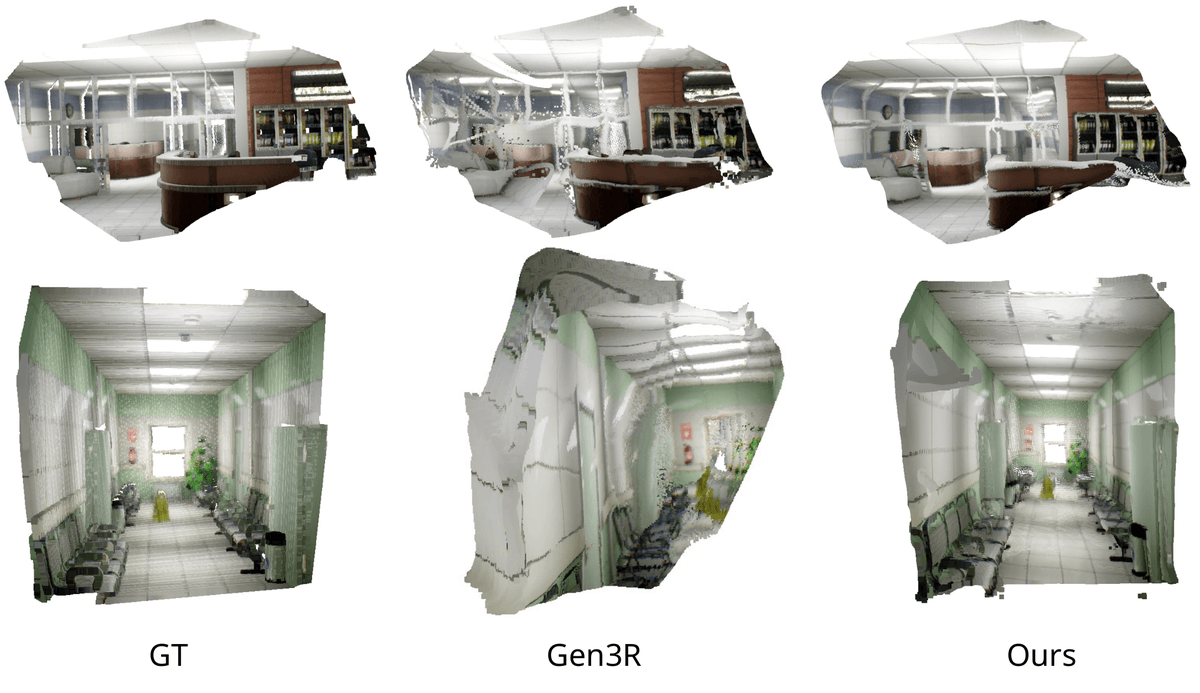
Systems like Cosmos, MovieGen, and Wan compress video into VAE latents with roughly 16 channels, then train diffusion or autoregressive models to reconstruct future RGB frames. The objective rewards photorealism, not 3D consistency. Decoded futures can produce severely distorted geometry, with recovered structure collapsing into fragmented sheet-like surfaces and dynamic objects like cyclists appearing in the wrong location relative to the ego vehicle.
There is also a compute problem. Cosmos reportedly requires tens of millions of GPU-hours, and even Gen3R needs multi-day training on 24 H20 GPUs just to finetune its VAE. That prices most labs out of world modeling entirely.
The authors' bet is that the bottleneck is representation, not architecture. VGGT is a feed-forward model that directly outputs 3D attributes of a scene, including camera parameters, point maps, and depth maps, using an alternating-attention mechanism that interleaves frame-wise self-attention and global self-attention. Its features already encode multi-view geometry and metric structure. Why re-derive that from pixels every step?
The setup: a frozen backbone with a small temporal predictor
VGGT-World splits a frozen VGGT into an encoder (layers 0-4) and a decoder (layers 5-47). The encoder turns each observed frame into a deterministic geometry state, a tensor of tokens in a 1024-dimensional space. A small flow transformer then predicts chunks of future tokens autoregressively, and the frozen decoder plus original 3D heads convert the predicted trajectory back into depth maps and point clouds. No VAE training, no heavy video backbone adaptation.
But directly modeling dynamics in a 1024-D feature space is where things get interesting, because two nasty problems appear.
Why velocity prediction breaks in high-dimensional feature space
Flow matching, the standard training recipe for modern diffusion-style models, usually predicts a velocity vector field that pushes noise toward data. The authors found this simply does not work here. Valid geometry states occupy only a structured subset of the ambient 1024-D space, so isotropic Gaussian corruption mostly perturbs states along off-manifold directions, rendering velocity estimation ill-conditioned. Small velocity errors quickly send trajectories flying off the geometry manifold.
Their fix is to predict the clean target latent directly, called z-prediction, rather than the velocity. The signal-to-noise ratio jump is dramatic during training.

Fighting compounding drift with a flow-forcing curriculum
The second problem is classic autoregressive exposure bias: at inference, the model conditions on its own predictions, but during training it saw only ground truth. Tiny errors compound and the rollout drifts off the manifold.
VGGT-World handles this with a two-stage curriculum:
- Stage 1 uses standard teacher forcing with ground-truth history.
- Stage 2 partially rolls out the model's own ODE solver to an intermediate timestep, then interpolates the partially denoised state with the ground truth using a mixing coefficient lambda that linearly anneals from 0 to 1.
This is smoother than either analytic Gaussian corruption (which knocks features off-manifold) or fully self-generated histories (which are slow and unstable early in training). The paper provides a formal ELBO derivation showing why the curriculum is required for the bound to stay tight.
The numbers
On KITTI depth forecasting, VGGT-World hits mean AbsRel of 0.065 short-term and 0.098 mid-term, versus 0.082 and 0.115 for DINO-Foresight, the strongest prior baseline. On Cityscapes, the AbsRel improvement reaches roughly 32%. Notably, the pixel-space Cosmos-12B underperforms even a trivial Copy-Last baseline that just repeats the previous frame's depth, which is a striking indictment of scaling video generation without geometry priors.
Efficiency numbers are the other headline. Per-frame latency:
| Model | Latency (s/frame) | Trainable params |
|---|---|---|
| Cosmos-12B | 9.50 | 12.0B |
| Gen3R | 6.90 | ~2.7B |
| VGGT-World | 1.90 | 0.43B |
The whole thing trains on a single RTX Pro 6000 GPU.
A surprising side effect: forecasting improves the present
One unexpected finding: predicting the future actually helps reconstruct the current frame. When VGGT sees only two sparse context frames, geometry inference is ambiguous. Aggregating the forecasted future tokens with the observed ones and passing the combined sequence through the frozen decoder produces better completeness and lower Chamfer distance than running VGGT on the current frame alone. The effect peaks around a 7-frame horizon before degrading.
Where it fits and where it does not
This is useful territory for anyone working on embodied agents, autonomous driving perception, or SLAM-adjacent tasks where geometric consistency matters more than pretty pixels. Because the backbone stays frozen, iteration cycles are hours not weeks. Because outputs are depth maps and point clouds rather than RGB, downstream planners can consume them directly.
The limitations are honest. There is no support yet for pose or action conditioning, so the rollouts are not directly controllable, which matters for planning. The self-supervised setup avoids ground-truth depth but also limits how precisely you can steer generation. And scaling to truly heterogeneous, web-scale datasets remains untested. The authors flag both action-conditioned control and larger-scale training as ongoing work.