
Vellore Institute Pushes Quantum Neural Networks from 52% to 98.7% Accuracy
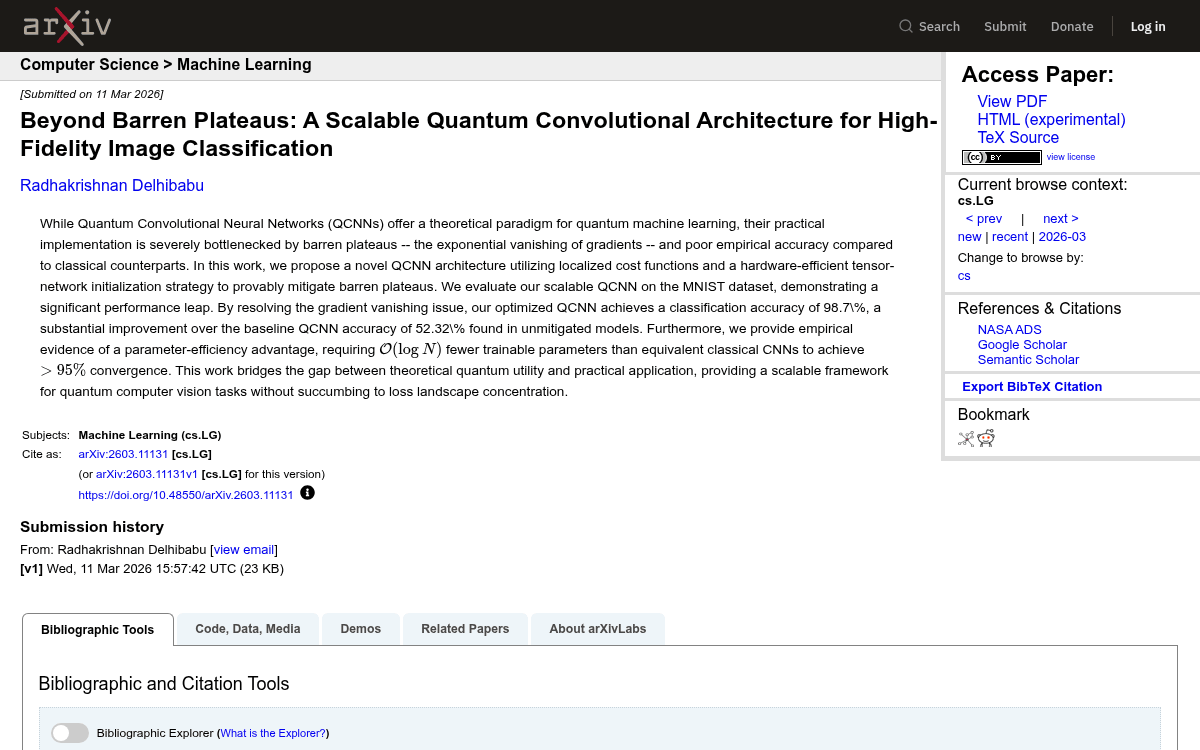
A new quantum convolutional network jumps from 52% to 98.7% on MNIST by combining local cost functions with tensor-network warm starts.
 Pro
Takeaways
- New QCNN architecture hits 98.7% MNIST accuracy, up from 52.32% baseline.
- Localized cost functions turn exponential gradient decay into polynomial decay.
- Tensor Network Initialization warm-starts weights inside the convergence funnel.
- Uses only 45 trainable parameters versus roughly 120,000 for a classical CNN.
- Maintains 94.2% accuracy under 1% depolarizing noise, viable for NISQ hardware.
- Full Cirq and TensorFlow Quantum code is open source on GitHub.
Quantum convolutional neural networks have long looked good on paper and terrible in practice. A new architecture from Vellore Institute of Technology finally closes that gap on image classification, pulling MNIST accuracy from a coin-flip 52.32% to 98.7% while using orders of magnitude fewer parameters than an equivalent classical CNN. The trick is not a bigger circuit but two targeted fixes for the training problem that has haunted variational quantum models: the barren plateau.
The Flat Landscape That Kills Quantum Training
QCNNs translate the weight sharing and hierarchical filters of a classical CNN into parameterized unitary gates and partial-trace pooling. In theory, this gives them logarithmic depth and exponentially fewer parameters than a CNN. In practice, the paper reports that classical CNNs routinely achieve accuracies exceeding 99% on standard benchmarks like MNIST, whereas naive QCNN implementations languish in the 50%–60% range.
The culprit is well known in the quantum ML literature. McClean and colleagues showed that for deep parameterized quantum circuits, the variance of the partial derivative of the cost function decays exponentially with the number of qubits. When the variance of the gradient collapses like this, the loss surface becomes a barren plateau: essentially flat everywhere, so gradient descent cannot tell signal from shot noise. Overcoming barren plateaus is considered key to extracting the full potential of quantum computers in AI applications, and until recently researchers focused on mitigation rather than avoidance.
Two Fixes, One Trainable Network
The paper stacks two interventions on top of a standard QCNN pipeline.
- Localized cost function. Instead of measuring a global projector onto the all-zeros state of the surviving qubits, the model measures single-qubit Pauli-Z expectations and averages them. When the cost function is local, the variance of the gradient transitions from an exponential decay to a polynomial decay, provided the circuit depth scales at most logarithmically with the number of qubits. QCNNs already satisfy that depth condition because each pooling layer halves the active qubit count.
- Tensor Network Initialization (TNI). Before touching the quantum simulator, the QCNN is mapped to a classical tree tensor network and pre-trained on the same data using bounded bond dimension. Those weights are then loaded as the seed for the real quantum circuit, dropping it directly into the convergence funnel rather than a random flat spot.
The gradient behavior is verified empirically. Sampling 500 random parameterizations for qubit counts from 4 to 14, the authors find the global cost variance collapses exponentially, while the localized cost holds roughly 10^-2 at n=10, the qubit count needed for MNIST.
Inside the Circuit
MNIST digits are flattened to 784-dimensional vectors, zero-padded to 1024, normalized, and loaded via amplitude encoding into just 10 qubits. Convolutional blocks apply a hardware-friendly ansatz rather than the general 15-parameter SU(4) decomposition: two Rx rotations, a controlled-Z, then two Ry rotations, in a brick-layer pattern that mimics classical weight sharing. Pooling is implemented as a CNOT-sandwiched Ry rotation followed by tracing out the control qubit, halving the register at each stage.
Gradients are computed with the parameter-shift rule and fed into Adam with exponential decay. The pipeline is built on Google's Cirq and TensorFlow Quantum, with the TensorNetwork library handling the classical TTN pre-training step. Full training runs 150 epochs at batch size 32, with a TNI warm-start of 50 iterations at bond dimension 16.
The Numbers That Matter
On the binary MNIST task of classifying 0 vs 7, the results are lopsided:
- Baseline QCNN with global cost: 52.32% accuracy, trapped in a barren plateau.
- Proposed QCNN with local cost and TNI: 98.7% test accuracy with just 45 trainable rotational parameters.
- Reference classical CNN: 99.9% accuracy, but with roughly 1.2 x 10^5 parameters.
The ablation study is where TNI earns its place. Running the same localized QCNN from uniform random initialization drops initial loss 42% higher than the warm-started version and, more importantly, produces more than a 30% chance of premature convergence to a local minimum that caps accuracy near 88%. The classical tensor network essentially acts as a deterministic funnel into the correct basin.
Holding Up Under Noise
A model that only works on a perfect simulator is not useful for near-term hardware. The authors inject a depolarizing channel after every two-qubit gate and sweep the error probability from 0.1% to 5%. At a 1% per-gate error rate, which is in the neighborhood of current superconducting processors, accuracy only falls to 94.2%. Even at 5% error, the model stays above random guessing.
Two structural reasons for that resilience are worth noting. Local Pauli-Z expectations are naturally decoupled: an error in one branch of the QCNN tree only corrupts the observable it intersects, leaving the other spatial features intact. And the logarithmic circuit depth limits the time window in which decoherence can accumulate.
What You Can Actually Use
The full hybrid pipeline, including the Cirq layer definitions, the TNI protocol, and the localized cost function, is available on GitHub for reproduction. The MNIST setup can be run on the TensorFlow Quantum simulator without physical quantum hardware, and the design maps cleanly onto heavy-hex superconducting topologies once dynamic SWAP routing is added.
The realistic scope is narrower than the headline suggests. This is a binary MNIST classifier at 10 qubits, not a general-purpose vision model. The training loop still relies on parameter-shift gradients, which scale poorly in wall-clock time as the parameter count grows on real hardware. And amplitude encoding assumes you can efficiently prepare the input state, which is nontrivial for unstructured data. But for anyone experimenting with variational quantum models on classical benchmarks, this is a concrete recipe for getting past the barren plateau instead of merely explaining why it exists.