
Vanderbilt's DAE-Aware Safety Filter Keeps Robots and Power Grids From Failing
A new framework fixes a hidden failure mode where standard safety filters silently break on systems with physical conservation constraints.
 Pro
Takeaways
- Standard control barrier functions can silently fail on systems with algebraic constraints, causing infeasibility and safety violations.
- The new DAE-aware CBF framework uses projected vector fields to keep trajectories on the constraint manifold.
- A key lemma links DAE differentiation index and barrier relative degree via
d = nu + d' - 1. - Verification uses sum-of-squares for polynomial barriers and SMT with Z3 for neural network barriers.
- Validated on a wind turbine (index-1) and a flexible-link manipulator (index-2 DAE) with formal safety certificates.
- Open-source implementation on GitHub, built on top of Drake for the QP.
Control barrier functions (CBFs) are the workhorse of real-time safe control. They act as a safety filter: take whatever a nominal controller wants to do, and if it would push the system into an unsafe region, minimally tweak the input at each timestep to keep trajectories inside a certified safe set. The theory is clean for ordinary differential equations. But a lot of the systems we actually care about, including power grids, chemical reactors, and multibody robots, are not pure ODEs. They come with algebraic constraints from physical conservation laws, and that is where the standard machinery quietly breaks.
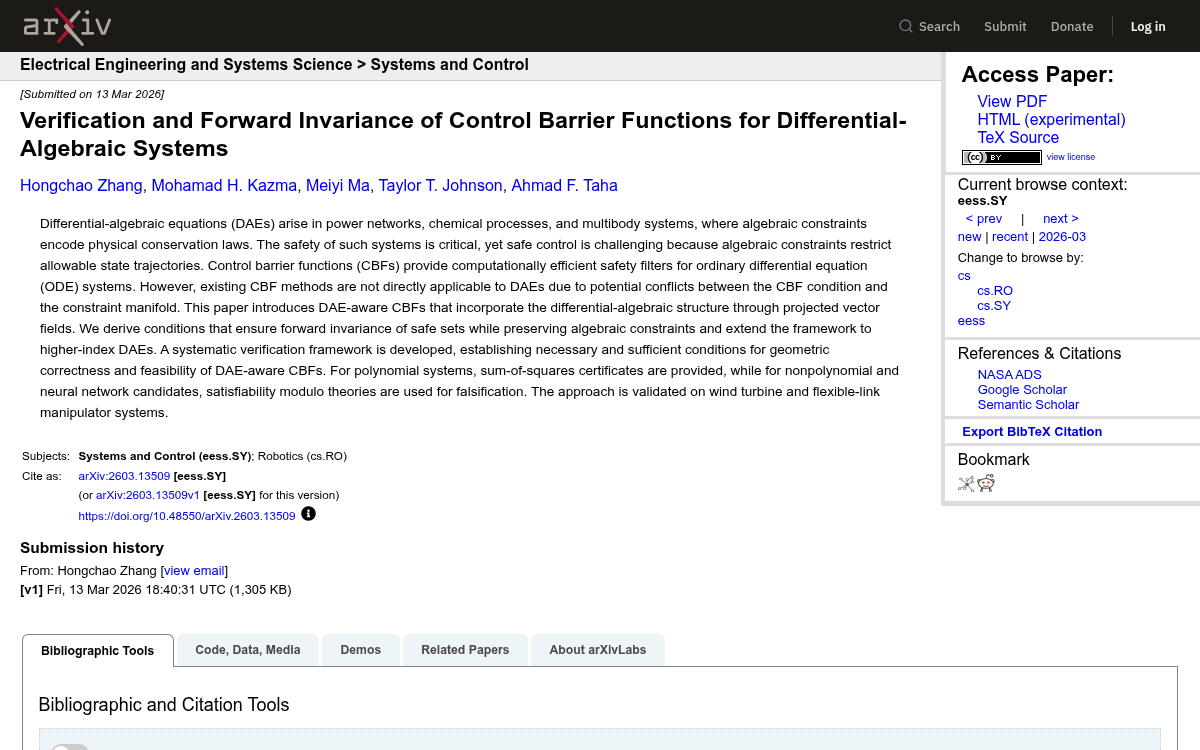
A team at Vanderbilt has now published a framework for CBFs on differential-algebraic equation (DAE) systems, together with a formal verification pipeline and open-source code. The core contribution is a class of DAE-aware CBFs that route the safety condition through projected vector fields on the constraint manifold, plus sum-of-squares and SMT-based verification for polynomial and neural network barrier candidates.
Why standard CBFs quietly fail on DAEs
A DAE has both differential states with dynamics like dx_d/dt = f(x) + g(x)u and algebraic states pinned by an equality phi(x) = 0. That equality defines a hidden constraint manifold that the trajectory must never leave. Existing CBF methods are not directly applicable to DAEs due to potential conflicts between the CBF condition and the constraint manifold.
The failure mode is subtle. The CBF quadratic program searches for a control input that satisfies the barrier inequality, but the input also has to be compatible with the algebraic constraint. Those two requirements can be jointly infeasible even when the state is safely inside the certified region. The paper illustrates this with a wind turbine DAE where a naive CBF-QP evolves happily on the manifold and then abruptly becomes infeasible, dropping the safety function below zero.
Projected vector fields as the fix
The trick is to rewrite the dynamics as if they lived only on the manifold. Differentiating the algebraic constraint with respect to time gives a compatibility condition that ties the algebraic state derivative to the differential dynamics. Solving that with a Moore-Penrose pseudoinverse yields projected vector fields f_hat and g_hat whose trajectories are guaranteed to stay on the manifold by construction.
Once you are on the manifold, you can apply the standard CBF condition using Lie derivatives along the projected fields. The authors prove this works for index-1 DAEs and then generalize to higher-index systems, where the control input only shows up after multiple differentiations of the constraint. A key structural result, Lemma 1, ties the differentiation index of the DAE to the relative degree of the barrier: d = nu + d' - 1. That formula tells you exactly how many derivatives of the barrier are needed before u appears, which in turn determines the order of the high-order CBF hierarchy you need.
Verification: SOS for polynomials, SMT for neural barriers
A barrier candidate is only useful if you can certify two things: geometric correctness (the barrier set actually lives inside the safe set on the manifold) and feasibility (there is always a control input satisfying both the barrier and compatibility conditions). The paper builds a unified verification framework around Farkas duality and the Positivstellensatz.
- For polynomial systems, correctness and feasibility reduce to sum-of-squares (SOS) programs with polynomial multipliers.
- For non-polynomial or neural network barriers, the same conditions become nonlinear programs, solved via SMT falsification with Z3.
- The feasibility check is split into an interior condition and a boundary tangency condition, following Nagumo's theorem, which gives necessary and sufficient conditions rather than the usual sufficient-only guarantee.
Results on wind turbines and flexible manipulators
The framework is validated on two systems of increasing difficulty. The wind turbine is an index-1 DAE where a degree-2 polynomial barrier is verified with SOS in about 11 seconds total, versus roughly 247 seconds for the SMT route. The safety function h(x) stays positive throughout the trajectory, in contrast to the DAE-unaware baseline that dropped to -0.1059.
The flexible-link manipulator is an index-2 DAE with trigonometric nonlinearities. Here the DAE-aware high-order CBF has order d = 2 + 2 - 1 = 3. Despite an aggressive initial swing of 3 rad/s, the controller keeps the end-effector below the 1.8 m safety limit with a margin of 0.23 m. Both a polynomial barrier verified via SOS and an 8-8-tanh-8-tanh-1 neural barrier verified via Z3 are demonstrated, though the SMT verifier hits timeouts on the interior and boundary checks for the neural version.
What it is good for, and what it is not
This is a safety filter you would plug in when the underlying model already has physical equalities you cannot ignore, such as power flow equations, holonomic constraints in mechanics, or mass balance in chemical reactors. The code is available on GitHub and the QP is implemented on top of Drake.
The honest limitations, called out by the authors themselves:
- Scalability of both SOS and SMT verification is still the bottleneck, which rules out large power networks for now.
- The framework assumes an exact model; robustness to uncertain DAEs is open.
- Synthesis of the barrier function itself is not addressed. The wind turbine barrier in the paper is hand-designed, and only its validity is verified.
The real advance is not just extending CBFs to a new class of systems, but making the differential-algebraic structure explicit in both the safety condition and the verification pipeline. Previous DAE-CBF work assumed trajectories stayed in the consistency space without deriving how the control input enforces manifold invariance, and did not handle higher-index DAEs or offer formal verification. Closing those gaps is what turns this from a theoretical curiosity into something you could plausibly deploy on a physical system with hard conservation laws.