
Valeo.ai's LOSC Turns Any 2D Vision Model Into a 3D Lidar Segmenter
A new pipeline transfers 2D vision-language segmentation to lidar scans, beating prior zero-shot methods by wide margins on nuScenes and SemanticKITTI.
 Pro
Takeaways
- LOSC turns off-the-shelf 2D vision-language models into zero-shot lidar segmenters via label consolidation.
- Time-based voxel voting plus augmentation-based label filtering removes noisy pseudo-labels before training.
- Iterative finetuning of a ScaLR-pretrained WaffleIron backbone improves labels across three rounds.
- Beats prior SOTA by 3.2 mIoU on nuScenes and 6.5 mIoU on SemanticKITTI semantic segmentation.
- Panoptic segmentation via ALPINE clustering gains over 10 PQ points versus SAL on both datasets.
- Code and weights are available at github.com/valeoai/LOSC.
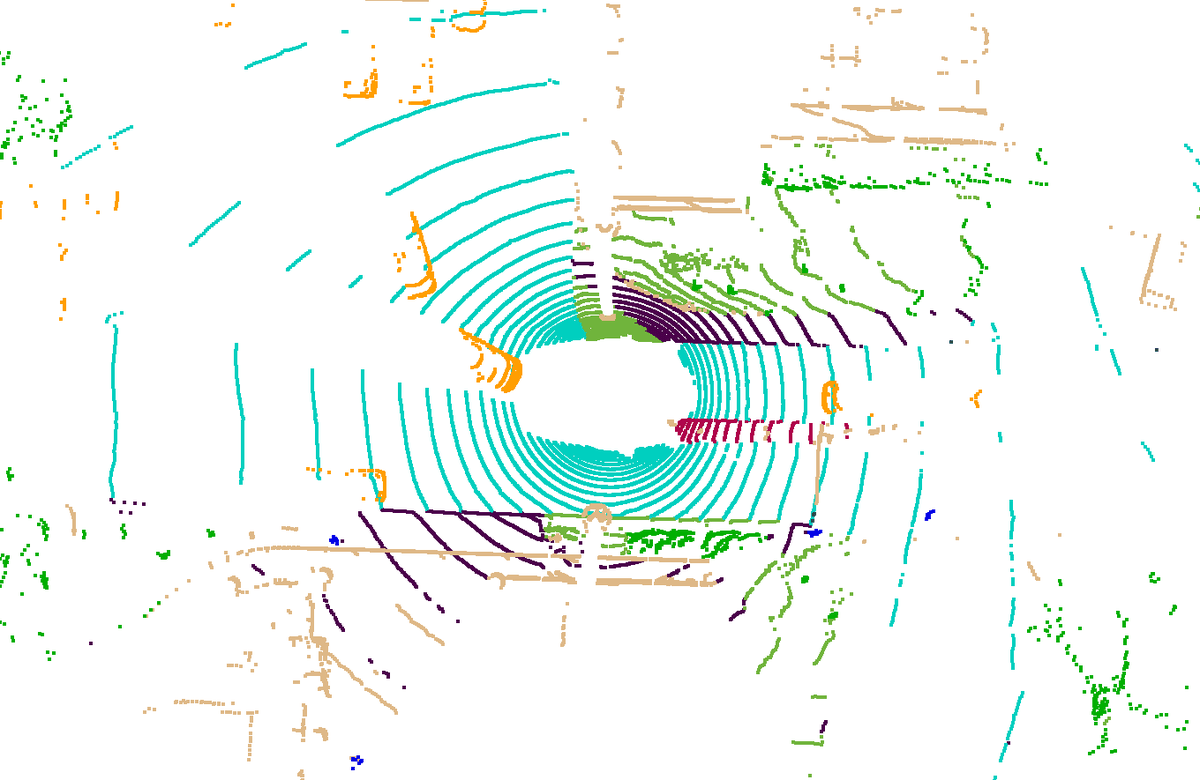
Vision-language models can label almost anything in a photograph, but pointing a lidar at the same street corner is a different story. A new method called LOSC (LiDAR Open-voc Segmentation Consolidator) closes a big chunk of that gap, showing that with the right label cleanup you can turn a generic 2D segmenter into a competitive 3D lidar segmenter without any manual 3D annotations.
Why lidar is the awkward stepchild of open-vocabulary models
Modern VLMs like CLIP and its dense-prediction descendants are trained on huge web-scraped image-text corpora. Point clouds, depth maps, and other 3D formats paired with text are far rarer, so 3D open-vocabulary segmentation lags well behind its 2D cousin. The standard workaround is to run a 2D model on camera images that are calibrated with the lidar, then back-project the pixel labels onto the corresponding 3D points.
That trick sounds clean but breaks down in practice for a few concrete reasons:
- VLMs miss or mislabel segments, and object boundaries get fuzzy.
- Camera and lidar sit at different positions, so parallax can dump a 2D label onto the wrong 3D point.
- Points outside the camera's field of view get no label at all. On SemanticKITTI, where a single 90 degree camera has to cover a 360 degree lidar, roughly three quarters of the scan is dark.
The resulting pseudo-labels are both noisy and sparse, which is a bad training signal for any downstream 3D network.
The core trick: agree with yourself before you train
LOSC, from researchers at Valeo.ai and Ecole des Ponts, is built around a simple idea: only trust labels that survive independent sanity checks. The team layers three consolidation steps on top of the raw back-projected labels, then uses the cleaned labels to finetune a pretrained 3D backbone.

The pipeline runs like this:
- Initial back-projection. Feed each camera image through an off-the-shelf open-vocabulary segmenter (they benchmark Grounded SAM, SEEM, OpenSeg, and OpenSeeD, and pick OpenSeeD with minimal prompts). Project the resulting per-pixel labels onto the lidar points.
- Time-Based Consolidation (TBC). Aggregate a whole driving sequence into one coordinate frame, voxelize at 10 cm, and give every point in a voxel the majority-vote label. Far-away cars that were unrecognizable at 40 meters get correctly labeled once the ego vehicle drives past them.
- Augmentation-Based Consolidation (ABC). Run the VLM ten times per image with different augmentations from the Albumentations library (horizontal flip, hue-saturation, blur, color jitter, auto-contrast, sharpen, chromatic aberration, emboss, fancy PCA, CLAHE). Only keep a point's label if it agrees across every single augmentation, otherwise mark it as ignore. This is essentially test-time augmentation used as a confidence filter.
- Combine the two (ATC). Augmentation filtering throws away a lot of points, which hurts rare classes. For each class the authors check whether enough points survive (they use a threshold of at least 200k points and 1/3 of the time-based count) and pick augmentation-based labels only when the class is well represented, otherwise fall back to the time-based labels.
- Iterative finetuning. Start from a self-supervised WaffleIron backbone pretrained with ScaLR, finetune on the consolidated pseudo-labels for 10 epochs, run inference on the training set, apply TBC again, and repeat. LOSC uses three iterations.
Numbers that justify the plumbing
The consolidation strategy pays off. On nuScenes semantic segmentation LOSC reaches 49.3 mIoU against the previous best annotation-free method GGSD at 46.1, and it beats AFOV (47.9) despite AFOV using images at inference time. On SemanticKITTI, LOSC scores 35.2 mIoU versus 28.7 for SAL, a 6.5 point jump.
Panoptic segmentation, obtained by piping LOSC's semantic output through the learning-free ALPINE clustering method, is where the gap widens: 48.4 PQ on nuScenes versus SAL's 38.4, and 32.4 PQ on SemanticKITTI versus SAL-4D's 30.8. For reference, WaffleIron trained with full ground-truth supervision hits 78.7 mIoU on nuScenes and 63.4 on SemanticKITTI, so there is still real room between annotation-free and fully supervised, but the gap has narrowed considerably.
The ablations are informative:
- Starting from ScaLR-pretrained weights instead of random initialization adds 3.1 mIoU on nuScenes and 16.1 mIoU on SemanticKITTI.
- TBC alone adds roughly 6 and 10 mIoU points on the two datasets.
- ABC on its own barely helps or slightly hurts, but combined with TBC it adds another 1.6 to 2.1 points.
- Iterative finetuning gives diminishing but consistent gains up through the third round.
Where it falls over
The failure modes are honest and predictable. Flat surface classes bleed into each other: road, sidewalk, and terrain frequently get confused because the visual differences at pixel level are subtle. On SemanticKITTI the model systematically merges tree trunks into vegetation, and classwise IoU is zero for several fine-grained categories including bicyclist, motorcyclist, parking, other-ground, trunk, and pole, mostly because OpenSeeD does not distinguish them well from their parent categories.
Moving objects are a theoretical wrinkle for voxel-level majority voting, but the authors argue that with a 10 cm voxel and 2 to 10 Hz frame rates, two different-class objects almost never contaminate the same voxel in practice. The panoptic results back that up.
Why this matters
The real breakthrough is not any single mechanism, it is the demonstration that you can treat a 2D VLM as a completely black box and still build a strong 3D segmenter around it. No prompt engineering, no VLM finetuning, no custom architecture, and only a handful of parameters (tau between 1/4 and 1/2, three iterations, 10 cm voxels) that transfer across datasets without tuning.
For autonomous driving teams staring at the cost of manual lidar annotation, that is a practical recipe: pick your class list, write minimal text prompts, run OpenSeeD on your existing camera footage, and let the consolidation pipeline do the rest. The code is available on GitHub under the valeoai organization, and the method uses publicly released ScaLR pretrained weights for the WaffleIron backbone. As the authors note in the paper's conclusion, the same recipe would work on top of any strong 2D segmenter, not just an open-vocabulary one, which makes it a useful template for domain-specific 3D labeling well beyond driving.