
UW Study Warns AI Monoculture Collapses Knowledge Faster as Models Scale
New research shows that segmenting training data across multiple models beats one giant model when synthetic outputs recycle through the pipeline.
 Pro
Takeaways
- Training a single large model on all available data amplifies collapse over long horizons of synthetic data recycling.
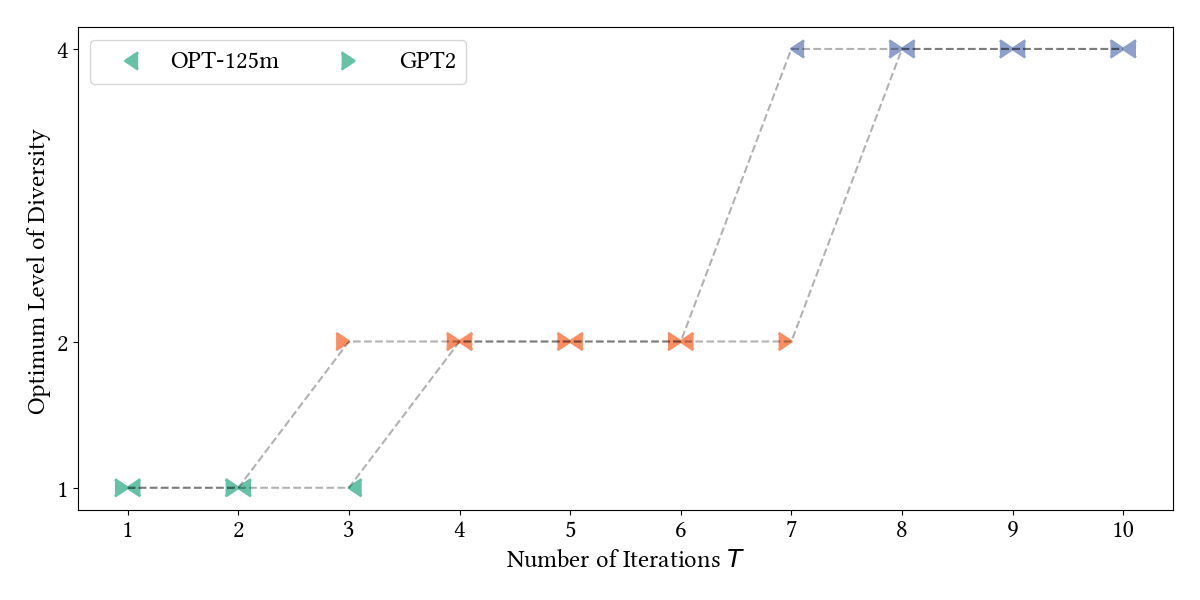
- Optimal number of models in an ecosystem grows monotonically with self-training iterations.
- At 10 iterations, four segmented OPT-125M or GPT-2 models beat a single model trained on the full dataset.
- Scaling to OPT-350M amplifies collapse in homogeneous ecosystems, inverting standard neural scaling laws.
- Injecting 10% real data or raising sampling temperature helps less than adding model diversity.
- Authors propose Effective Data Quality (EDQ) to explain why redistributing outputs across dissimilar models preserves informativeness.
A widely held assumption in machine learning is that the best model is the biggest one trained on the most data. A new paper from the University of Washington's Center for an Informed Public pushes back on that idea, arguing that when models increasingly train on each other's outputs, a single dominant model is a recipe for long-term collapse. Instead, an ecosystem of smaller, differentiated models can preserve knowledge better over time.
The work, titled Epistemic diversity across language models mitigates knowledge collapse, treats the AI landscape less like a horse race and more like an ecosystem, borrowing ideas from ecology and philosophy of science to ask a simple question: how much diversity across models is optimal?
The recycling problem
Model collapse is a degenerative process in which generative models re-trained on their own outputs begin producing homogeneous, biased, and nonsensical outputs. As AI-generated text floods the internet and gets scraped into the next round of training data, the concern is that the distribution of ideas represented in models keeps narrowing. This homogenization in model-generated data may contribute to knowledge collapse, a degradation to a narrow, and potentially inaccurate, set of ideas.
Prior work has focused on preventing this at the single-model level, mostly by mixing in fresh human data or filtering synthetic examples. In most experimental settings such methods cannot entirely prevent performance decay, and it is often infeasible technically and practically to constantly source with fresh data or reliably separate real from artificial data. The authors take a different angle: what if the fix is not better data, but more different models?
Segmenting the data pool
The experimental setup is deliberately simple. The team takes a pre-trained base model (OPT-125M or GPT-2) and creates ecosystems of 1, 2, 4, or 16 fine-tuned copies. All models begin as identical copies of a pre-trained model but are fine-tuned on equal-sized, non-overlapping subsets of the training data. The dataset is Wikitext2, and the total token budget per ecosystem is held fixed, so a 16-model ecosystem gives each individual model only 1/16 of the data.
Each iteration works like this:
- Every model generates continuations for its slice of prompts using five-way beam search.
- All generated outputs get pooled, shuffled, and redistributed uniformly across the models.
- Each model fine-tunes on its new slice for 5 epochs.
- Perplexity is measured on the original Wikitext2 test set.
Diversity is quantified using the Hill-Shannon Diversity, which reflects the effective number of distinct, equally common elements in a population. Because all models are weighted equally, diversity simplifies neatly to the number of models M in the ecosystem.
The monotonic result
Ten self-training iterations later, a clear pattern emerges. In the primary approach, the single-model setting performs best only in the short term, considering fewer than four iterations for OPT-125M and fewer than three iterations for GPT2. Ecosystems with lower diversity perform well initially but exhibit rapidly increasing perplexity as the number of iterations grows. The 16-model ecosystem starts out worse (each model saw less data), but degrades far less, and eventually wins.

Across the full 10 iterations, a diversity level of four yields the lowest aggregated mean perplexity for both model families. More importantly, the optimum keeps shifting: the more times synthetic data cycles through the system, the more segmentation you need. Extended runs out to 20 iterations show the trend continues.

Scaling makes it worse, not better
Here is where the finding gets uncomfortable for frontier labs. The team ran the same experiment with OPT-350M and the full 2.1M-token Wikitext2 corpus. The benefits of diversity increase as both model size and dataset size scale. The most pronounced effect of larger models is the amplified collapse of low-diversity ecosystems, leading to the observed shift in the optimal diversity level.
In other words, scaling laws invert once the ecosystem enters what the authors call a low effective-data-quality regime. Bigger models trained on more recycled data collapse harder, not softer. This aligns with prior theoretical work from Dohmatob et al. on strong model collapse.
Robust to the usual fixes
The authors tested two standard collapse-mitigation strategies to see whether they change the picture:
- Injecting 10% real data at every iteration improves performance overall, but mainly helps the most homogeneous ecosystems. The optimal diversity curve barely moves.
- Temperature sampling at τ = 0.5, 1.0, and 2.0 shows similar marginal effects. Higher temperatures actually hurt diverse ecosystems.
The positive effect of ecosystem diversity exceeds these improvements. Diversifying models matters more than diversifying data within a single model.
Effective Data Quality
To explain why, the paper introduces Effective Data Quality (EDQ). Standard measures of data quality compare training data to the true distribution. EDQ instead measures the gap between the training data and the true distribution relative to the gap between the model itself and the true distribution. The intuition: data that just mirrors what a model already knows is not useful to it, even if the data is technically high quality.
In a diverse ecosystem, model A produces outputs that are low-EDQ for itself but high-EDQ for model B, because B has a different learned distribution. Redistributing outputs across dissimilar models effectively upgrades the informativeness of the shared data pool. In a monoculture, that mechanism is absent, and each model just reinforces its own blind spots.
What it means in practice
The paper does not claim any single frontier model has already collapsed. But the trajectory is worth watching. Given the current trajectory toward AI monoculture, a shift toward greater model diversity appears necessary to sustain long-term knowledge production. Concrete implications:
- Benchmark scores at a single point in time miss ecosystem-level dynamics. Model similarity may itself be a leading indicator of collapse risk.
- Domain-specific and community-specific models are not just a fairness nice-to-have; they may be structurally necessary for the ecosystem's health.
- Combining different model families (the authors tested OPT + GPT-2) yields larger diversity benefits than segmenting a single family, suggesting architectural pluralism compounds with data pluralism.
There is no code repository linked in the paper itself, but the experiments use standard HuggingFace Transformers and PyTorch Lightning on publicly available OPT-125M, GPT-2, and Wikitext2, so the setup is straightforward to reproduce. The limits are also worth noting: 125M and 350M parameter models are tiny by current standards, and Wikitext2 is a narrow corpus. Whether the same U-shaped diversity curve appears at trillion-parameter scale on internet-scale data is an open empirical question, though the trend the authors observe suggests the effect grows rather than shrinks with scale.