
UW's OmniReset Teaches Robots Dexterous Manipulation Without Human Demonstrations
A new reinforcement learning recipe replaces demos, curricula, and reward tuning with diverse simulator resets, letting robots learn contact-rich manipulation that transfers zero-shot to hardware.
 Pro
Takeaways
- OmniReset replaces per-task reward engineering, curricula, and demos with diverse simulator resets sampled across four interaction regions.
- Uses vanilla PPO with fixed hyperparameters and a single task-agnostic reward shared across all six manipulation tasks tested.
- Outperforms BC-PPO, DeepMimic, and demo-curriculum baselines across long-horizon, contact-rich tasks with wide initial condition ranges.
- Distilled RGB policies transfer zero-shot to a UR7e arm at 85% success on peg insertion versus 2% for behavior cloning.
- Scaling parallel environments is essential for value propagation from near-goal states back to reaching states.
- Details, code, and videos at the OmniReset project page and on arXiv.
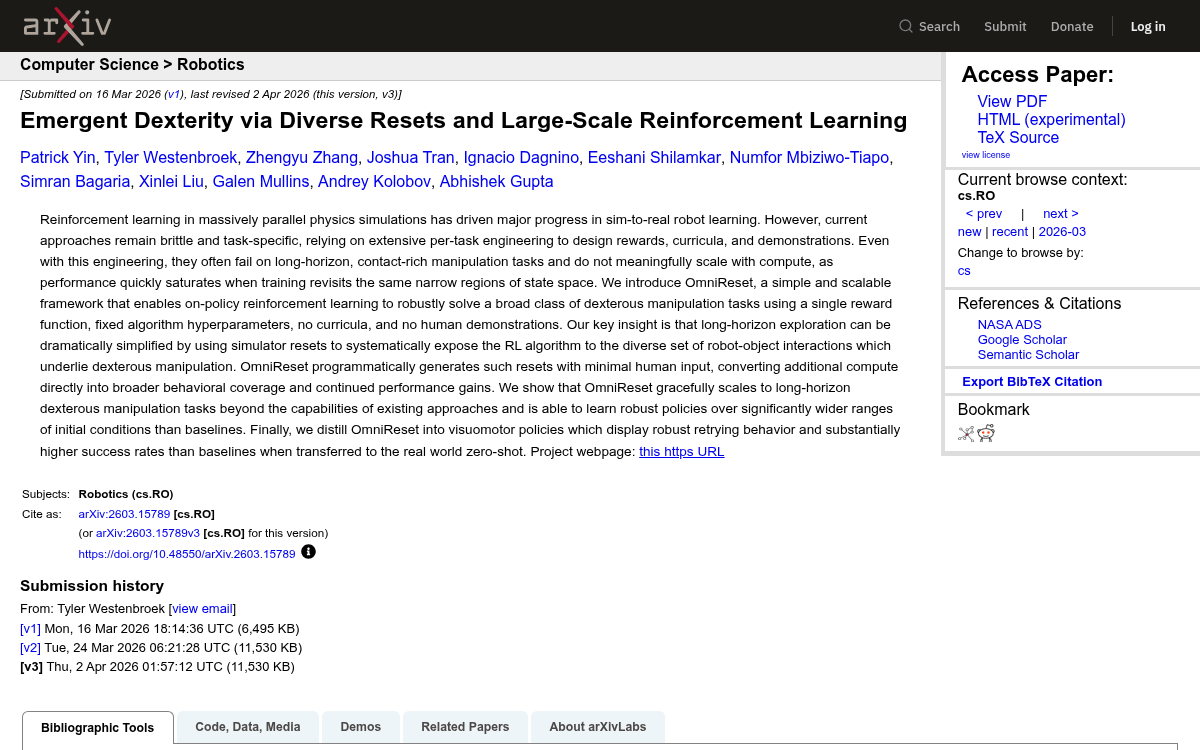
Reinforcement learning has powered a wave of sim-to-real breakthroughs in legged locomotion, but manipulation has been stubbornly resistant. Every new pick, twist, or insertion task tends to demand fresh reward shaping, hand-designed curricula, or human demonstrations, and even then policies stall long before they use all the compute you throw at them. A new framework called OmniReset from researchers at the University of Washington, NVIDIA, and Microsoft Research takes a different route. Instead of teaching the agent how to solve the task, it teaches the simulator how to start the task in interesting places.
The result is a scalable PPO recipe that solves long-horizon, contact-rich manipulation with fixed algorithm hyperparameters, no curricula, minimal reward engineering, and no human demonstrations, and produces vision-based policies that transfer to a real UR7e arm zero-shot.
Why manipulation RL keeps hitting a wall
The authors diagnose the core issue bluntly: the central bottleneck in robotic RL is that standard exploration techniques saturate as parallelism and compute are scaled, repeatedly sampling a narrow state-action distribution and becoming trapped in local minima. You can spin up 8,000 parallel environments, but if they all reset the robot to the same starting pose, the agent keeps rediscovering the same failure modes.
The usual patches are labor-intensive. Practitioners inject prior knowledge through task-specific reward shaping, hand-designed curricula, or user-provided demonstrations, or they bolt RL onto motion planners so that policy learning only handles the contact-rich phase. Each fix works, and each also caps how much the system can improve with more compute.
Reset the world, not the algorithm
OmniReset's premise is that dexterous behaviors, while diverse in appearance, share a small set of recurring interaction modes: approaching an object, initiating contact, forming a stable grasp, and manipulating near a goal. If you can seed training with dense coverage over those modes, sparse rewards propagate cleanly through the value function and the policy learns to stitch modes together on its own.
Rather than a curriculum that orders states from easy to hard, the framework samples from four programmatically generated reset regions on every episode:
- Reaching resets: target object scattered on the table, gripper spawned anywhere in the workspace.
- Near-object resets: gripper placed at a pre-computed grasp point on the object with a small random offset, gripper randomly open or closed. Covers both non-prehensile pushing and grasp initiation.
- Stable grasp resets: object floating in the air with the gripper already holding it at a feasible grasp point.
- Near-goal resets: object spawned at small perturbations from the goal, gripper in contact. This is where insertion and twisting behavior gets its success signal.

Feasible grasps come from the grasp sampler of Mittal et al., which computes a set of 1000 feasible grasp points on the target object. Feasible near-goal offsets are generated by spawning the object at the goal and applying small random forces until it dislodges. All of this happens in an offline pass that rejects invalid samples via collision checking, and the validated resets are cached on-GPU for efficient sampling during training.
The resets aren't connected by any graph or ordering. Paths between them are determined entirely by RL, and any dynamic behavior between these states is emergent from the learning process. In the Drawer Insertion task, for example, the policy converges on a non-prehensile strategy where it repeatedly flips the drawer and pushes it in, ignoring the grasp resets entirely.
The rest of the recipe
Everything else is deliberately vanilla. The reward is a single fixed weighted sum shared across all tasks: a sparse success bonus, a distance-to-goal term, a reach term, an action smoothness penalty, and a termination penalty for unsafe states. No task ever gets its own tweak.
Training uses PPO with an asymmetric actor-critic setup, where the critic sees privileged simulator state and the actor sees only what a real robot would observe. The policy uses generalized state-dependent exploration noise (gSDE), which conditions Gaussian action noise on features from the policy's final layer so exploration strategy can differ across regions of state space, useful for tasks with distinct sub-stages.
Scaling the parallel environment count matters too. Ablations show that small batches can learn to succeed from near-goal states but fail to backpropagate value all the way to reaching states, so the multi-stage behavior never emerges. Large batches prevent catastrophic forgetting while value information flows backwards from the goal.
What the numbers look like
The team benchmarks on six tasks including Leg Twisting, Drawer Insertion, Peg Insertion, Cube Stacking, Wall Slide, and Cupcake Placement, each in Easy and Hard variants (Hard uses a much wider initial condition distribution). Baselines are BC-PPO, DeepMimic-style reward augmentation, and a demo-based auto-curriculum in the spirit of DemoStart, all given 100 successful demonstrations that OmniReset does not receive.

OmniReset dominates across the board, and the gap widens on the Hard variants where baselines mostly fail to make meaningful progress. A robustness study perturbing initial conditions with forces from 0 to 5N shows the same pattern: baseline success rates fall off quickly under small perturbations, while OmniReset barely moves.
For real-world transfer, the state-based policies are distilled into RGB visuomotor policies via student-teacher distillation using 80,000 expert rollouts with synchronized images and actions, running an ImageNet-pretrained ResNet-18 encoder feeding a Gaussian MLP head at 10Hz. Zero-shot deployment on the UR7e arm produces:
| Task | State RL (Sim) | Distilled RGB (Real) | BC Baseline (Real) |
|---|---|---|---|
| Peg Insertion | 94.97% | 85.37% | 2.44% |
| Leg Twisting | 93.94% | 56.36% | 1.82% |
| Drawer Assembly | 89.60% | 15.38% | 1.92% |
The behavior cloning baseline trained on 100 real demonstrations essentially never succeeds, while the distilled OmniReset policies clear tasks even after multiple failed attempts. Qualitatively, the visuomotor policy exhibits robust retrying behavior, recovering from initial failures and eventually completing the task.
The catch, and what it means in practice
The framework has real limitations. It depends on the grasp sampler working well, which is a problem for highly non-convex objects. Bimanual manipulation and multi-fingered hands would require pre-computing more complex contact configurations, and it is an open question whether the same reset design scales there. Distilled RGB policies also lag their state-based teachers substantially in simulation (roughly 50% success versus 90%+), suggesting DAgger-style online adaptation or RL fine-tuning on pixels is needed to close the gap.
The bigger story is that this looks like the manipulation equivalent of the scaling-is-enough lesson that transformed language modeling. If you make the exploration problem trivially easy by sampling directly from the right states, an off-the-shelf PPO implementation with an unremarkable reward can absorb massive amounts of compute and produce contact-rich, multi-stage skills that generalize to hardware. Code and additional videos are on the project webpage, and the framework is built on top of IsaacLab.