
UW's LandSalp Robot Tracks Its Own Shape Without Encoders or Cameras
A three-link, thruster-driven robot learns to estimate its own shape and pose using only gyroscopes, Gaussian process residuals, and a Kalman filter.
 Pro
Takeaways
- LandSalp, a three-link salp-inspired robot, estimates shape and pose from gyroscopes alone via GP-augmented UKF.
- Gaussian processes learn residual errors of the physics model, handling non-Gaussian, non-zero-mean noise the standard UKF cannot.
- Multi-gait training generalizes as well as single-gait training, cutting per-gait data requirements substantially.
- Joint angle observability rises and falls with thruster input magnitude, quantified via a measurement Jacobian heuristic.
- Pose drifts as expected without absolute position updates; shape estimates stay accurate without joint encoders.
- Currently offline in MATLAB; future work targets FloatSalp marine robot and neural network replacements for GPs.
Estimating where a robot is and how it is bent, using only a few cheap sensors, is one of those problems that sounds trivial until you remove the encoders, GPS, and cameras. A team from the University of Washington and Oregon State University tackled exactly that setup on LandSalp, a three-link chain robot inspired by salps, the jellyfish-like marine animals that form colonies and swim by jetting water.
Their proof-of-concept shows that shape can be reliably recovered on a free-floating, underactuated multi-link robot equipped with nothing but one gyroscope per link, provided you augment a classic Kalman filter with a data-driven correction that handles ugly, non-Gaussian noise.
A robot that can barely feel itself
Prior state estimation work for multi-link and snake robots has used Kalman filters to fuse information from multiple sensors into state and pose estimates, but those systems carried joint angle encoders and were directly controlled via torque or position control at the joints. LandSalp has none of that. Its joints are passive, and each link carries a thruster at its center of mass plus a single gyroscope. Moving or turning the chain requires cyclic, reciprocating thruster patterns called gaits, similar to how salps rhythmically pulse water.
Underactuated dynamics plus minimal sensing means the estimator has to figure out both the pose (position and orientation of the whole chain in the plane) and the shape (the two inter-link joint angles) from angular velocity readings alone.

The filter that learns its own mistakes
An initial sanity check killed the obvious approach. Comparing model predictions against motion capture and gyroscope data revealed that the resulting error residuals had non-zero mean and non-Gaussian statistics, which breaks the assumptions a standard Kalman filter relies on. The authors' fix is an Unscented Kalman Filter augmented with Gaussian processes (GPs), non-parametric models that predict a mean and a variance for any input.
They use the Enhanced-GP variant, where GPs model the process and measurement residuals rather than the full process and measurement models. The physics-based kinematic model does the heavy lifting, and the GP just learns the systematic error the physics leaves behind. Eight GPs are trained in total, one per output dimension.
The pipeline for each timestep looks like:
- Predict the next state using the physics-based kinematic model.
- Add the GP mean residual as a correction term.
- Use the GP predicted variance as the process/measurement noise covariance.
- Fold everything into the standard UKF update.
What the experiments show
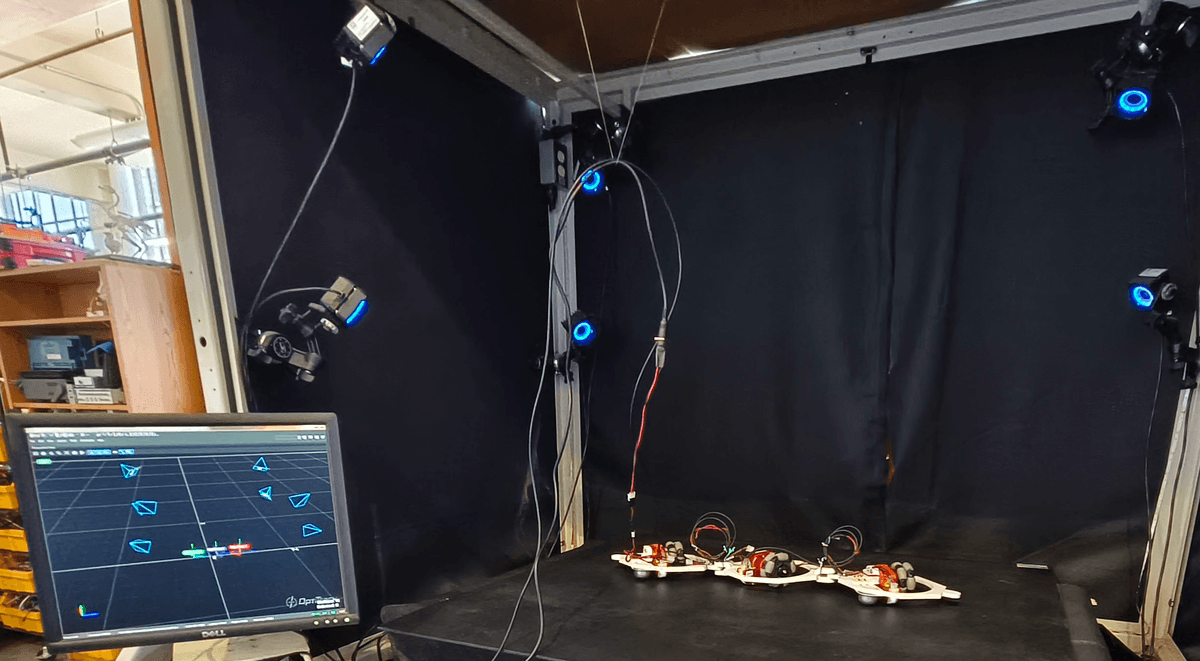
The team ran the robot on a flat platform with OptiTrack motion capture serving as ground truth, comparing two training regimes: one trained only on forward-gait data and one trained on an equal mix of forward, backward, left, right, and turning gaits. Both datasets held 2250 points collected over 450 seconds, downsampled to 5 Hz.
Two findings stand out:
- Shape estimates hold up. Joint angles are tracked accurately without any encoders, and pose drifts slowly, exactly what you would expect from a dead-reckoning system integrating gyroscope readings.
- Training generalizes across gaits. A GP trained on the multi-gait dataset performs comparably to one trained exclusively on forward-gait data, revealing an overlap in the gait input space. Fresh training data is not required for every possible motion.
When pushing harder makes you easier to see
A subtler contribution is a heuristic built from the observability Gramian that connects estimator confidence to the gait itself. The joint angle covariance rises and falls periodically with the gait cycle, and the authors show that a norm of the measurement Jacobian, computed per actuator, tracks these swings. When the thrusters push harder and in the right directions, the joint angles become more observable and the filter tightens its estimates.
Gait design and estimator design are therefore coupled. You can pick trajectories that make the robot easier to estimate, not just easier to move, which opens the door to observability-optimal gait design as a first-class objective.
Where it fits, and where it breaks
The work is currently an offline analysis. Porting the training pipeline and filter to Python or C++ would allow faster training on larger datasets, and as multi-link systems scale to tens or hundreds of links, the state space grows significantly in dimension, making the GP input space increasingly difficult to cover. GPs scale poorly with data size, so a neural network or Bayesian linear regression is floated as a future replacement for larger chains.
The immediate target is underwater robotics, specifically FloatSalp, a three-link marine surface robot the team is developing. The framing applies anywhere you have a chain of rigid bodies with weak sensing: tethered spacecraft, modular inspection robots, and eventually soft robots where joint encoders are simply not an option. No code accompanies the paper, and training was done with MATLAB's fitrgp using default hyperparameters, a deliberate choice to show the method works without heavy tuning.