
UW and MIT's SPADE Trains AI to Write and Solve Its Own Challenges
A single LLM plays both game designer and player, writing its own training environments as executable Python and improving 30B models by 8.1 points.
Takeaways
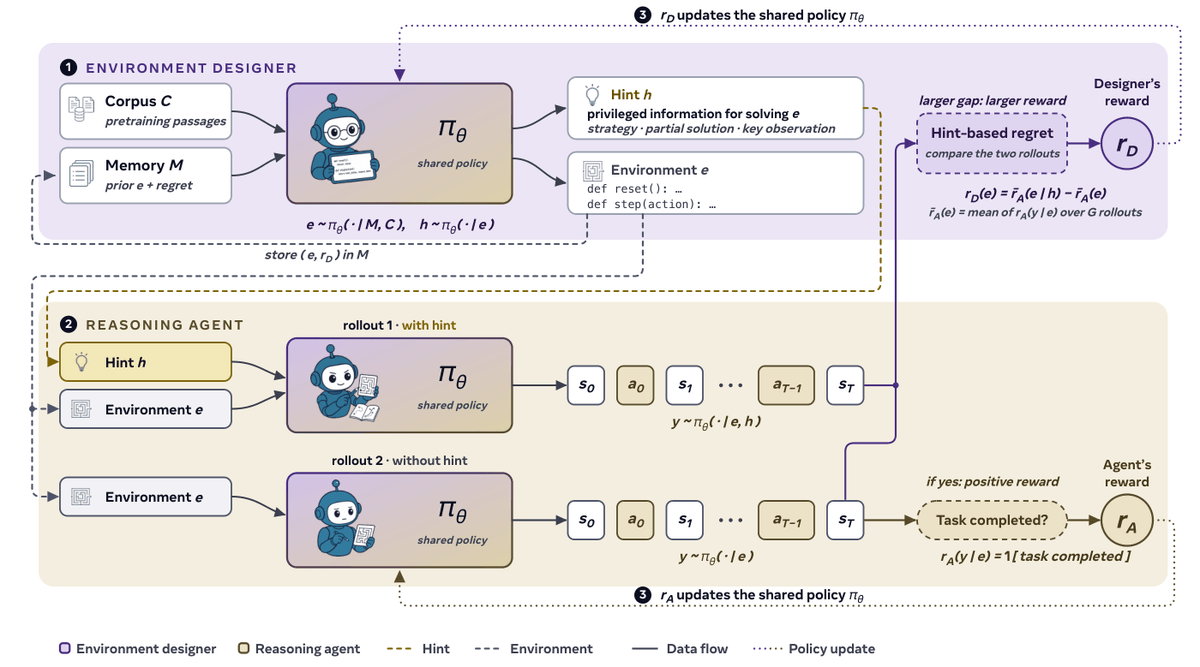
- SPADE trains one LLM to play both Environment Designer and Reasoning Agent, writing Gym-style Python environments as code.
- Hint-based regret rewards the designer for environments the agent solves with a hint but not without one.
- At 30B scale, gains reach +8.1 over base and +5.3 over the strongest fixed-environment baseline across 8 held-out benchmarks.
- Tool-use gains: +13.9 on ACEBench-Agent and +5.7 on BFCL v4 multi-turn at 30B-A3B.
- Corpus grounding is what sustains diversity; without it, generation collapses to one task family (Vendi 0.68 vs 0.04).
- Code, configs, models, and a live browser demo of generated environments are available at github.com/spade-rl/spade.
Training reinforcement learning agents on language tasks keeps hitting the same wall: the environments run out. Whether hand-curated by humans, generated by a frozen synthesizer, or scraped from static pools, the goals stop adapting once the learner catches up. A new paper from a team spanning University of Washington, Stanford, CMU, and MIT proposes a way out. Their framework, SPADE, has a single language model take on two roles at once: it writes the training environments as executable Python code, then trains itself to solve them.
The result is a self-play loop where the curriculum keeps moving with the learner. Continuous self-improvement requires an ever-expanding pool of self-generated, diverse, adaptive goals, yet existing environment pools keep the goal distribution fixed as the learner scales. SPADE tries to break that ceiling by making environment design itself a learnable role trained via RL.
Why fixed environment pools are the new bottleneck
Modern agentic AI progress increasingly comes from RL on interactive tasks with verifiable rewards, not just pretraining. That has turned environment supply into a major industry investment, with labs weighing environment budgets exceeding $1 billion a year and startups raising nine-figure rounds to supply them. Every existing option has a ceiling:
- Hand-curated environments scale only as fast as humans can write them.
- Synthetic generation with a frozen generator saturates once the model exhausts the fixed distribution.
- Prior self-play methods generate single-turn tasks or question-answer pairs, rather than full multi-turn environments with state transitions and reward functions.
- Ungrounded self-play collapses onto the model's own biases, what the authors call the invisible leash.
None of these produces a system whose training tasks keep growing in complexity as the agent improves.
One model, two roles, code as environment
SPADE formalizes this as a two-role self-play game. The same LLM, switched by system prompt, either acts as the