
UW and Caltech's RQRE-OVI Beats Nash in Multi-Agent Robustness by 3x
RQRE-OVI replaces brittle Nash equilibria with a unique, risk-sensitive solution concept that provably converges and outperforms Nash in cross-play scenarios
 Pro
Takeaways
- Core problem: Nash equilibrium in multi-agent RL is computationally intractable and brittle — tiny Q-value estimation errors can cause discontinuous policy jumps.
- Proposed solution: RQRE-OVI replaces the Nash oracle with a Risk-Sensitive Quantal Response Equilibrium solver, combining bounded rationality (ε) and risk aversion (τ) for a unique, stable equilibrium.
- Key theory: The RQRE policy map is provably Lipschitz continuous in payoffs (unlike Nash), with a finite-sample regret bound scaling as Õ(L_env · B · √(K·d³·H³)).
- Cross-play dominance: In Overcooked, RQRE agents achieve 2–3× the reward of Nash-based partners when paired with unseen agents at test time.
- Tunable tradeoff: Higher risk aversion improves robustness but reduces peak self-play performance, exposing a Pareto frontier between the two objectives.
- Code available: Open-source implementation allows drop-in replacement of Nash oracles in existing OVI frameworks.
Nash equilibrium has long been the gold standard for multi-agent reinforcement learning, but it comes with a dirty secret: it can be computationally intractable, non-unique, and catastrophically brittle when agents encounter partners they weren't trained with. A new paper from researchers at the University of Washington and Caltech proposes a principled alternative , and backs it up with both theory and experiments.
The paper introduces RQRE-OVI (Risk-Sensitive Quantal Response Equilibrium with Optimistic Value Iteration), an algorithm that targets a different equilibrium concept altogether: one that is unique, smoothly varying, and provably robust to partner perturbations. The results show that RQRE-OVI matches Nash-based methods in self-play while dramatically outperforming them when agents are paired with unseen or noisy partners.
Why Nash Breaks Down
In multi-agent RL, the standard goal is to find a Nash equilibrium , a joint policy where no agent can improve by deviating unilaterally. Nash equilibrium is computationally intractable in general and brittle due to equilibrium multiplicity and sensitivity to approximation error. The brittleness problem is especially severe under function approximation: Q-values are estimated with error, and when a game admits multiple Nash equilibria, tiny perturbations in those estimates can cause an algorithm to jump between entirely different equilibrium strategies across episodes.
The paper formalizes this with a concrete example. Consider a simple two-player coordination game where the payoff matrix changes slightly. Any Nash-selection rule must exhibit a Lipschitz constant that diverges to infinity as the perturbation shrinks to zero , meaning no finite stability guarantee is possible for Nash. This isn't a quirk of a particular algorithm; it's a fundamental consequence of equilibrium multiplicity.
Developing principled algorithms with rigorous theoretical guarantees for multi-agent reinforcement learning remains an open challenge, particularly in settings with continuous or large state spaces, where equilibrium selection and brittleness lead to poor generalization and robustness.
The Fix: Two Behavioral Ingredients
RQRE combines two ideas from behavioral economics to sidestep Nash's problems:
- Bounded rationality (Quantal Response): Instead of computing exact best responses, agents use softmax-style responses , they assign higher probability to better actions but never go fully deterministic. This is controlled by a precision parameter
ε. Asε → ∞, you recover Nash; asε → 0, you get the uniform distribution. The key payoff: this regularization makes the equilibrium unique for any finite game. - Risk sensitivity: Each agent evaluates outcomes not just by expected value, but through a convex risk measure , for example, the entropic risk measure, which penalizes variance exponentially. This is controlled by a risk-aversion parameter
τ. Higherτmeans the agent is more willing to sacrifice peak performance to avoid bad outcomes.
This exposes a Pareto frontier between expected performance and robustness, with Nash recovered in the limit of perfect rationality and risk neutrality. The two parameters together give practitioners a tunable dial between pure performance and robustness.

The Algorithm: RQRE-OVI
The paper proposes RQRE-OVI, an optimistic value iteration algorithm for computing RQRE with linear function approximation in large or continuous state spaces. The algorithm works as follows:
- Optimistic Q-estimation: At each episode, the algorithm maintains a linear approximation of each player's Q-function:
Q(x,a) = φ(x,a)ᵀw + β√(φᵀΛ⁻¹φ), where the second term is an exploration bonus that inflates estimates in under-visited regions. - Risk-adjusted Bellman backup: Instead of a standard expectation over next states, the backup applies a convex risk operator , capturing both environment uncertainty (stochastic transitions) and strategic uncertainty (opponent actions).
- Stage-game RQRE solver: At each state and timestep, the algorithm solves a small stage game to find the RQRE policy. This can be done with no-regret algorithms like mirror prox or multiplicative weights, which converge geometrically when the objective is strongly monotone.
- Ridge regression update: Parameters are updated via least-squares regression on the risk-adjusted targets, using the accumulated trajectory data.
The critical difference from prior work like NQOVI is that the Nash oracle is replaced by the RQRE solver. This swap is not just computationally convenient , it's what enables the Lipschitz stability guarantee.
What the Theory Proves
The paper's main theorem establishes a regret bound of the form:
regret(K) ≤ Õ(L_env · B · √(K·d³·H³)) + KH(ε_env + L_env(ε_pol + ε_eq))
Here K is the number of episodes, d is the feature dimension, H is the horizon, and the error terms capture approximation quality in the risk operators and equilibrium solver. Three key theoretical results stand out:
- Lipschitz stability:
The RQRE policy map is Lipschitz continuous in estimated payoffs, unlike Nash.
The Lipschitz constant is
c/μwhereμ = 1/ε + τ·α_p, so stronger regularization or more risk aversion directly improves stability. - Distributional robustness: RQRE admits a distributionally robust optimization interpretation. The bounded rationality parameter corresponds to a constraint on how far the agent's policy can deviate, and the risk-aversion parameter corresponds to a constraint on how adversarial the environment or opponents can be.
- Regret vs. robustness tradeoff: Increasing rationality (larger
ε) tightens regret but reduces robustness. Increasing risk aversion (largerτ) relaxes the solver accuracy requirements , meaning more risk-averse agents need less precise equilibrium computation to achieve the same performance guarantees.

Experiments: Where It Actually Matters
The authors test on two environments: a dynamic Stag Hunt (a coordination game with two equilibria , a high-reward but fragile one, and a low-reward but safe one) and Overcooked (a cooperative kitchen task requiring sustained role coordination).
In self-play, RQRE-OVI matches or beats Nash-based methods. In Overcooked, RQRE and QRE variants significantly outperform NQOVI, which the authors attribute to Nash's equilibrium selection problem: inconsistent equilibrium choices across stages disrupt the sustained coordination the task demands.
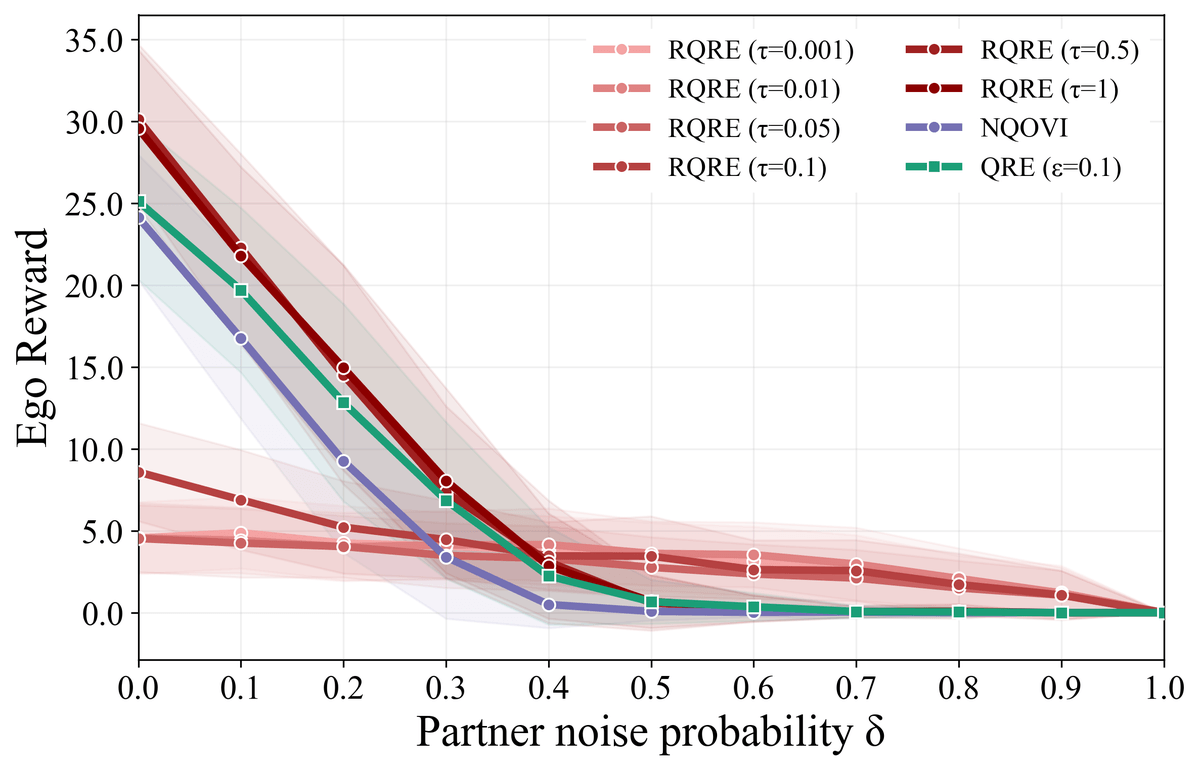
The more striking results come from cross-play , pairing agents trained under different algorithms at test time. In Overcooked, RQRE agents achieve 2–3× the reward of their NQOVI partners across nearly all pairings. Moderate risk aversion (τ = 0.01) consistently delivers the strongest advantage. Crucially, QRE alone (bounded rationality without risk sensitivity) performs comparably to Nash in cross-play, suggesting risk aversion , not just regularization , is the key driver of robustness.
Under partner perturbation (replacing the partner's action with a fixed deterministic action with probability δ), risk-averse RQRE agents retain 60–80% of their performance at δ = 0.3, while NQOVI and high-τ variants drop below 40%.

When Should You Use This?
RQRE-OVI is most valuable in scenarios where:
- Agents will be deployed with partners they weren't trained with (zero-shot coordination, human-AI teaming)
- The environment has multiple equilibria and you need consistent behavior across episodes
- You need formal robustness guarantees rather than just empirical stability
- The state space is large or continuous, requiring function approximation
It's less appropriate when you need to squeeze out maximum self-play performance and your deployment partners are known and fixed. The risk-aversion parameter introduces a performance-robustness tradeoff that's tunable but real.
The Bigger Picture
This work is part of a broader push to replace Nash equilibrium in MARL with solution concepts that are both computationally tractable and behaviorally grounded. The RQRE concept was originally introduced by Mazumdar et al. (2025) for finite-action games; this paper extends it to the linear function approximation regime , the first such extension , and provides the first finite-sample regret guarantees for this class of algorithms.
Code is available from the authors. The framework is modular: the Nash oracle in any existing optimistic value iteration algorithm can be swapped for the RQRE solver, and the risk parameters can be tuned post-hoc to trade performance for robustness without retraining.