
UVA's STADA Catches Self-Driving Failures 6x Faster Using Formal Logic
A new framework called STADA turns temporal logic safety rules into simulated driving scenarios, hitting more than double the coverage of prior methods
 Pro
Takeaways
- STADA generates AV test scenarios directly from LTLf temporal logic specifications, targeting formally defined safety rules
- Compiles specs into relational graphs that enumerate distinct ways a precondition can be satisfied
- Achieves 80% coverage across 15 feasible scenarios versus 33% for the best baseline (paper)
- Matches best baseline coverage using roughly 6x fewer simulations
- Built on Scenic and CARLA, tested against Transfuser and Interfuser agents
- Fails on maneuvers agents were not trained for, like overtaking via the opposing lane
Testing self-driving software in simulation sounds straightforward until you try to write a scenario that provokes a specific rule violation. Getting an AI-controlled car into the exact context where a stop sign yield rule or a bicycle-passing rule actually applies is surprisingly hard, and most tools either lean on hand-crafted templates or blast the simulator with random traffic and hope something interesting happens. A group from the University of Virginia and William & Mary just published STADA, a framework that generates those scenarios directly from formal safety specifications written in temporal logic.
The precondition problem
Driving rules generally have the shape precondition → postcondition. The precondition sets the stage (you are behind a cyclist at a safe distance) and the postcondition constrains behavior (you must maintain that distance while overtaking). Validating an AV's adherence to such properties requires constructing a scenario that meets the precondition, and that is the hard part. Existing approaches split into two camps that both fall short: fixed scenario sets or crash-reconstruction techniques produce tests that meet the precondition but do not explore the diversity of ways it can be established, while algorithmic or LLM-based fuzzing produces large, diverse test sets that may fail to meet the precondition at all.
STADA targets that gap. It takes a specification written in LTLf (Linear Temporal Logic over Finite Traces, a variant of temporal logic bounded to finite executions and translatable to a deterministic finite automaton), and systematically enumerates the distinct ways the precondition can be satisfied in simulation.
Relational graphs as the pivot
The core idea is to compile the specification into a set of relational graphs (RGs). Nodes are entity types referenced in the spec, such as the ego vehicle, other cars, or lanes, and edges are labeled with a spatial relation plus a temporal operator drawn from initial, next, eventually, or until. The process starts with a graph containing only the ego node and iteratively refines it to satisfy each atomic proposition in the specification. Only graphs that pass consistency checks (a vehicle cannot be both ahead of and behind another) survive, and isomorphic duplicates are pruned.

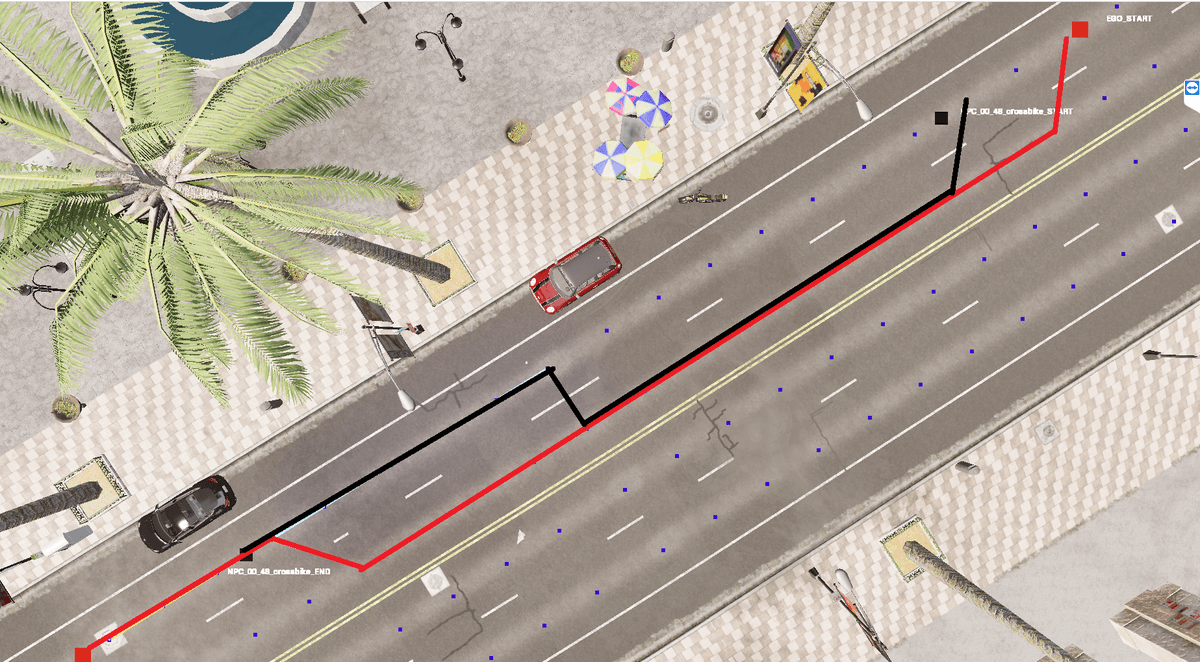
Each surviving graph then feeds a scene constructor built on Scenic, the probabilistic scenario language, which instantiates the initial layout inside CARLA. A dense waypoint graph is overlaid on the road network so trajectories can express fine-grained maneuvers like mid-lane changes, and a K-shortest-paths algorithm with a greedy diversity selector picks routes for the ego and NPCs.
Nudging the NPCs
One clever pragmatic detail: preconditions typically require the ego and other vehicles to be near each other, so NPC speed is adjusted at every simulation step. If an NPC is ahead of the ego it slows down; if behind, it speeds up, with the magnitude proportional to longitudinal (not Euclidean) distance so lateral offsets do not throw off the controller. This keeps the vehicles in the proximity band where traffic rules actually trigger without hard-coding scripted behavior.
The numbers
The team evaluated STADA against three baselines: CARLA_base (random placement, same vehicle count), CARLA_10x (ten times more vehicles), and ScenicNL, which generates Scenic programs from natural language via GPT-4. The system under test was either Transfuser or Interfuser, both top CARLA Leaderboard agents. Coverage was measured at three granularities, from fine-grained distinct configurations up to a binary hit-or-miss.

Across 8 specifications drawn from Virginia driving law, STADA achieved the highest coverage at 12 out of 15 (80%) for both agents, outperforming CARLA with 10x vehicles (33%) by 47 percentage points, base CARLA by 60-67 points, and ScenicNL by 67-74 points. On efficiency, STADA passed the second best method's maximum coverage of 33% within about 10 to 12 simulations, showing a 50 to 55 percent gain in the first 20 to 25 simulations, roughly six times fewer runs than the best baseline needed.
Where it still stumbles
STADA is not magic. Some specifications remained uncovered because the ego agents themselves refuse to execute the maneuver. For the opposing-lane overtake rule, STADA generates a valid path across the double yellow, but Transfuser and Interfuser were never trained to overtake into oncoming traffic and prioritize safety over path adherence. Simultaneity requirements are also brittle: a rule demanding two vehicles enter an intersection on the same frame is essentially unhittable at 20 Hz simulation, which the authors work around by relaxing the next-frame operator to an eventually operator.
Why it matters
The practical takeaway is that if you already write safety requirements as formal specs (a growing practice in AV validation), STADA gives you a path from those specs to targeted simulation campaigns without hand-writing scenarios or drowning in random fuzzing noise. The paper does not link a public code repository, but the approach is built on standard components: Scenic for scene generation, CARLA 0.9.15 as the simulator, and the SceneFlow specification framework from the same group for evaluating traces. The authors also note the approach generalizes beyond driving to any domain with a rich simulator and formal behavioral specifications, which is where things like robotic manipulation or drone testing could plausibly pick it up next.