
Utah's MorphoFlow Builds 3D Bone Models from Just a Few Scan Slices
A new framework learns 3D anatomical shape distributions from a handful of segmented slices, using normalizing flows and automatic dimension pruning.
 Pro
Takeaways
- MorphoFlow learns 3D anatomical shape distributions from sparse slice annotations instead of dense 3D segmentations.
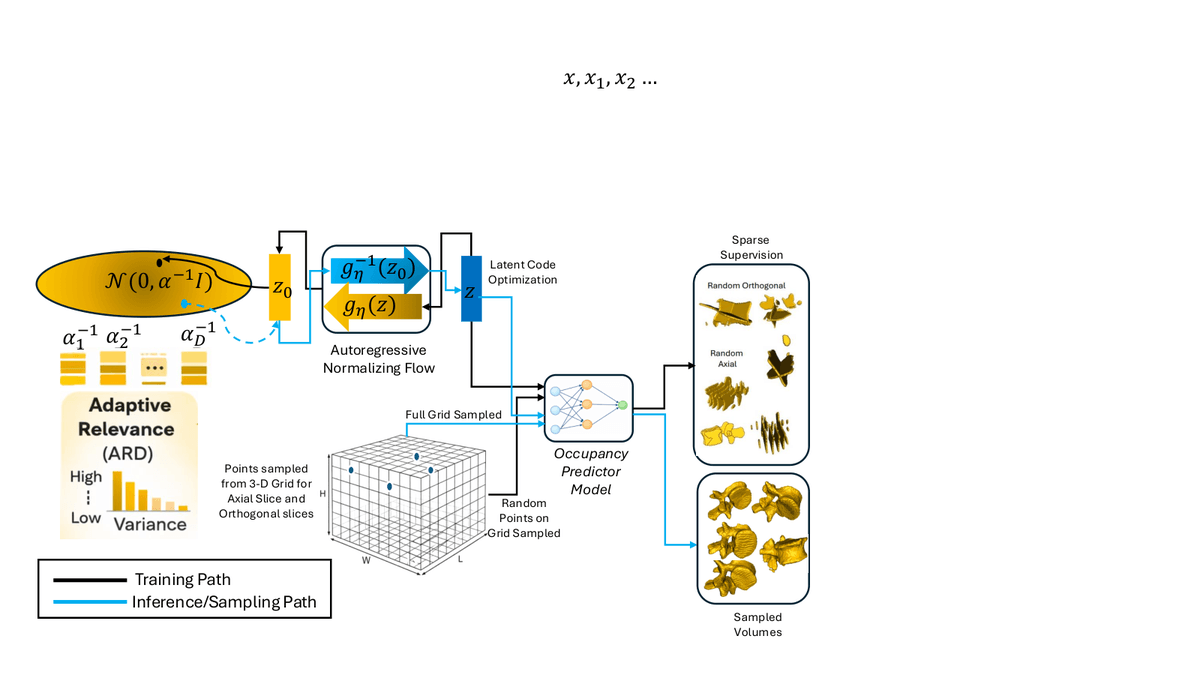
- Combines neural implicit occupancy fields, autodecoder training, autoregressive normalizing flow prior, and ARD sparsity.
- Reaches Dice ~0.98 on femur and ~0.92 on VERSE lumbar vertebrae from thin sparse slices.
- ARD automatically prunes about 40% of latent dimensions, removing manual dimensionality tuning.
- Generated samples show >0.80 correlation between latent distance and surface distance, enabling synthetic-shape augmentation.
- Code will be released upon acceptance; high-curvature regions remain the biggest source of uncertainty.
Building statistical models of how bones and organs vary across a population usually requires exhaustively labeled 3D scans. That is expensive, slow, and often infeasible in clinical workflows where radiologists only annotate a few slices. A new paper from the University of Utah's Scientific Computing and Imaging Institute proposes MorphoFlow, a generative shape modeling framework that learns compact, probabilistic representations of 3D anatomy from sparse surface annotations rather than dense volumetric masks.
When annotators only label a few slices
Statistical shape models (SSMs) are the workhorse for population-level anatomical analysis, feeding into reconstruction, treatment planning, and disease analysis. Most existing pipelines expect segmentation masks derived from CT or MRI, which are labor-intensive to produce. In practice, annotators mark only a subset of slices, or work with anisotropic acquisitions where thick spacing obscures fine geometry.
Current optimization- and deep-learning-based SSM methods rely on densely segmented shapes or high-resolution volumes. Under weak supervision they often struggle to capture fine detail, learn compact latent representations, or generalize beyond the training resolution. Existing tools like ShapeWorks use particle-based correspondences that assume clean, complete meshes to begin with.
What MorphoFlow actually does
The framework stitches together three ideas into one training objective: