
UT Dallas Builds ActionGenome4D so AI Remembers Objects It Can't See
A new task, dataset, and trio of models push video scene graphs beyond the visible frame into a persistent 3D world state
 Pro
Takeaways
- New task World Scene Graph Generation requires reasoning about both observed and unobserved objects in 3D world coordinates
- ActionGenome4D upgrades Action Genome with per-frame 3D reconstruction, world-frame OBBs, and dense relationship labels
- Three methods explore different inductive biases: persistent memory buffer (PWG), masked auto-encoder (MWAE), temporal transformer (4DST)
- 4DST leads SGDet metrics; MWAE wins multi-label PredCls; PWG competitive despite being non-differentiable
- Open-source VLMs benchmarked via Graph-RAG hit 53% micro F1 but collapse on tail predicates
- Code and pipeline released at github.com/rohithpeddi/WorldSGG
Video scene graph generation has a blind spot problem. The moment an object slides behind a couch or drifts out of the camera's field of view, the model forgets it exists. That's fine for image retrieval, but it breaks down for anything resembling a robot, an agent, or a system that needs to remember the world when it isn't looking at it. A new paper from researchers at UT Dallas and IIT Delhi tries to fix this by introducing World Scene Graph Generation (WSGG), a task that forces models to reason about every interacting object in a scene, whether it's currently visible or not.
The team backs the new task with a purpose-built dataset called ActionGenome4D, three complementary architectures, and a set of vision-language model baselines. Code is available at github.com/rohithpeddi/WorldSGG.
The frame-centric trap
Existing video scene graph methods are fundamentally frame-centric: they reason only about currently visible objects, discard entities upon occlusion, and operate in 2D. That means three concrete failures: everything lives in shifting 2D pixel coordinates with no shared spatial reference, objects vanish from the graph the moment they aren't detected, and temporal models only slide short windows across per-frame outputs without a persistent world model.
Developmental psychology has long recognized object permanence as a foundational cognitive milestone: the understanding that objects continue to exist when they leave direct perception. The authors argue that an embodied agent needs the same capability. WSGG formalizes this by requiring models to output, at every timestamp, a complete graph over both observed and unobserved objects, grounded in a shared 3D world coordinate frame.

Building a 4D dataset from scratch
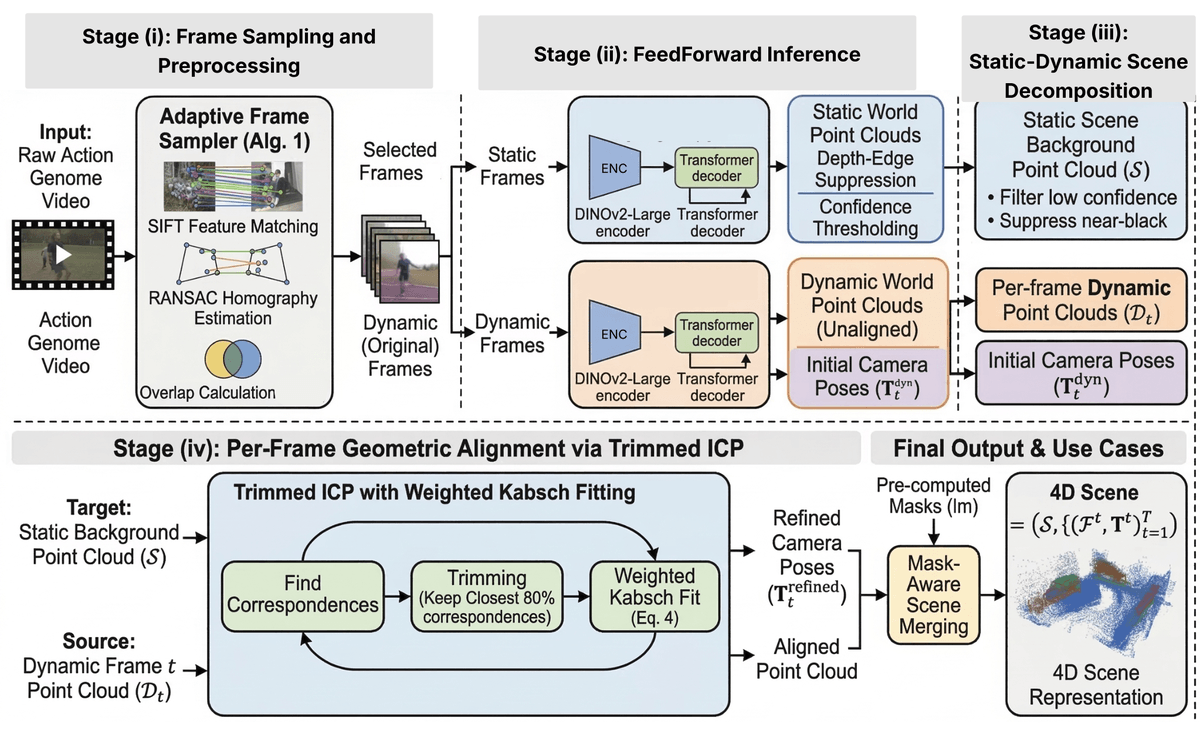
To train and evaluate on this task, the team upgraded Action Genome into ActionGenome4D through an automated pipeline followed by manual correction. The reconstruction stack combines several foundation models:
- 3D scene reconstruction via π³, a feed-forward neural network that jointly estimates per-pixel local 3D coordinates, per-pixel confidence scores, and camera-to-world SE(3) poses in a single forward pass.
- Grounding DINO for zero-shot object detection, fused with ground-truth 2D annotations.
- SAM2 in dual image-and-video mode for temporally consistent per-object masks.
- SMPL-based floor alignment plus multi-scale erosion and Kalman smoothing to produce world-frame oriented 3D bounding boxes.
- A VLM pipeline that generates dense pseudo-labels for relationships involving unobserved objects, followed by human correction on the test set.
The resulting dataset spans 9,250 videos and 232,103 annotated frames, with three relationship axes inherited from Action Genome: attention (3 labels, single-label), spatial (6 labels, multi-label), and contacting (17 labels, multi-label).
Three inductive biases for reasoning about the unseen
The interesting design question is: how should a model represent an object it can't see? The paper explores three answers, all sharing the same DINOv2/v3 backbone, 3D structural encoder, spatial GNN, and relationship predictor.
PWG (Persistent World Graph) takes the simplest route. It implements object permanence at the feature level via a non-differentiable zero-order hold: when an object disappears, the model keeps using the DINO features from its last visible frame, along with a staleness counter that tracks how long ago that was. Think of it as SORT-style tracking extended from bounding boxes to visual features.
MWAE (Masked World Auto-Encoder) reframes the problem as masked completion. Borrowing from MAE and VideoMAE, it treats occlusions and camera motion as natural masking. Unobserved objects get a learnable [MASK] embedding, and an associative retriever uses asymmetric cross-attention where masked tokens can only attend to visible memory entries, preventing them from feeding each other noise. A cross-view reconstruction loss forces the retriever to actually recover the missing visual features.
4DST (4D Scene Transformer) replaces the static buffer with a differentiable per-object bidirectional transformer that attends across the full video. It fuses visual, structural, 3D motion, camera-pose, and ego-motion tokens, adding a learned visibility embedding to distinguish observed from inferred time steps. This extends the factorized spatial-temporal attention paradigm from video transformers like ViViT and TimeSformer to full 4D relational reasoning.

What the numbers say
All three methods are evaluated under PredCls (ground-truth objects and 3D localizations given) and SGDet (end-to-end detection) with both With Constraint (top-1) and No Constraint (multi-label) settings, using Recall@K and mean Recall@K metrics.
The results paint a nuanced picture:
- 4DST delivers the most consistent gains, leading SGDet With Constraint (R@10 = 42.64 DINOv2-L; R@20 = 58.03, R@50 = 71.95 DINOv3-L) and SGDet No Constraint mR (25.70/38.02 DINOv2-L). Its differentiable temporal transformer enables end-to-end propagation, boosting both object classification and tail-class recall.
- MWAE excels in multi-label settings, leading PredCls No Constraint (R@10 = 81.50, mR@10 = 55.09 DINOv3-L); its reconstruction and simulated-occlusion losses act as complementary regularizers for diverse predicates.
- PWG trails the best method by only 1–2 points in most PredCls settings despite its non-differentiable design, confirming that the persistent 3D scaffold alone provides a strong structural prior and validates the WSGG formulation.
That last point is the quiet breakthrough. Even a zero-order hold, freezing visual features at their last known state, performs competitively once you give it a proper 3D world coordinate frame to reason in. The 3D scaffold is doing a lot of heavy lifting.
What about just throwing a VLM at it?
The paper also benchmarks Qwen 2.5-VL, InternVL 2.5, and Kimi-VL on an unlocalized version of the task using a Graph-RAG pipeline. The results are sobering. Qwen 2.5-VL is the strongest backbone: under RAG + PredCls it reaches 53.3% micro F1 vs. 40.8% for InternVL 2.5, but SGDet roughly halves recall relative to PredCls, identifying world-level object detection as the primary bottleneck. The gap between micro-averaged and macro-averaged F1 (53.3 vs. 26.6 for Qwen) also reveals that VLMs disproportionately favor frequent predicates and struggle badly with tail classes.
Where this matters
WSGG is squarely aimed at downstream tasks that need persistent world state: robotic manipulation that tracks tools after they leave the camera, embodied navigation that builds spatial memory of traversed rooms, and long-horizon activity understanding. The paper's own limitations are honest: ActionGenome4D inherits the indoor, single-person setting of Action Genome, π³ produces noisy geometry on textureless or reflective surfaces, and the object vocabulary is fixed. The manual correction workflow also implies that scaling this beyond the current dataset will be expensive.
Still, the combination of a well-defined new task, three architectures that stake out distinct design philosophies, and a released codebase gives the community a concrete platform to build on. The interesting open question is whether the differentiable temporal attention in 4DST can be adapted to streaming, variable-length observation windows for real-time world-state tracking, which the authors flag as immediate future work.