
UT Austin's Hair-Thin Fiber Teaches Surgical Robots to Feel Contact
A single embedded optical fiber plus a two-stage learning pipeline lets flexible surgical robots detect where and how hard they hit tissue.
 Pro
Takeaways
- UT Austin researchers combined a single OFDR optical fiber with cascaded ML for continuum robot force sensing.
- Gradient Boosting classifier detects contact; a CNN with FiLM conditioning predicts spatial force distribution.
- Localization error peaks at 2-3 mm along a 170 mm backbone; force error outliers reach 0.1 N.
- Fiber sits on one side, so the current setup handles planar bending rather than full 3D contact.
- Builds on the group's 2024 single-fiber shape sensing work for tendon-driven manipulators.
- Targets minimally invasive surgery: bronchoscopy, catheters, biopsy tools navigating tight anatomy.
Snake-like surgical robots are great at slithering through tight anatomy, but they have one glaring weakness: they don't really know when they've bumped into something, or how hard. A team at UT Austin just published a paper showing that a single hair-thin optical fiber, paired with a two-stage machine learning pipeline, is enough to detect contact, localize it along the robot's body, and estimate the force, all at once.
Why floppy robots can't feel
Continuum manipulators are widely used in minimally invasive procedures due to their compliant structure and ability to navigate deep and confined anatomical environments. These are the flexible, tendon-driven arms used in endoscopy, biopsy, and catheter-based surgery. The catch is that they bend continuously along their length rather than at discrete joints, so their distributed deformation makes force sensing, contact detection, localization, and force estimation challenging, particularly when interactions occur at unknown arc-length locations along the robot.
Traditional force sensing options each have a fatal flaw. Fiber Bragg Grating (FBG) sensors, the most common optical approach, only give you a handful of discrete measurement points. FBG sensors have demonstrated great potential in shape sensing and consequently tip position estimation, however, due to the limited number of sensing locations, these sensors can only accurately recover basic shapes, and become unreliable in the presence of obstacles or many inflection points such as s-bends. Model-based methods rely on assumptions that break under real tissue contact, and image-based approaches require external cameras that can't see inside a patient.
One fiber, dense strain data
The solution swaps FBG for Optical Frequency Domain Reflectometry (OFDR). OFDR can achieve much higher spatial resolution, and can therefore accurately reconstruct more complex shapes. Instead of a few discrete gratings, it treats the entire fiber as a continuous strain sensor. In the authors' previous work, an OFDR fiber bonded to a flat nitinol wire was pushed inside a 170 mm long tendon-driven continuum robot, giving strain readings roughly every 1.3 mm along the backbone.
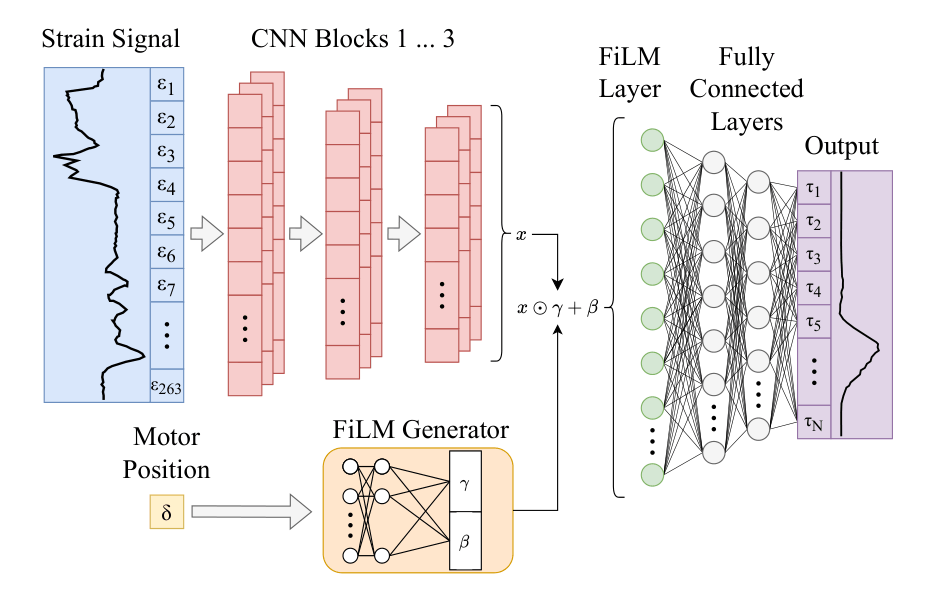
The proposed cascade learning framework (CLF) uses a single distributed OFDR fiber embedded along one side of the robot. The OFDR sensor provides dense strain measurements along the manipulator backbone, capturing strain perturbations caused by external interactions. The framework first detects contact using a Gradient Boosting classifier and then estimates contact location and interaction force magnitude using a CNN-FiLM model that predicts a spatial force distribution along the manipulator.
How the two-stage pipeline works
The pipeline is deliberately split so each model has one job:
- Stage 1 - Gradient Boosting classifier: A lightweight tree ensemble looks at the raw strain profile and answers a yes/no question: is the robot currently touching something, or is that just its own bending?
- Stage 2 - CNN with FiLM conditioning: If contact is detected, a convolutional network processes the strain signal along the fiber. FiLM (Feature-wise Linear Modulation) layers inject side information (like the commanded robot configuration) by scaling and shifting the CNN's feature maps, so the same network can adapt to different bending poses.
- Output: Rather than regressing a single force value and location, the model predicts a spatial force distribution along the arc length. The peak of that distribution gives both where the contact is and how hard it's pushing.

The numbers
The team validated the setup on a sensorized tendon-driven arm operating inside an obstructed environment, running 16 test scenarios split across constant-velocity and constant-curvature trajectories. The contact classifier scored near the top of the ROC-AUC, precision, and recall range on most tests, though a few cases dipped closer to 0.5, meaning contact detection during aggressive bending is still imperfect.
For the regression stage, force error clusters tightly around zero newtons with outliers reaching about 0.1 N, and localization error peaks between 2 and 3 mm along a 170 mm backbone with a tail out to roughly 7 mm. For context, competing FBG-based approaches on similar arms report single force estimation RMSE of 0.084 plus or minus 0.073 N over a 0.3-1.5 N range, so the OFDR approach is in the same ballpark while using only one fiber instead of three.

Where this actually matters
The practical payoff is for procedures where a flexible tool is snaking through tissue and unexpected contact could tear something. Think bronchoscopy, colonoscopy, cardiac catheterization, and femoral head core decompression, an application the same lab has previously targeted. Knowing that contact happened at, say, 90 mm from the base with 0.4 N of force lets a controller back off or reroute before damage occurs.
There are real limits worth flagging. The fiber sits on one side of the robot, so the current setup handles planar bending rather than full 3D contact directions. The training and validation happen on a specific tendon-driven arm, and OFDR interrogators (like the ODiSI 6000 Series from Luna Innovations) are expensive lab equipment, not something you'd casually add to a disposable catheter. And the paper reports no public code or model release at this point.
The quieter breakthrough
The headline is single-fiber contact sensing, but the more interesting move is treating force as a distribution rather than a point estimate. Predicting a spatial force profile along the arc length sidesteps the ill-posed inverse problem that has haunted continuum robotics for years: you can't uniquely invert a bent shape back to a single force vector, but you can learn a plausible force field that matches the observed strain. That framing generalizes well beyond this specific hardware and is likely where follow-up work will go.