
UT Austin's convMMD Fits Noisy Real-World Data Without Breaking Statistical Rates
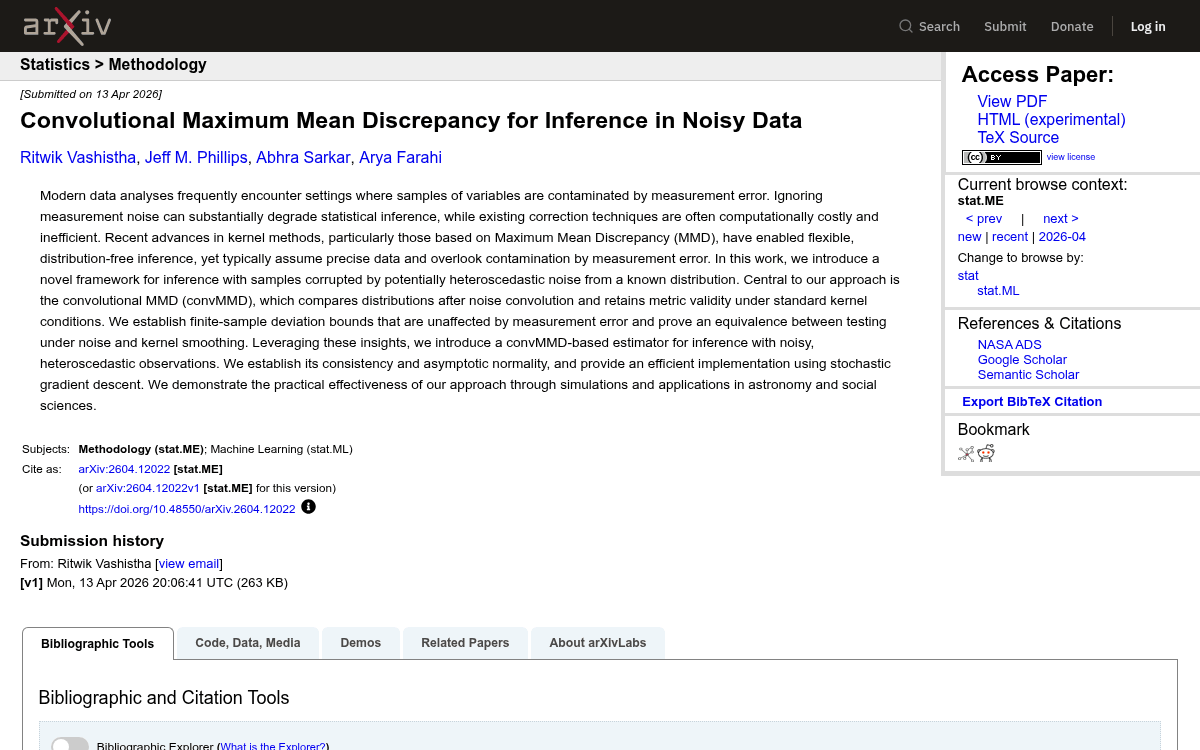
A new kernel framework called convolutional MMD delivers robust parameter estimation from noisy measurements without sacrificing the parametric convergence rate.
 Pro
Takeaways
- convMMD compares distributions after noise convolution, enabling inference from noisy samples with a known error distribution.
- For translation-invariant kernels, noisy MMD equals clean MMD with a smoother, noise-widened kernel.
- Estimator is consistent and asymptotically normal, retaining the parametric sqrt(N) rate despite measurement error.
- Simulations on Gaussian mixtures and error-in-variables regression beat XDGMM, SIMEX, and linmix under non-Gaussian noise.
- Real applications include Dark Energy Survey galaxy cluster scaling, Davis anthropometry, and housing survey logistic regression.
- Limitations: assumes known noise distribution, requires kernel bandwidth choice, and involves O(N^2) kernel evaluations.
Measurement error quietly wrecks statistical analyses. Sensors drift, survey respondents round, and astronomical instruments carry known uncertainty budgets. A new paper from researchers at UT Austin and the University of Utah proposes convolutional Maximum Mean Discrepancy (convMMD), a kernel-based framework that folds the noise distribution directly into how distributions are compared, letting you fit parametric models to noisy observations without the usual computational pain or fragility of Gaussian-only assumptions.
Why noisy data breaks standard tools
Measurement error shows up across biology, environmental science, economics, epidemiology, and astronomy. What you observe is a convolution of the true signal with a noise distribution, which makes direct likelihood-based inference intractable outside trivial cases where everything is Gaussian.
Classical fixes fall into a few buckets, each with drawbacks:
- Fourier deconvolution kernels are flexible but can be numerically unstable and wildly oscillating, with convergence rates much slower than the parametric square-root-N rate.
- SIMEX (Simulation Extrapolation) works by injecting extra simulated noise and extrapolating back, but typically requires known noise variance and often relies on Gaussian error assumptions.
- Bayesian hierarchical models handle complex errors well but incur heavy computational cost and offer limited asymptotic theory.
Maximum Mean Discrepancy, a kernel distance between distributions, has become a workhorse for two-sample testing, generative modeling, and domain adaptation. Standard MMD assumes clean data, so feeding it noisy samples silently biases the results.