
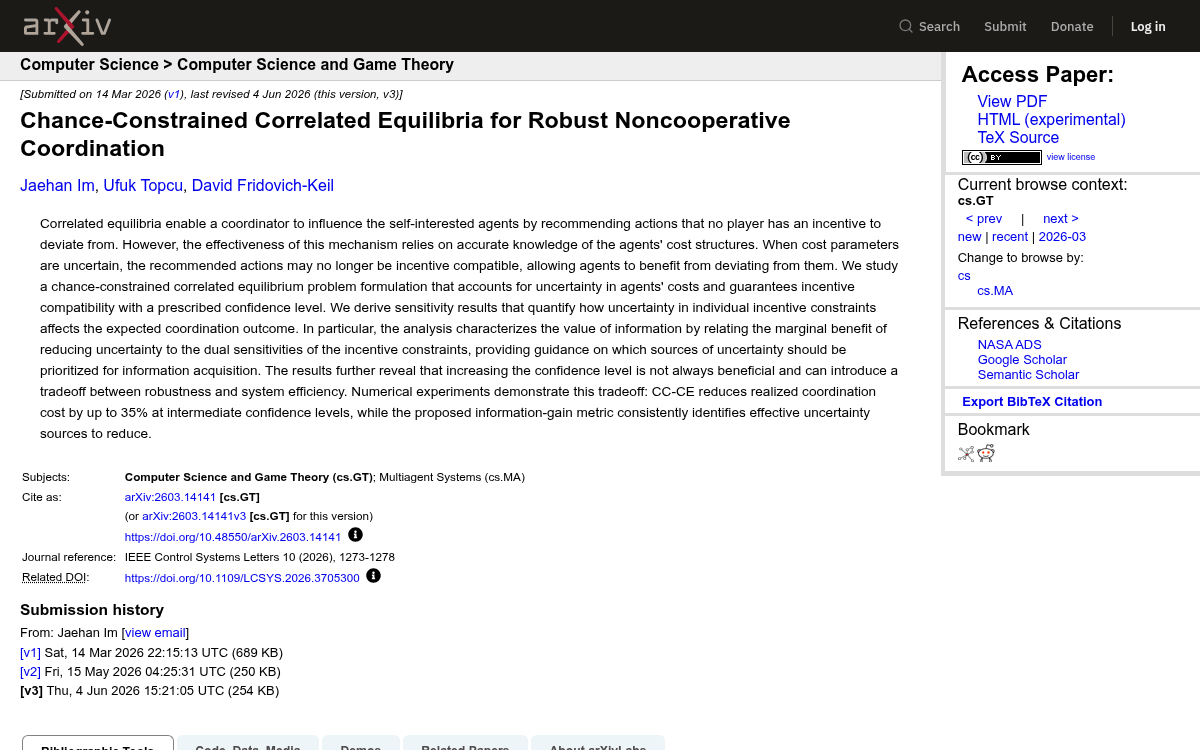
UT Austin's CC-CE Cuts Multi-Agent Coordination Costs by 35% Under Uncertainty
A new formulation makes correlated equilibrium recommendations reliable when a coordinator only has noisy estimates of what each self-interested agent actually cares about.
 Pro
Takeaways
- New chance-constrained correlated equilibrium enforces incentive compatibility with confidence α under noisy cost estimates.
- Gaussian noise assumption yields a deterministic linear program with recommendation-weighted uncertainty margins.
- InfoGain metric (σ × λ × π) prioritizes which uncertainty sources to measure more accurately.
- CC-CE cut realized coordination cost by 30-35% in vertiport experiments versus naive correlated equilibrium.
- Higher confidence α trades robustness for efficiency; pushing α to 1 hurts performance.
- Julia implementation available at github.com/CLeARoboticsLab/CCCE.
Game theory has a clean trick for herding self-interested agents toward better outcomes without forcing them to cooperate: a coordinator draws a joint action from a carefully chosen distribution and privately whispers a suggestion to each player. If the distribution is a correlated equilibrium, no one gains by disobeying. The catch is that this only works when the coordinator knows exactly how much each agent values every possible outcome, which is rarely true.
A new paper from researchers at UT Austin, Chance-Constrained Correlated Equilibria, tackles that gap. It reformulates the equilibrium condition as a probabilistic constraint, then works out which sources of uncertainty are actually worth spending effort to measure more accurately.
Why nominal correlated equilibria break
In many applications, the coordinator lacks accurate knowledge of each player's cost structure. Once an agent's true deviation cost drifts from the coordinator's estimate, the incentive-compatibility inequality that made following the recommendation rational can flip sign. Agents notice, deviate, and the coordination scheme unravels.
The authors model this by adding a Gaussian noise term to each agent's deviation cost. That single change is enough to turn the classical linear program into something that can silently violate its own equilibrium constraints in expectation.

Tightening the constraints with probability
The proposal is a chance-constrained correlated equilibrium (CC-CE): require each incentive constraint to hold with probability at least a user-chosen confidence level α. Under the Gaussian noise model, the deviation constraint admits a deterministic equivalent obtained via the standard Gaussian chance-constraint reformulation. The nominal deviation margin gets tightened by a recommendation-weighted uncertainty term q(α)σπ.
Two things fall out of that reformulation. First, the problem stays a linear program, so it is still solvable at scale. Second, the amount each constraint is tightened depends on how likely the coordinator is to actually recommend the action in question. Rare recommendations barely feel the uncertainty, common ones feel it strongly.
Which uncertainty is worth reducing?
The more interesting contribution is a sensitivity analysis that answers a very practical question: if you can only afford to sharpen your estimate of one agent's cost, which one? Reducing uncertainty for agent i improves performance in proportion to the aggregate dual sensitivity of its associated deviation constraints.
Combining that with the uncertainty contribution term gives a clean scoring rule the authors call InfoGain:
σ— how noisy the coordinator's estimate is for that agentλ— the dual multiplier, or shadow price, of that specific deviation constraintπ— how often the recommendation involved in the constraint is actually issued
Multiplied together, they approximate the first-order gain from eliminating that particular source of uncertainty. If any of the three factors is small, buying better information there is a waste.
Confidence is not free
You might expect that cranking α toward 1 always helps. It does not. Higher confidence contracts the feasible set through the recommendation-weighted uncertainty margins, so nominal coordination cost climbs even as the deviation rate falls. The two effects compete, and past a certain point the coordinator pays more in conservatism than it saves in reliability.
Numerical results on vertiport coordination
The test case is air mobility: three queues of aircraft competing for two vertiports, with a coordinator issuing occupancy recommendations under noisy estimates of arrival times and congestion. Compared with Naive-CE, CC-CE reduces the realized system cost by 30 to 35 percent at intermediate confidence levels. Push α too high and that gain reverses, exactly as the theory predicts.
The information-acquisition experiment is equally telling. After solving CC-CE, the authors zero out the uncertainty on five hand-picked constraints and resolve. InfoGain achieves the lowest normalized nominal cost across the tested congestion regimes, reaching roughly a 4.5 percent reduction relative to the baseline CC-CE solution when γ=2. Picking constraints by uncertainty alone or by dual multiplier alone both underperformed, confirming that the three factors have to be multiplied together rather than weighed in isolation.
Where it fits and where it does not
The framework suits centralized recommenders for agents that cannot be assumed cooperative, such as air traffic flow management, ride-hailing dispatch, or spectrum allocation, provided you have some prior on how wrong your cost model might be. It is less useful when the uncertainty is adversarial or wildly non-Gaussian, since the deterministic equivalent leans on the Gaussian quantile. The present analysis relies on an agent-level Gaussian uncertainty model, and the authors flag deviation-specific, correlated, and non-Gaussian structures as open extensions.
Julia code for the solver and experiments lives in the CCCE repository, built on top of ParametricMCPs.jl and the PATH complementarity solver.