
UT Austin's CAPO Beats PPO by 8.6x Running Parallel Instead of Deeper
A new algorithm reruns PPO in parallel on the same batch and merges the results, cutting wasted gradient updates and beating baselines by up to 8.6x.
 Pro
Takeaways
- CAPO runs K parallel PPO copies on the same batch with different shuffle orders and aggregates them into one policy.
- Fisher geometry shows PPO's extra epochs mostly generate waste orthogonal to the natural gradient direction.
- On Gymnasium MuJoCo, CAPO beats PPO by up to 8.6x on Humanoid and +71% on HalfCheetah.
- Compute-matched deeper PPO (Kx epochs) degrades on every task, confirming the optimization-depth dilemma.
- Aggregating in natural parameter space via a logarithmic opinion pool provably tightens trust region compliance.
- Overhead is Kx gradient compute with no extra environment interaction and only 0-72% wall-clock cost.
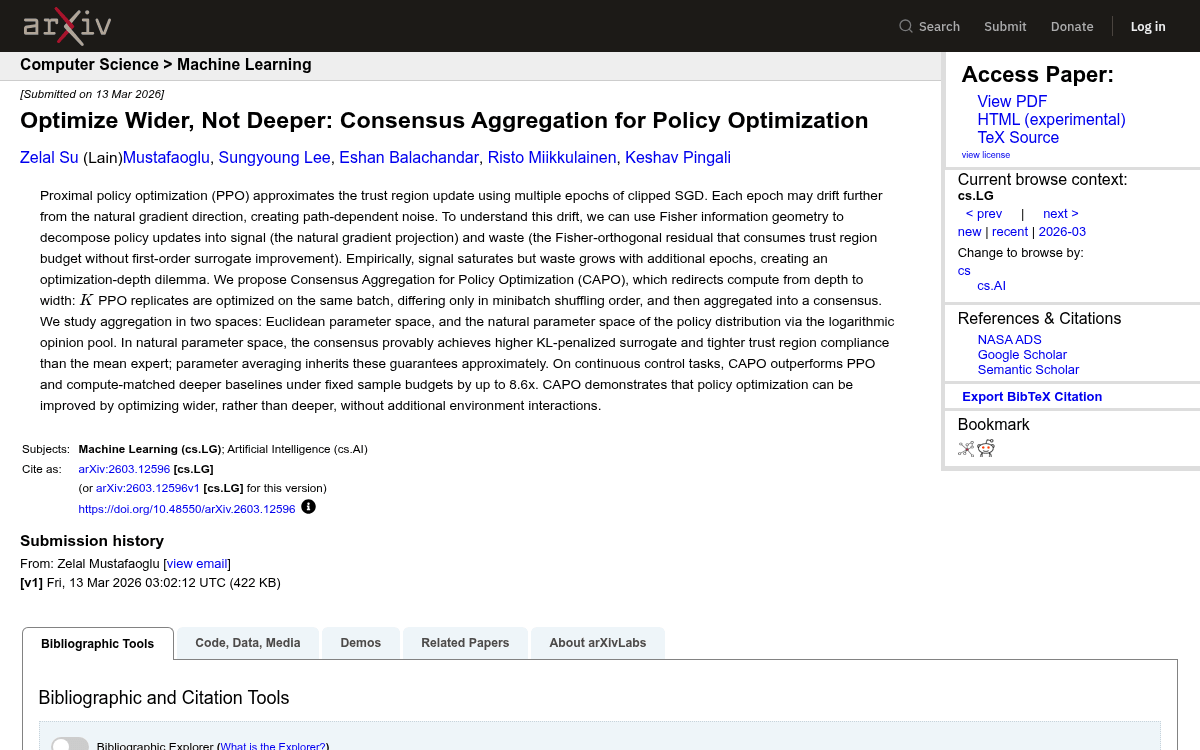
Anyone who has trained a policy with PPO knows the pain: crank up the number of gradient epochs to squeeze more out of each rollout, and returns often collapse instead of climbing. A new paper from UT Austin explains why, and proposes a fix that trades sequential depth for parallel width. It is called CAPO (Consensus Aggregation for Policy Optimization), and on continuous control benchmarks it beats PPO by up to 8.6x on the same sample budget.
Why extra PPO epochs backfire
PPO is the workhorse behind everything from robot locomotion to RLHF for large language models. It approximates a trust region update by running several epochs of clipped SGD on a collected batch. The trouble, the authors argue, is that each epoch may drift further from the natural gradient direction, creating path-dependent noise.
To make that concrete, they borrow tools from Fisher information geometry and split every PPO update into two pieces:
- Signal: the projection onto the natural gradient direction, which is the direction of steepest improvement per unit of KL divergence.
- Waste: the component orthogonal to the natural gradient in the Fisher metric, which burns through the trust region budget without improving the surrogate objective.
Measured on Hopper, the picture is grim. At E=4, alignment is only 22%, meaning 22% of the KL budget produces surrogate improvement and 78% is waste. Push the epoch count up and it gets worse: waste grows 11x from E=2 to E=40, alignment never exceeds 0.25, and returns peak around E=10 before collapsing. More compute, spent sequentially on the same data, actively hurts.
Width instead of depth
CAPO's insight is that PPO's output is effectively a random variable, and one of its biggest sources of randomness is the minibatch shuffle order across epochs. Different shuffles produce different waste vectors that point in different directions. Average enough of them and the waste partially cancels while the shared signal survives.
The algorithm is refreshingly simple:
- Collect one on-policy batch from the current policy.
- Spawn K copies of PPO (K=4 by default), each starting from the same weights and Adam state, differing only in their minibatch shuffle seed.
- Run E epochs of PPO in parallel on the shared batch.
- Aggregate the K resulting policies into a single consensus, then repeat.
Aggregation happens in one of two spaces. CAPO-Avg averages parameters in Euclidean space. The default CAPO variant uses a logarithmic opinion pool in the policy's natural parameter space, which for diagonal Gaussian policies gives a precision-weighted combination: experts that are more confident on a given action dimension pull the consensus mean harder on that dimension. The consensus distribution is then distilled into the next policy network, with a line search that rejects any step exceeding the trust region.
The authors prove a clean result in this natural parameter space: because KL is a Bregman divergence and therefore convex in the natural parameters, Jensen's inequality guarantees the averaged policy has KL cost no larger than the mean expert's, while linear surrogate improvement is preserved exactly. Put differently, the consensus is provably a better trust region step than the average individual expert.
The numbers
On six Gymnasium MuJoCo tasks with (64, 64) MLP policies and 1M steps (4M for Humanoid), CAPO wins on five of six. Highlights:
| Task | PPO | PPO-Kx (deeper) | CAPO |
|---|---|---|---|
| Hopper | 2711 | 1210 | 3193 (Avg) |
| HalfCheetah | 1604 | 1532 | 2737 (+71%) |
| Walker2d | 2518 | 1432 | 3871 (+54%) |
| Ant | 2142 | 232 | 2328 |
| Humanoid | 739 | 429 | 6367 (8.6x) |
The Humanoid result is the headline: LogOP's per-dimension precision weighting pays off in high-dimensional action spaces. The compute-matched baseline that spends the same gradient budget on more sequential epochs (PPO-Kx) degrades on every task, most catastrophically on Ant where it falls roughly 9x below plain PPO. That is the optimization-depth dilemma in action.
Direct waste measurements confirm the mechanism. CAPO-Avg reduces waste on every environment, with reduction scaling with parameter count: 2% on HalfCheetah and Walker2d, 5% on Hopper, and 17% on Humanoid. CAPO (LogOP) amplifies waste on low-dimensional tasks but achieves 33% waste reduction on Ant and 46% on Humanoid.
What it costs, and what it does not fix
The compute overhead is Kx gradient computation per generation, but no extra environment interaction and no extra inference cost. Because the K experts are embarrassingly parallel and CAPO uses fewer generations overall, wall-clock overhead is modest: roughly 0-40% for CAPO-Avg and 19-72% for CAPO. Notably, PPO-Kx, which spends the same gradient budget sequentially, is often slower than CAPO in wall-clock time because it cannot parallelize its epochs.
The limits are honest and clear. All experiments use continuous control with Gaussian policies. The theory extends to any exponential family, but there is no empirical evidence yet for discrete action spaces, vision-based RL, or language model fine-tuning. The authors flag LLM post-training as a natural next target, since optimizer noise compounds across long sequences in exactly the way the signal-waste framework describes.
Why it matters
Beyond the raw numbers, the real contribution is diagnostic. The Fisher signal-waste decomposition gives a principled way to look at any trust region update and ask how much of its KL budget is doing useful work. That framing suggests concrete, boring recommendations that are worth remembering the next time you tune PPO: keep epochs near 10, turn on KL early stopping, and if you have spare GPUs, use them to run parallel replicas rather than more sequential passes.
Code and pretrained models do not appear to be publicly released alongside the paper, but the pseudocode in the manuscript is short enough that reimplementing on top of a reference PPO like CleanRL is straightforward.